KOSDAQ Strength Highlighted in a Bear Market, How Long Will It Last?
Recovery Above 1030 During Trading
Volatility Expected to Increase Toward Year-End
Need for Caution with KOSDAQ and Small to Mid-Cap Stocks
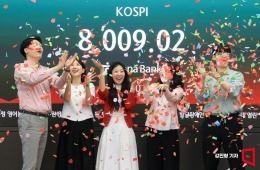
[Asia Economy Reporter Song Hwajeong] While the KOSPI has yet to recover the 3000-point level, the KOSDAQ continues to show relative strength, recovering the 1030-point level. However, as the year-end approaches, there are opinions that caution is needed regarding the KOSDAQ and small-to-mid cap stocks due to supply and demand issues.
As of 9:40 AM on the 16th, the KOSDAQ recorded 1030.24, up 1.21 points (0.12%) from the previous day. It started with a downward trend but then turned upward, continuing its rise for the fourth consecutive day. Meanwhile, the KOSPI fell 6.4 points (0.21%) to 2993.12.
Since September, the stock market has entered a correction phase, causing the KOSPI’s 3000-point level and the KOSDAQ’s 1000-point level to break down, showing weakness. However, since mid-October, the KOSDAQ has shown stronger performance than the KOSPI. This month, the KOSPI rose only 0.97%, while the KOSDAQ increased by 3.7%. The KOSDAQ, which had fallen to the 950-point level at the beginning of last month, recovered the 1030-point level during intraday trading on this day. This contrasts with the KOSPI, which still has not regained the 3000-point level.
The diverging fortunes of the KOSPI and KOSDAQ were mainly influenced by supply chain uncertainties. Yujun Choi, a researcher at Shinhan Financial Investment, explained, "Due to supply chain uncertainties, the KOSPI manufacturing sector underperformed compared to other indices, falling 6% since the beginning of the year, and the influence of manufacturing within the stock market has also decreased." He added, "The KOSDAQ showed strong resilience during the October rebound phase because the manufacturing sector accounts for about 40%, making it relatively free from supply chain issues, and demand seeking high expected returns also flowed in." While the index moved within a box range, individual sectors such as secondary batteries and gaming stocks continued, allowing the KOSDAQ, which was relatively free from supply chain issues, to gain momentum.
Hot Picks Today
 Cerebras Soars 70% on IPO Debut: Is Nvidia's Reign Ending as a New AI Semiconductor Power Emerges?
- "After Vowing to Become No. 1 Globally, Sudden Policy Brake Puts Companies’ Massive Investments at Risk"
- Even the Wealthy Ask, "Is It Okay to Enter Now?"... Flocking In With Cash Bundles [Wealth Investment Strategies] ⑨
- "Will the Elevator Beep When I Get In?"... Larger Bodies, Unchanged Elevator Standards
- "He's Handsome, It's Such a Pity?"... Lawyer Responds to Bizarre 'Appearance Evaluation' of High School Girl Murder Suspect
However, this atmosphere is expected to change as the year-end approaches due to the seasonality of supply and demand. Institutions repeatedly set up dividend-related arbitrage purchases at year-end and liquidate those positions early the following year. Individual investors begin realizing profits from November to avoid major shareholder requirements and capital gains taxes, releasing large volumes of sell orders in December. According to Daishin Securities, since 2000, the average monthly net selling volume has been 480 billion KRW in November and 1 trillion KRW in December. Kyungmin Lee, a researcher at Daishin Securities, analyzed, "The year-end supply and demand seasonality is unfavorable for the KOSDAQ and small-to-mid cap stocks, which have a high proportion of individual investors and thin liquidity." He added, "As the ex-dividend date approaches, volatility in the KOSDAQ and small-to-mid cap stocks may increase, so it is necessary to minimize exposure to the KOSDAQ and small-to-mid cap stocks until year-end and prioritize reducing weight even among domestic stocks."
© The Asia Business Daily(www.asiae.co.kr). All rights reserved.