Why Financial Authorities Who Once Pressured Banks Are Now Offering Incentives
Financial Supervisory Service Hints at Possible Abolition of Comprehensive Inspections
Financial Services Commission Announces Major Expansion of Concurrent and Ancillary Businesses
Interpreted as Efforts to Restore Collapsed Market Trust

[Asia Economy Reporter Kim Jin-ho] "To innovate banks' business models, we will actively expand concurrent and ancillary businesses such as improving the trust system and allowing investment advisory services." (October 28 · Ko Seung-beom, Chairman of the Financial Services Commission - Meeting with Commercial Bank CEOs)
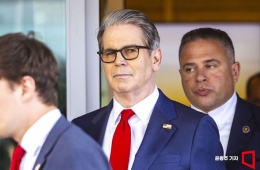
"We will reorganize the inspection system for financial companies to respond flexibly to changes in the financial environment and to utilize inspection resources efficiently." (November 3 · Jeong Eun-bo, Governor of the Financial Supervisory Service - Meeting with Financial Holding Company Chairmen)
The financial authorities have been sending successive conciliatory gestures to the market, drawing attention to the background. They are accommodating the banking sector’s long-standing wish to expand non-interest income, while also pledging to reform the inspection system, which financial companies find most burdensome. This is seen as part of efforts to restore market trust in the financial authorities.
According to the financial authorities on the 4th, the Financial Supervisory Service (FSS) plans to announce the results of its review of the financial company inspection and sanction task force (TF) within the year. The core is to shift the FSS inspection system from a retrospective approach to proactive risk identification and prevention.
Governor Jeong said in a press briefing after the meeting with financial holding company chairmen the day before, "We aim for a sophisticated and balanced inspection system," adding, "We will expand communication with financial companies during inspections and sanction deliberations, and flexibly adjust inspection cycles for small financial companies such as savings banks within holding companies."
This is interpreted as a possible de facto abolition of comprehensive inspections of financial companies. The comprehensive inspections, revived during the tenure of former FSS Governor Yoon Seok-heon with an emphasis on consumer protection, have been strongly criticized by the financial sector over the past three years as a ‘sweeping crackdown’ aimed at detection and punishment. The current move is seen as an improvement to quell such dissatisfaction.
The FSS also announced plans to remove restrictions on information sharing within financial groups. This means allowing information sharing within groups for business purposes to enhance group synergy. It also indicated a proactive improvement in the calculation of banks’ Liquidity Coverage Ratio (LCR). To ensure the stable establishment of the Financial Consumer Protection Act, the FSS will continue supervisory guidance-oriented oversight until the end of the year. Governor Jeong explained, "We will change the frequency of financial consumer protection status evaluations from once a year to once every three years."
The Financial Services Commission recently announced market-friendly policies as well. The main points are opening the door for banks to enter the investment advisory business, which had been limited to real estate, and expanding the scope of trust assets that customers can entrust. This has been regarded as a long-standing project for expanding non-interest income in the banking sector.
Regarding platform businesses operated as innovative financial services, the authorities plan to increase banks’ ancillary businesses to a reasonable level by reviewing business performance and environmental changes. This means allowing Kookmin Bank’s temporarily designated innovative financial service of a budget phone service and Shinhan Bank’s soon-to-launch food delivery platform to continue operating.
The background behind the two heads of the financial authorities proposing successive regulatory easing incentives is widely interpreted as an intention to restore the broken trust in the financial market. This reflects efforts to actively resolve various controversies such as the continuous disciplinary actions against financial companies over the past few years and the Derivative Linked Fund (DLF) incident. Considering the infringement on financial companies’ autonomy due to continued tightening of loan regulations, actively allowing entry into other businesses to improve profitability is also cited as a reason.
Hot Picks Today
 No Bacteria Detected in Arisu After 24 Hours of Repeated Drinking from a Tumbler
- "We Can't Just Let Them Be Damaged Inside"... Samsung Electronics Removes 360,000 Wafers in Preparation for Strike
- Accelerating Maintenance of Private Facilities in Rivers and Valleys... Institutional and Legal Reforms Included
- Wife in $6.7 Million Debt Took Out $3 Million in Husband's Life Insurance, Poisoned Him... US Court: "She Can Never Be Released"
- "He's Handsome, It's Such a Pity?"... Lawyer Responds to Bizarre 'Appearance Evaluation' of High School Girl Murder Suspect
A banking sector official said, "We understand that consumer protection is the financial authorities’ most important responsibility, but comprehensive inspections as a sweeping crackdown are problematic," and evaluated, "It is positive that the financial authorities are taking steps to improve this." Another banking official said, "I was surprised that the authorities announced they would allow at once issues that have been steadily requested over the past few years, such as expanding trust products," adding, "From the perspective of financial companies seeking change in a rapidly changing environment, this is a welcome development."
© The Asia Business Daily(www.asiae.co.kr). All rights reserved.