"Struggling to Make Ends Meet Now"... Citizens Sigh Amid Soaring Loan Interest Rates Following Rising Prices
Loan Interest Rates Rising Sharply, Already in Mid-5% Range
October Consumer Prices Up 3.2%... Highest in 9 Years 9 Months
Citizens "Life Getting Tougher... It's Hard"
Experts "If Rates Keep Rising, Financially Vulnerable Will Face Greater Burden"

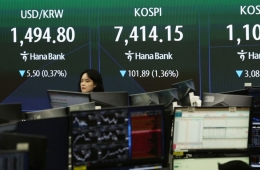
A loan counter at Hana Bank in Euljiro, Seoul. The photo is unrelated to specific expressions in the article. Photo by Asia Economy DB.
View original image[Asia Economy Reporter Heo Midam] "Loan interest rates are rising, prices are rising, are they trying to kill the common people?"
Recently, the loan interest rates at commercial banks have shown a steep upward trend, with rates rising by 0.2 percentage points in just one day. As the interest burden rapidly increases, the worries of the 'Youngkkeun-jok' (those who invest by borrowing to the limit) who took out loans to buy homes are deepening, and the burden on those who will need to borrow in the future is also growing. Meanwhile, with prices also rising, citizens are sighing with self-deprecating frustration over their increasingly difficult livelihoods. Some voices of dissatisfaction say, "Everything has gone up except for our salaries."
With recent expectations of a base interest rate hike and the government's household loan restriction policies combined, bank loan interest rates are rising rapidly. As of the 1st, the variable interest rates for new mortgage loans linked to the COFIX at KB Kookmin, Shinhan, Hana, and Woori Banks were recorded at 3.31% to 4.814% per annum. Compared to the end of August (2.62% to 4.19%), the lower and upper bounds rose by 0.69 percentage points and 0.624 percentage points respectively over two months.
The increase in mixed (fixed) mortgage loan interest rates was even greater. For mixed mortgage loans, the rates rose from 2.92% to 4.42% per annum to 3.97% to 5.377%, soaring to the low to mid-5% range. The upper and lower bounds increased by 0.957 percentage points and 1.050 percentage points respectively.
The problem is that interest rates are likely to rise further. If the Bank of Korea raises the base interest rate again at the monetary policy meeting scheduled for the 25th, mortgage loan interest rates could reach 6% within the year. Additionally, if banks continue to raise additional interest rates and reduce preferential rates due to the financial authorities' strong total loan volume regulations to curb household loans, the actual perceived increase in loan interest rates by borrowers will be even steeper, experts warn.

A citizen is shopping at a large supermarket. The photo is unrelated to specific expressions in the article. Photo by Asia Economy DB.
View original imagePrices rising day by day are also a factor increasing the burden on the common people. According to the 'October Consumer Price Trends' announced by Statistics Korea on the 2nd, consumer prices last month rose 3.2% compared to the same month last year. This is the highest figure in 9 years and 9 months since January 2012 (3.3%).
Given this situation, citizens are sighing deeply. Kim, a worker in his 20s, said, "Shouldn't deposit interest rates rise as much as loan interest rates? Deposit rates are stagnant, which seems unfair," and added, "The world has become harsh. If salaries had risen as much as interest rates or prices, it would be different, but everything has gone up except for salaries."
Another office worker in his 30s, Lee, expressed frustration, saying, "Loan interest rates are rising without limit, and prices are following suit. Only the common people are suffering. I didn't buy a house, but prices skyrocketed, making me a 'lightning poor' (byeorakgeoji), and now with jeonse prices soaring and interest rates rising, only people like us commoners are shedding tears of blood."
The financial authorities commented on the situation where loan interest rates are rising more steeply than deposit interest rates, saying, "Considering the possibility of future rate hikes, such a situation may continue."
On the 3rd, at a CEO meeting of the insurance industry held at Lotte Hotel in Sogong-dong, Financial Services Commission Chairman Ko Seung-beom explained, "Recently, interest rates have risen significantly, market interest rates have increased, and this is reflected in loan interest rates. As a result, the overall interest margin (the difference between loan and deposit interest rates) may widen."
He continued, "Especially regarding the interest burden on the common people and vulnerable groups, the Financial Services Commission has various measures in place and has already announced many. We will pay more attention to and respond to policy measures for low-income financial services."
Hot Picks Today
!["Rather Than Endure a 1.5 Million KRW Stipend, I'd Rather Earn 500 Million in the U.S." Top Talent from SNU and KAIST Are Leaving [Scientists Are Disappearing] ①](https://cwcontent.asiae.co.kr/asiaresize/93/2026051414165763158_1778735817.jpg) "Rather Than Endure a 1.5 Million KRW Stipend, I'd Rather Earn 500 Million in the U.S." Top Talent from SNU and KAIST Are Leaving [Scientists Are Disappearing] ①
"Rather Than Endure a 1.5 Million KRW Stipend, I'd Rather Earn 500 Million in the U.S." Top Talent from SNU and KAIST Are Leaving [Scientists Are Disappearing] ①
- [Breaking] Park Sukeun, Central Labor Relations Commission Chair: "Some Gaps Narrowed Between Samsung Electronics Labor and Management"
- Is This the Peak? As Others Hesitate..."The Answer Is Clear for Surviving the KOSPI 10,000 Era"
- Former Journalist and Investor Released on Bail After Gaining 11.2 Billion Won by Inflating Stock Prices Through News Articles
- "No Cure Available, Spread Accelerates... Already 105 Dead, American Infected"
Experts point out that if interest rates rise, the burden on the common people will increase. Professor Kim Taegi of Dankook University's Department of Economics said, "If interest rates rise, the burden on financially vulnerable groups will increase further. The same applies to the 'Youngkkeun-jok.' Housing finance is different from general finance in that it has special characteristics. The core of housing finance is to support those who currently lack cash, but treating housing finance like general finance causes problems."
© The Asia Business Daily(www.asiae.co.kr). All rights reserved.