'Allowing Adoption of Stepchildren by Singles and Defining the Concept of Companion Animals'... Ministry of Justice Proposes Civil Code Amendment
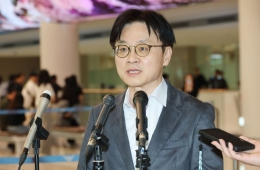
![Jeong Jae-min, Legal Affairs Officer and head of the 'Sagong Ilga (One-person Household for Social Coexistence)' task force under the Ministry of Justice, is giving a briefing on June 6th at the 2nd floor conference room of the Seoul High Prosecutors' Office regarding improvements to the adoption system for adopted children and follow-up legislation on the non-objectification of animals. <br>[Image source=Yonhap News]](http://www.asiae.co.kr/news/img_view.htm?img=2021090616291818145_1630913359.jpg)
Jeong Jae-min, Legal Affairs Officer and head of the 'Sagong Ilga (One-person Household for Social Coexistence)' task force under the Ministry of Justice, is giving a briefing on June 6th at the 2nd floor conference room of the Seoul High Prosecutors' Office regarding improvements to the adoption system for adopted children and follow-up legislation on the non-objectification of animals.
[Image source=Yonhap News]
[Asia Economy Reporter Choi Seok-jin, Legal Affairs Specialist] The Ministry of Justice has decided to pursue an amendment to the Civil Act to allow single individuals to adopt special adoptees, a practice currently permitted only for married couples. Additionally, the Ministry plans to introduce a legal definition of companion animals in the Civil Act, incorporating attributes such as "emotional bonds."
The Ministry of Justice's task force under the 'Sagong Ilga (One-person Households for Social Coexistence)' initiative (TF leader: Legal Affairs Officer Jeong Jae-min) held a briefing on the 6th at the second floor conference room of the Seoul High Prosecutors' Office to disclose these legislative amendment plans.
The Ministry reported that the Sagong Ilga TF discussed these policies at its third meeting held on the 31st of last month.
First, the Ministry agreed to amend the Civil Act to improve the current "special adoptee adoption system," which requires joint adoption by a married couple, to allow single individuals who have sufficient willingness and ability to raise children well to adopt special adoptees independently.
The special adoptee system, introduced through the 2005 amendment of the Civil Act, differs from the existing adoption system by completely terminating the relationship with the biological parents and recognizing only the kinship relationship with the adoptive parents.
Article 908-2 of the Civil Act (Requirements for Special Adoptee Adoption, etc.) stipulates that, except in cases where one spouse in a married couple who has been married for at least one year adopts the biological child of the other spouse as a special adoptee, adoption must be jointly conducted by a married couple who have been married for at least three years. Furthermore, the adoptee must be a minor.
The Civil Act restricts special adoptee adoption to married couples because single-parent households would have to be solely responsible for child-rearing, which is considered less favorable for the child's upbringing compared to married households with two adoptive parents.
However, the Sagong Ilga TF considered several factors: ▲ there may be single individuals capable of raising children as well as married couples; ▲ even if both adoptive parents exist at the time of adoption, they may become single due to divorce or bereavement; ▲ the current system may reinforce social prejudice against single-parent families; and ▲ the family court's adoption approval process can appropriately assess parenting ability and environment by considering various circumstances. Based on these, the TF decided to improve the system to allow single individuals to adopt special adoptees independently.
Previously, in 2013, the Constitutional Court ruled constitutionally valid the provision in Article 908-2, Paragraph 1, Subparagraph 1 of the Civil Act that limits special adoptee adoption to married couples due to a lack of quorum for an unconstitutional decision. However, a majority of the justices (five) expressed dissenting opinions citing reasons similar to those above.
The Sagong Ilga TF stated, "There was consensus that even when a single individual adopts a special adoptee independently, the family court's adoption approval review stage must thoroughly examine the adoptive parent's parenting ability and situation to ensure no neglect of the child's welfare."
Meanwhile, the Ministry of Justice also announced plans to prepare follow-up legislation to the Civil Act amendment bill on the "de-objectification of animals," which was publicly proposed from July to the 30th of last month.
A Ministry official said, "Various organizations and individuals from all walks of life have expressed support for the bill. The Ministry plans to submit the bill to the National Assembly in early October after going through the State Council soon."
Regarding this, the Sagong Ilga TF's third meeting discussed the direction, principles, and basic wording of follow-up bills based on the de-objectification of animals and established several policies.
First, separate from the current concept of companion animals under the Animal Protection Act, the Civil Act will define the concept of companion animals, including conceptual markers such as "emotional bonds," considering legislative examples from other countries.
Additionally, to address the issue where companion animals have been treated as objects under the Civil Act?resulting in compensation for death or injury caused by others being limited to exchange value (sale price)?the Ministry plans to establish provisions allowing compensation for veterinary treatment costs exceeding exchange value and to provide a legal basis for claiming damages for mental distress (consolation money).
There is also a plan to add companion animals to the list of items exempt from seizure under the Civil Execution Act.
Hot Picks Today
 No Bacteria Detected in Arisu After 24 Hours of Repeated Drinking from a Tumbler
- "We Can't Just Let Them Be Damaged Inside"... Samsung Electronics Removes 360,000 Wafers in Preparation for Strike
- "Up to 100 Trillion Won in Losses Feared, It's Not About Second Place but Catastrophe"... Industry Minister: 'Emergency Mediation Unavoidable If Samsung Strike Occurs'
- Wife in $6.7 Million Debt Took Out $3 Million in Husband's Life Insurance, Poisoned Him... US Court: "She Can Never Be Released"
- "He's Handsome, It's Such a Pity?"... Lawyer Responds to Bizarre 'Appearance Evaluation' of High School Girl Murder Suspect
A Ministry of Justice official stated, "We will promptly prepare detailed bills based on the opinions presented at the Sagong Ilga TF's third meeting, gather additional opinions, and promote the legislative amendment process."
© The Asia Business Daily(www.asiae.co.kr). All rights reserved.