Afghan Special Contributors Begin Life in Jincheon... Support Provided for Livelihood and Housing Expenses (Comprehensive)
After Quarantine Release, 6-Week Residency at National Human Resources Development Institute for Social Adaptation Education Including Korean Language, Culture, and Legal Order

A bus carrying Afghans who helped Korea in the past is moving from Marina Bay Hotel in Gimpo, Gyeonggi Province to the National Human Resources Development Institute in Jincheon, Chungbuk on the 27th. Photo by Mun Ho-nam munonam@
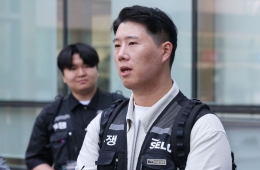
View original image[Asia Economy Reporter Baek Kyunghwan] On the 27th, 377 Afghan collaborators and their families who set foot on Korean soil began their lives at the National Human Resources Development Institute in Jincheon, Chungbuk. They will receive support from the 'Living Facility Operation Team,' consisting of 59 members including 40 Ministry of Justice staff and 12 private professional quarantine personnel. In particular, support necessary for initial settlement such as living expenses, medical expenses, and housing support will be provided in consultation with related ministries.
On the 27th, the Ministry of Justice announced detailed support measures for the domestic settlement of Korean collaborators, Afghan local staff, and their families who arrived the previous day. Kang Seong-guk, Vice Minister of Justice, who welcomed the entrants on site, said, "The Afghan entrants are in a situation where psychological stability is most needed, so warm encouragement is necessary," and added, "Since they worked for our country in Afghanistan, please make efforts to help them adapt well to our society in the future."
Previously, they spent a day at a temporary living facility and arrived at the National Human Resources Development Institute in Jincheon, Chungbuk, in the afternoon. They are locals who assisted the Korean government’s work at the Korean embassy, hospitals, vocational training centers, etc., in Afghanistan, and will spend 6 to 8 weeks here.
Among them, the first 2 weeks are a quarantine period. Upon arrival at Incheon Airport, they underwent COVID-19 testing and all tested negative, so they moved to Jincheon. However, considering the possibility of an incubation period, the Ministry of Justice plans to quarantine them for 2 weeks to monitor symptoms. To this end, 40 Ministry of Justice staff with expertise in foreign affairs, as well as medical personnel to check their tests and health, are dispatched to the Human Resources Development Institute.
After 2 weeks, settlement education prepared by the Ministry of Justice will be conducted. This includes social adaptation education such as Korean language, culture, and legal order necessary for settling in Korean society.
Basic living support is provided by the government’s 'Living Facility Operation Team' consisting of 59 members. Ten medical personnel including 2 doctors and 3 nurses from the Ministry of Justice Correction Headquarters, and military doctors and nursing officers from the Ministry of National Defense will reside at the facility 24 hours a day to monitor the health of the entrants and conduct two rounds of PCR tests.
Accommodations were arranged considering children under 12 who must have guardians and people with disabilities among the families, assigning 3-person or 4-person rooms. One interpreter is stationed at the facility, and there is a pool of 9 interpreters available for telephone interpretation. Additionally, plans for support necessary for initial settlement such as living expenses, medical expenses, and housing support will be established in consultation with related ministries.
Their status will also change soon. The Afghans who entered the country with short-term visit (C-3) arrival visas issued at the airport the previous day will have their status changed to residence status (F-1) that allows long-term stay, securing stable residency status.
After completing education, they will be issued a residence (F-2) visa that allows free employment. The 'F-2' visa is issued to those who intend to stay long-term in Korea to obtain permanent residency and allows a stay of up to 5 years per issuance without restrictions on employment activities.
However, under current laws, it is impossible to issue residence visas to Afghan collaborators and their families. Therefore, the Ministry of Justice has begun revising the 'Immigration Control Act Enforcement Decree' to allow residence visas to be granted to foreigners who have made special contributions to the Republic of Korea or contributed to public interest.
Among the total 390 entrants, 13 who remained in Islamabad due to accumulated fatigue and transport aircraft seat availability departed on another military transport aircraft the previous evening and will arrive at Incheon Airport on the afternoon of the 27th. It is known that 428 people initially applied for entry, but the rest either stayed in their hometowns or chose to go to third countries. The second group of entrants will undergo the same entry process as the Afghans who arrived the previous day.
The Ministry of Justice intends to consider additional support measures for Afghans. Proactively, humanitarian special stay measures have been implemented for Afghans currently residing in Korea. This applies to 434 Afghans with long- and short-term domestic stays who are currently legally residing but have difficulty extending their stay period and wish to remain in Korea, granting them special stay status.
They can also work after screening. However, those without domestic guarantors or connections, or serious criminals such as violent offenders, will be subject to protective measures. The 72 people whose stay period has expired and who have been handed over to police and related agencies will be allowed to voluntarily depart once the situation in Afghanistan stabilizes.
Hot Picks Today
!["Heading for 2 Million Won": The Company the Securities Industry Says Not to Doubt [Weekend Money]](https://cwcontent.asiae.co.kr/asiaresize/93/2025061015355092669_1749537351.jpg) "Heading for 2 Million Won": The Company the Securities Industry Says Not to Doubt [Weekend Money]
"Heading for 2 Million Won": The Company the Securities Industry Says Not to Doubt [Weekend Money]
- "Anyone Who Visited the Room Salon, Come Forward"… Gangnam Police Station Launches Full Staff Investigation After New Scandal
- "Can't Even Turn On a Fan? How Will They Endure the Heat?"... Massive Blackout Hits the Philippines Amid Scorching Heat
- "Drink Three Cups of Coffee and Stay Up All Night Before the Test"... Manual of Insurance Planner Who Collected 1 Billion Won in Payouts
- Did Samsung and SK hynix Rise Too Much?... Foreign Assets Grow Despite Selling [Weekend Money]
Meanwhile, Minister of Justice Park Beom-gye explained the reason for naming the Afghans 'special contributors' rather than refugees or special merit recipients during his commute to the Government Complex Gwacheon on the same day. Minister Park said, "Special merit is usually applied when nationality is granted for special contributions, and we have decided that it is better to promote legislation under the term 'special contributor' going forward," adding, "I will speak about refugee policy after some time has passed."
© The Asia Business Daily(www.asiae.co.kr). All rights reserved.