Abolition of Villa and Officetel Purchase-Lease... "Trust Erosion" Due to Inconsistent Policies
Ruling Party Real Estate Special Committee Decides to Completely Ban New Registrations Regardless of Housing Type
Existing Operators' Qualifications Revoked After Lease Period Ends
"Won't Tenants Ultimately Bear the Full Brunt of the Damage?"

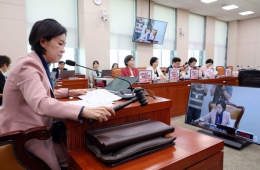
Yoon Ho-jung, the floor leader of the Democratic Party of Korea, and Kim Jin-pyo, the chairman of the Real Estate Special Committee, are attending and conversing at the policy members' meeting on real estate held at the National Assembly on the 27th. Photo by Yoon Dong-ju doso7@
View original image[Asia Economy Reporter Onyu Lim] The Democratic Party of Korea has decided to abolish the purchase rental business for non-apartment types such as villas and officetels, causing the market to be in turmoil. The government initially encouraged registration of rental businesses in 2017 under the Moon Jae-in administration by offering various incentives such as tax benefits, but after four years, it has completely reversed this policy, leading to criticism that trust in government policy has plummeted to the bottom.
According to the Democratic Party's Real Estate Special Committee on the 28th, the committee decided the day before to completely ban new registrations of purchase rental businesses regardless of housing type. Following the abolition of the rental business system for apartments in the July 10th measures last year, this policy is now being expanded to include non-apartments such as officetels, row houses, multi-family houses, detached houses, and multi-unit houses. Existing business operators will also lose their qualifications once the rental period ends.
In addition, the Real Estate Special Committee plans to allow exemption from capital gains tax surcharges only if the property is sold within six months after the rental business status is revoked, in order to attract rental housing to the market. Previously, this benefit could be enjoyed regardless of the period.
In the December 13th measures of 2017, the government introduced a plan to revitalize registered rental businesses centered on various tax reduction measures to alleviate tenant housing instability and legalize rental income. However, since 2018, the ruling party has pointed to rental business operators as one of the causes of the rapid rise in apartment prices, leading to a reversal of the policy. Going forward, the benefit of excluding properties from comprehensive real estate tax will only apply during the remaining mandatory rental period, and once the mandatory rental period ends, normal taxation will resume without additional extension.

The industry expects that 500,000 households will be immediately affected by this decision. As of the end of April, the number of registered rental housing units subject to automatic cancellation was 116,048 apartments and 384,660 non-apartments. The number of affected housing units is expected to increase to 582,971 units this year, 724,717 units by the end of 2022, and 827,264 units by the end of 2023.
Rental business operators are strongly opposing the government's and ruling party's policy reversal. Sung Chang-yeop, president of the Korea Housing Rental Association, said, "The ruling party is blaming innocent rental business operators for the failure of real estate policy," adding, "How can we trust the government when it reverses policies it encouraged in the early days of the Moon Jae-in administration?"
Hot Picks Today
 "Now Our Salaries Are 10 Million Won a Month" Record High... Semiconductor Boom Drives Performance Bonuses at Major Electronic Component Firms
- Living the Homebody Dream? "I Was Shocked by My Spending" How to Cut Costs to 5,000 Won for Essentials [The Principles of Benefits]
- Is It Really Like an Illness? "I Can't Wait to Go Again"—Over 1 Million Visited in Q1, Now 'Busanbyeong' Takes Hold [K-Holic]
- "Heading for 2 Million Won": The Company the Securities Industry Says Not to Doubt [Weekend Money]
- Experts Already Watching Closely..."Target Price Set at 970,000 Won" Only Upward Momentum Remains [Weekend Money]
The bigger problem is that innocent tenants may suffer due to these institutional changes. If a rental business operator sells a property to avoid capital gains tax surcharges and the buyer intends to live in the property, the tenant cannot renew the contract. If less than six months remain on the contract period, renewal is possible, but after that, there is a high possibility that rent will increase significantly. Rental business operators have been subject to a 5% limit on rent increases for new contracts, so the prices of these properties were lower than market prices.
© The Asia Business Daily(www.asiae.co.kr). All rights reserved.