'From Moonppang to Walkie-Talkies' Various Evasion Tactics... Entertainment Business Owners Say "We Have to Do This"
Prolonged Ban on Entertainment Venues Leads to 'Secret Operations'
Use of 'Moonppang' and Walkie-Talkies... Even Power Cut Tactics Employed
Temporary Store Rentals for Irregular Business Also Flourishing
Group Actions by Owners Expected... Entertainment Industry Association to Hold Press Conference on 20th
Police Inspect 48,000 Sites Over 6 Weeks, Crack Down on 757 Cases and 4,372 People

[Asia Economy Reporter Song Seung-yoon] "If we get caught in a crackdown, there's nothing we can do. But we still have to make a living..."
Choi Moon-ho (33, pseudonym), who manages several entertainment establishments in the Gyeonggi area, recently assigned six to eight so-called ‘Munppang’ (staff members who act as lookouts) at the main entrances and emergency exits of his venues in preparation for police crackdowns. These individuals patrol around the premises to alert the inside of any enforcement activity.
They even have protocols in place for when the police enter the premises. First, customers are diverted to emergency exits on other floors, and staff scatter in teams across multiple floors. To avoid leaving traces of illegal operations, they communicate via walkie-talkies when a crackdown is imminent. According to him, they even stop the power switches and elevator operations in the active business areas to make tracking more difficult. Choi said, "There have been several reports filed against us, but we have never been caught yet," adding, "If we don't do this, we simply can't survive."
As the ban on gatherings at entertainment facilities continues for an extended period, cases of secret operations are increasing, and various methods to evade crackdowns are evolving. The use of walkie-talkies and cutting off internal building power resembles a 007-style operation, creating a situation that is almost laughable.
Irregular operations are also rampant, such as renting a place registered as a regular restaurant and simply relocating the venue to continue business. Because they cannot openly open their doors due to fear of crackdowns, they only accept verified regular customers or hire ‘ppikki’ (recruiters) to selectively admit those who appear to have already been drinking. Han Myung-hee (52, pseudonym), who runs an entertainment establishment in the Bucheon area, said, "Sometimes taxi drivers pick up customers and bring them here, and we share part of the profits with them," adding, "I know that many places operate like this, not just us."

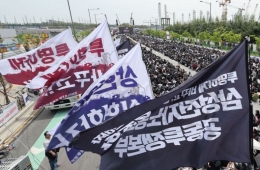
Officials from the Korea Entertainment Food Service Association are marching on the 10th from LG Twin Towers in Yeongdeungpo-gu, Seoul, to the Blue House, urging the repeal of the ban on gatherings at entertainment bars. They stated, "Since the government's ban on gatherings was enforced from March last year when COVID-19 quarantine measures were strengthened, we have been unable to operate for a full 10 months." They added, "As a result, more than 90% of entertainment business owners, who are small-scale operators making a living, are facing dire situations such as eviction lawsuits from building owners." Photo by Kim Hyun-min kimhyun81@
View original imageCollective actions by business owners demanding the easing of operating restrictions are expected to continue. Members of the Korea Entertainment Food Service Central Association’s Gyeonggi and Incheon branches held a protest in Seoul on the 10th of this month, demanding the lifting of operating restrictions.
The central association plans to hold a press conference in front of Seoul City Hall on the 20th. Some business owners in the Incheon area expressed their intention to continue operating despite the gathering ban but decided to hold off until the new social distancing adjustment plan begins on the 23rd of this month. Choi Won-bong, Secretary General of the Korea Entertainment Food Service Central Association, said, "If control is imposed unconditionally, side effects like those we are seeing now are inevitable," adding, "If entertainment facilities continue to go underground, even if confirmed cases occur, tracing will be impossible, which will only cause adverse effects."
Hot Picks Today
 "Buy on Black Monday"... Japan's Nomura Forecasts 590,000 for Samsung, 4 Million for SK hynix
- "Plunged During the War, Now Surging Again"... The Real Reason Behind the 6% One-Day Silver Market Rally [Weekend Money]
- KOSPI Turns Lower After Hitting 8,000 Points... Is Profit-Taking to Blame? [1-Minute Brief]
- "Samsung and Hynix Were Once for the Underachievers"... Hyundai Motor Employee's Lament
- "That? It's Already Stashed" Nightlife Scene Crosses the Line [ChwiYak Nation] ③
Meanwhile, from the 5th of last month to the 16th of this month, the police deployed 14,284 officers over six weeks and, in cooperation with 3,538 local government personnel, inspected 48,000 entertainment facilities nationwide. As a result, they cracked down on 757 cases involving 4,372 people for violations of quarantine guidelines such as the Infectious Disease Control and Prevention Act and the Food Sanitation Act. By type, there were 451 cases involving 3,855 people violating quarantine rules including the Infectious Disease Control and Prevention Act, 40 cases involving 182 people violating the Food Sanitation Act, and 265 cases involving 320 people violating the Music Industry Act. Additionally, one case involving 15 people was caught for violating the Act on the Punishment of Acts of Prostitution.
© The Asia Business Daily(www.asiae.co.kr). All rights reserved.