'COVID-19 Direct Impact' US-Korea Trade Volume Decreases for the First Time in 4 Years... Trade Balance Surplus Increases
Trade Trends in the 9th Year of the Korea-US FTA
Surpassing Global Trade Decline Rates as a 'Breakwater'... Increased Exports of Computers and Semiconductors

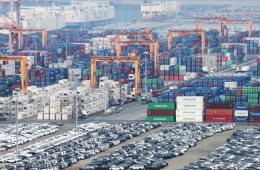
[Sejong=Asia Economy Reporter Kwon Haeyoung] Last year, the ninth year since the Korea-US Free Trade Agreement (FTA) came into effect, trade volume between the two countries decreased for the first time in four years due to the direct impact of the COVID-19 pandemic. Considering that the global trade volume declined by 6.3%, the Korea-US FTA played a partial role as a buffer. Imports of semiconductor manufacturing equipment and automobiles increased, and exports of computers and semiconductors also rose, resulting in a trade surplus that increased compared to the previous year, which was the lowest in eight years.
According to the "Trade Trends in the 9th Year of Korea-US FTA Implementation (2020)" announced by the Ministry of Trade, Industry and Energy on the 14th, trade between the two countries last year was recorded at $131.6 billion, down 2.7% from the previous year. Despite the global economic slowdown, reduced global trade, and low oil prices caused by the spread of COVID-19, Korea's total trade volume decreased by 6.3%, but trade with the US performed relatively well.
In terms of exports, while global exports decreased by 5.5%, exports to the US reached $74.1 billion, an increase of 1.1% compared to the previous year.
The main export items to the US were automobiles (parts), semiconductors, computers, and wireless communication devices, with exports increasing mainly in computers (104.2%) and semiconductors (25.3%). This was due to the expansion of server investments such as data centers driven by the spread of the non-face-to-face economy, accelerated transition to SSDs leading to increased SSD exports, and growing demand for laptops for remote work. Semiconductor demand for servers and PCs was strong, and mobile demand recovered in the second half of the year. On the other hand, exports of petroleum products (-46.5%), wireless communication devices (-26.4%), and automobile parts (-11.5%) decreased. Petroleum products saw a decline in export prices due to the sharp drop in international oil prices caused by the COVID-19 pandemic, and global demand for aviation fuel and transport fuel decreased due to movement restrictions. Automobile demand was also sluggish.
Imports from the US were recorded at $57.5 billion, down 7.1% from the previous year. Major import items included crude oil, semiconductor manufacturing equipment, aircraft and parts. Imports of semiconductor manufacturing equipment (44.6%) and automobiles (36%) increased significantly, while crude oil (-40%) and semiconductors (-7%) decreased.
As a result, the trade surplus with the US last year was $16.6 billion. This was an increase of $5.2 billion compared to 2019 ($11.4 billion), when the US trade surplus was at its lowest level in eight years.

Last year, the US accounted for 12.3% of Korea's import market, the same as the previous year. China recorded 23.3%, up 2 percentage points during the same period, and Japan recorded 9.8%, up 0.3 percentage points. Korea's market share in the US was 3.3%, up 0.2 percentage points from the previous year.
In 2019, service trade between the two countries increased by 5.1% from the previous year to $49.3 billion. The service trade balance recorded a deficit of $13.3 billion, with the deficit narrowing compared to the previous year.
Korea's investment in the US was recorded at $9.56 billion in the cumulative third quarter of 2020, down 7.6% compared to the same period last year. US investment in Korea last year decreased by 22.6% to $5.3 billion, marking a decline for the first time in three years since 2016.
Hot Picks Today
 No Bacteria Detected in Arisu After 24 Hours of Repeated Drinking from a Tumbler
- "Not Even Expecting Gratitude, Just Hoping for No Complaints": Teachers' Sad Portrait on the Eve of Teacher's Day
- "Available Only in Korea": Pokémon Card Prices Surge 2,532% Due to Rarity, Becoming Investment Assets
- High-Net-Worth Investors Increase Stock Holdings: "Samsung and SK hynix Are Basic, Now Searching for the Next Opportunity" [Investment Strategies of the Wealthy] ⑧
- Police Officer Cycling on Day Off Rescues Woman Attempting to Jump from Hangju Bridge
An official from the Ministry of Trade, Industry and Energy said, "Due to the global economic recession caused by COVID-19, US investment in Korea reversed to a declining trend for the first time in three years," adding, "Recently, US investment in Korea is expanding from traditional industries such as transportation machinery to new industries related to the 4th industrial revolution, including semiconductors, cloud computing, and e-commerce."
© The Asia Business Daily(www.asiae.co.kr). All rights reserved.