'50 Years Since Establishment' Think Tank KDI, What Was the Topic of Its First Research Report?
A 50-Year History of Establishment... Paralleling the History of the Korean Economy
Director Choi Jeong-pyo: "We Will Take on New Roles in a New Era"

[Sejong=Asia Economy Reporter Kim Hyunjung] The Korea Development Institute (KDI) marked its 50th anniversary on the 10th, having published approximately 17,000 research reports to date. It is recognized for conducting research projects across various fields of the economy, including industry, finance, law and economics, and macroeconomics, keeping pace with changes in the Korean economy and the times.
The first research report published by KDI shortly after its establishment in 1971, during the Nixon Shock, was on the topic of 'structural adjustment.' This report, titled 'Opinions on Corporate Restructuring,' was authored by the late Kim Man-je, the inaugural president of KDI, and emphasized the necessity of restructuring and cleaning up insolvent companies. It is regarded as the pioneering work in domestic corporate restructuring.
Following this, with the announcement of the 3rd Five-Year Economic Development Plan in 1973 and the national focus on fostering heavy and chemical industries, KDI engaged in economic feasibility analyses related to this and studied budget system reforms for efficient management of fiscal funds. It also provided support by developing models for the Five-Year Economic Development Plans.
During the second oil shock in 1978, KDI proposed directions for economic stabilization measures (in 1979) to address inflation, shifting the macroeconomic management focus from 'growth' to 'stability,' thereby steering the direction of national development strategy.
In the 1980s, a period of significant economic and social change, KDI was responsible for laying the theoretical groundwork prior to the enactment of the Fair Trade Act (1980) and also studied reform plans related to import liberalization in 1984.
Earlier, the National Pension System, proposed by KDI since 1972, was legislated in 1986 and implemented in 1988. In 1990, when the high-level inter-Korean talks were held, KDI established the North Korean Economy Research Center to commence full-scale research on the North Korean economy in preparation for reunification.
Particularly in the 1990s, KDI focused on its role as a think tank for policy alternatives and restructuring plans to overcome financial reform and the foreign exchange crisis. It drafted a phased plan for interest rate liberalization in 1991 and conducted preliminary research under strict confidentiality ahead of the implementation of the real-name financial system by presidential emergency decree in 1993.
In 1998, immediately following the IMF foreign exchange crisis, which was akin to a disaster situation, KDI took the lead in establishing policy directions, preparing comprehensive and detailed strategies including corporate and financial restructuring, thereby laying the foundational framework for overcoming the crisis and economic structural adjustment policies.
In the 2000s, KDI produced research outcomes such as ▲policy direction studies for aging population (2004?2006), ▲studies to find new growth engines after the foreign exchange crisis (2006, 2008), and ▲policy proposals to resolve income polarization (Changes in distribution structure and poverty after the IMF and foreign policy directions, 2000). Notable achievements also include the 'Study to Enhance the Productivity of Fiscal Expenditure' (2004), emphasizing the importance of medium-term fiscal planning after the foreign exchange crisis, and 'Vision 2030' (2006), which designed long-term national strategies following the surpassing of $20,000 per capita income.
After the 2011 savings bank insolvency crisis, KDI proposed 'Seeking a New Paradigm for Housing Policy after the Global Financial Crisis' (2012), and at the time of joining the world's seventh 20-50 club in 2012, suggested 'Paradigm Shift for Establishing a Virtuous Cycle of Growth and Employment' (2011, 2012). Regarding the recent controversial fiscal rules, KDI also released a report in 2016 titled 'Measures to Enhance Fiscal Soundness through Strengthening Fiscal Responsibility.'
Additionally, KDI has addressed intergenerational conflict analysis and coexistence measures through works such as 'Changes in Distribution Structure and Directions of Social Policy' (2011), 'Analysis of Intergenerational Conflict and Search for Coexistence Measures' (2015), and 'Impact of Mandatory Retirement at Age 60: Focusing on Effects on Youth Employment' (2019). Last year, as part of research on socio-economic changes due to COVID-19, it published 'Effects and Implications of the First Emergency Disaster Relief Fund Policy.'
Hot Picks Today
 "Now Our Salaries Are 10 Million Won a Month" Record High... Semiconductor Boom Drives Performance Bonuses at Major Electronic Component Firms
- Experts Already Watching Closely..."Target Price Set at 970,000 Won" Only Upward Momentum Remains [Weekend Money]
- "Heading for 2 Million Won": The Company the Securities Industry Says Not to Doubt [Weekend Money]
- Did Samsung and SK hynix Rise Too Much?... Foreign Assets Grow Despite Selling [Weekend Money]
- "Chanel Open Run? I Get a Free Pass"... The World of the Top 0.1% That Money Alone Can't Enter [Luxury World]
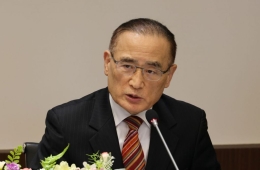
Earlier, KDI President Choi Jung-pyo emphasized at the 50th anniversary ceremony, "South Korea has entered a new phase with the COVID-19 pandemic, restructuring of the global economic cooperation system, digital transformation, and low birthrate and aging population, and this new era demands new roles from KDI." He added, "KDI will continue to maintain rigor and excellence in research while strengthening social responsibility." He further explained, "We will dedicate ourselves to proposing solutions for dynamic economic management and inclusive social composition, aiming to realize a quality of life where all members of society can be happy together."
© The Asia Business Daily(www.asiae.co.kr). All rights reserved.