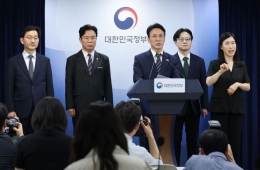
"Strengthening ESG Disclosure Capabilities and Surge in Related Lawsuits: Domestic Companies Must Prepare"
FKI Holds 'ESG Global Disclosure Evaluation and Legal Issues Seminar'
![Kim Jeong-nam, Executive Director of Samjong KPMG, is giving a presentation on the topic "Global Trends in ESG Disclosure and Response Strategies for Korean Companies" at the "ESG Global Disclosure, Evaluation, and Legal Issues Seminar" held at the Federation of Korean Industries Conference Center on the 11th. <br>[Photo by Federation of Korean Industries]](http://www.asiae.co.kr/news/img_view.htm?img=2021031110555726115_1615427757.jpg)
Kim Jeong-nam, Executive Director of Samjong KPMG, is giving a presentation on the topic "Global Trends in ESG Disclosure and Response Strategies for Korean Companies" at the "ESG Global Disclosure, Evaluation, and Legal Issues Seminar" held at the Federation of Korean Industries Conference Center on the 11th.
[Photo by Federation of Korean Industries]
[Asia Economy Reporter Kim Heung-soon] From 2025, ESG (Environmental, Social, and Governance) disclosure will be mandatory for companies with assets exceeding 2 trillion KRW, but it has been found that the publication of disclosure reports by domestic companies lags behind major countries. There are also concerns that the risk of lawsuits related to ESG companies will surge in the future, highlighting the need for preparation.
The Federation of Korean Industries (FKI) held an 'ESG Global Disclosure, Evaluation, and Legal Issues Seminar' on the 11th at the FKI Conference Center in Yeouido, Seoul, inviting experts from law firms, accounting firms, and evaluation agencies related to ESG to discuss these topics.
Korea’s ESG Report Publication Rate at 78%
"Korean Companies Must Strengthen ESG Disclosure Capabilities and Systems"
Jung-nam Kim, Executive Director at Samjong KPMG, introduced in his presentation titled 'Global Trends in ESG Disclosure and Our Companies’ Response Directions' that "Globally, the publication of ESG disclosure reports is on a continuous rise." According to Samjong KPMG, as of last year, there are 14 countries where over 90% of the top 100 companies by revenue publish non-financial reports. Japan and Mexico have all of their top 100 revenue companies publishing non-financial reports. In contrast, Korea and China stand at 78% each.
Executive Director Kim pointed out, "The mandatory ESG information disclosure in Korea is scheduled to be introduced gradually from 2025, and companies unprepared for this could face urgent challenges," adding, "The importance of ESG information disclosure in Korea has not yet been properly recognized by companies and information users." He emphasized, "Companies should respond to disclosure demands through 'disclosures that consider corporate characteristics and reflect key stakeholder requirements,' 'disclosures utilizing various channels,' and 'disclosures with strengthened linkage to financial performance.'"

"ESG-Related Companies Must Prepare for a Surge in Litigation Risks"
Yoon Yong-hee, a lawyer at Yulchon Law Firm, stated in his presentation on 'Legal Issues and Global Dispute Cases Related to ESG' that "As investors and others demand companies disclose more specific additional information, legal disputes are increasing, and the risk of companies facing ESG lawsuits is rising." He identified three types of ESG lawsuits: ▲ errors or omissions in ESG information stated in product labeling or disclosure materials ▲ securities fraud due to insincere disclosure ▲ illegal acts or defaults related to ESG factors by companies.
Environmental safety regulations in Korea are also being strengthened annually, with the frequency and intensity of inspections increasing. According to the Ministry of Environment, from 2008 to 2018, there were a cumulative 509 new administrative regulations, increasing by about 30 to 80 cases annually. Among the types of penalties for violations from 2014 to 2018, improvement orders increased by 4.6%, while suspensions of operations, usage bans, and closure orders surged by 64.6%, and permit cancellations rose sharply by 476%, indicating strong enforcement.

"More Active Information Disclosure Needed for ESG Management Evaluation"
Deok-gyo Oh, Research Fellow at the Korea Corporate Governance Service, emphasized in his presentation on 'ESG Evaluation Response Measures' that "In ESG responses, when evaluation agencies request information provision, the more information disclosed, the easier it is to respond," adding, "When there is no request for information provision, the scope of regularly disclosed information is important." He advised actively utilizing sustainability management reports and websites as methods of information disclosure. He also suggested categorizing and organizing improvement points based on evaluation results and having responsible personnel create an improvement roadmap for efficient management.
Hot Picks Today
 "Now Our Salaries Are 10 Million Won a Month" Record High... Semiconductor Boom Drives Performance Bonuses at Major Electronic Component Firms
- Wallets Open Wide on Big News...300 Trillion Won Heads to the U.S., "Tax Breaks" Fail to Keep Funds at Home
- "Hope You Enjoy the 'Welfare' for Bereavement of Children"... Ridicule of Strike Non-Participants Intensifies Union Conflict at Samsung Electronics
- "Heading for 2 Million Won": The Company the Securities Industry Says Not to Doubt [Weekend Money]
- Experts Already Watching Closely..."Target Price Set at 970,000 Won" Only Upward Momentum Remains [Weekend Money]
Tae-shin Kwon, Vice Chairman of the FKI, stated, "Efficient responses by Korean companies are necessary for the ESG disclosure obligations to be gradually implemented from 2025 and the recent surge in ESG-related lawsuits," adding, "The FKI has recently established a dedicated ESG organization and plans to promote various projects to spread ESG, including launching the ESG Global Forum this year, hosting international conferences, and dispatching ESG delegations linked with the Korea-US Business Council."
© The Asia Business Daily(www.asiae.co.kr). All rights reserved.