S-OIL Becomes Largest Domestic Shareholder of Fuel Cell Company... Enters Hydrogen Business

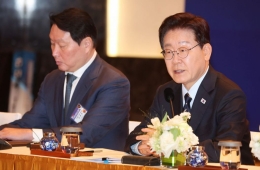
Ryu Yeol, President of S-Oil (left), and Lee Tae-won, CEO of FCI, are posing for a commemorative photo after signing an investment contract at the S-Oil headquarters in Mapo, Seoul, on the 5th.
[Asia Economy Reporter Choi Dae-yeol] S-OIL announced on the 7th that it will enter the hydrogen business by investing in a next-generation fuel cell company.
The company secured a 20% stake through an initial investment in FCI (Fuel Cell Innovations), which provides clean energy solutions based on fuel cells, becoming the largest shareholder in Korea. They stated that they plan to promote the hydrogen business by establishing a strategic partnership. Al Katani, CEO of S-OIL, said, "This investment marks the beginning of our investment in the overall hydrogen economy and will drive the company's sustainable growth," adding, "We will also actively respond to the government's efforts to reduce carbon emissions."
FCI is a Korea-Saudi joint venture holding about 40 patents for solid oxide fuel cells (SOFC). They collaborate with various companies and research institutions, including the Italian fuel cell specialist Solid Power, to develop products suitable for both Korean and overseas markets. With this investment, FCI plans to invest approximately 100 billion KRW by 2027, establish production facilities with a capacity of over 100MW, and expand into the green hydrogen business.
Additionally, they are considering cooperation plans for FCI to enter overseas fuel cell markets such as the Middle East. They plan to supply products to local power and telecommunications companies in cooperation with their Saudi partners. They have signed an initial supply contract for 150MW with the Saudi partner and are developing power generation and building-use products tailored to local climate conditions and legal/administrative regulations. They are also developing microgrid-type hybrid products that can complement the output variability of renewable energy and maritime fuel cells for ships in collaboration with external organizations.
Lee Tae-won, CEO of FCI, said, "The Middle East market has high gas price competitiveness, allowing fuel cell power generation to reach grid parity without government subsidies," adding, "To strengthen business competitiveness, we will simultaneously promote the localization of key components by 2027."
Fuel cells are devices that produce electricity by chemically reacting hydrogen with oxygen in the air and are considered a core device in the hydrogen economy. They have higher energy efficiency compared to thermal power generation and reduce greenhouse gases as there is no chemical combustion reaction. Solid oxide fuel cells operate at the highest temperatures among fuel cells and have higher power generation efficiency than conventional fuel cells. Their small size makes them useful for residential, building, and power generation applications, and they are expected to have high utilization value.
S-OIL is exploring ways to enter the entire hydrogen industry, from production to distribution and sales, as one of its new business areas. In cooperation with its major shareholder Aramco, it is reviewing businesses utilizing green hydrogen and ammonia, as well as liquefied hydrogen production and distribution.
Hot Picks Today
 Chilling Timing "Did They Know Again?"... $640 ...
- Trump: "Iran in a Crazy Situation... Orders to Fire on Mine-Laying Vessels in th...
- "I Spent Money in a Truly Meaningful Way"... How an SK hynix Employee Donated 10...
- "If You Have This at Home, Remove It Immediately"... 'This Item' Is as Harmful a...
- Foreign Vessels Once Swept Up the Seas Every Season... Now Face Fines of Up to 1...
© The Asia Business Daily(www.asiae.co.kr). All rights reserved.