300 Million KRW Per Person National Employment Support Program... 60% of Youths Experienced 'Breaks' Surge
Career-Interrupted Women and Middle-Aged Adults Also Eligible, but Youth Proportion 'Overwhelming'

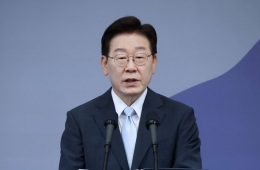
Minister Lee Jae-gap of the Ministry of Employment and Labor is speaking at the "National Employment Support System Participants Meeting" held on the 3rd at the Southern Employment Center in Yeongdeungpo-gu, Seoul. Photo by Kang Jin-hyung aymsdream@
View original image[Asia Economy Reporter Moon Chaeseok] Among applicants for the National Employment System, which provides job-seeking promotion allowances of 3 million KRW per person and employment support services, the largest group was young people, who are considered relatively vulnerable in the labor market. This reflects the reality of a sharp increase in young people who are 'resting' without any job-seeking activities.
The Ministry of Employment and Labor announced that as of the 2nd of this month, the number of applicants for this system was counted at 199,000.
This is a Korean-style unemployment assistance system that provides a job-seeking promotion allowance of 500,000 KRW per month for six months to those who meet certain criteria, such as low-income job seekers, along with customized employment support services.
The system is divided into Type 1, which supports both the job-seeking promotion allowance and employment support services, and Type 2, which provides only employment support services. Type 2 also supports employment activity costs up to a maximum of 1,954,000 KRW per person.
As of the 2nd, 63,000 people were recognized as beneficiaries. Among them, 55,000 belonging to Type 1 have started receiving the job-seeking promotion allowance sequentially.
Looking at applicants by age group, young people aged 18 to 34 accounted for the largest share at 60.9%. This proportion was larger than the combined 27.2% of those aged 35 to 54 and 11.9% of those aged 55 to 69.
Considering that the system also applies to career-interrupted women and middle-aged and older adults who are not enrolled in employment insurance, this result shows how much young job seekers are being pushed out of the employment market.
According to Statistics Korea and the Ministry of Employment and Labor, the number of young people classified as 'resting' last year was 448,000, a 24.4% increase from 360,000 in 2019.
This surge is due to young people losing motivation to work and giving up job-seeking activities amid the prolonged COVID-19 pandemic.
Typically, an increase in the 'resting' population is taken seriously as evidence that the country's future growth engine is fading.
Hot Picks Today
 "Stocks Are Not Taxed, but Annual Crypto Gains Over 2.5 Million Won to Be Taxed Next Year... Investors Push Back"
- "Groups of 5 or More Now Restricted"... Unrelenting Running Craze Leaves Citizens and Police Exhausted
- Despite Warnings of "Do Not Enter, You May Not Make It Out Alive"... Foreign Tourist Stranded After Unauthorized Climb on Jeju Sanbangsan
- AI Bubble or Real Growth? All Eyes on NVIDIA's Q1 Earnings
- "Even With a 90 Million Won Salary and Bonuses, It Doesn’t Feel Like Much"... A Latecomer Rookie Who Beat 70 to 1 Odds [Scientists Are Disappearing] ③
Minister of Employment and Labor Lee Jae-gap said, "The fact that 200,000 people applied within a month of the system's implementation seems to reflect the difficult employment situation caused by COVID-19," adding, "Especially seeing the high participation of young people, I empathize that this is a more challenging time for the youth than ever before."
© The Asia Business Daily(www.asiae.co.kr). All rights reserved.