"Adults Not Allowed" Limited Operation of Sports Facilities Sparks Renewed 'Backlash' Amid Effectiveness Debate
Limited Operation of Indoor Sports Facilities Allowed... Only for Children and Adolescents
National Health Club Directors Association "99% of Users Are Adults" Opposes
Central Disaster and Safety Countermeasures Headquarters "Considering Policy to Allow Operation from the 17th"

On the 7th, when the government announced that from the 8th it would allow all indoor sports facilities teaching children and adolescents in groups of nine or fewer to operate, a gym in Mapo-gu, Seoul held an "open protest" by keeping the lights on and staying in place to point out fairness issues in quarantine measures. Photo by Yonhap News Agency
View original image[Asia Economy Reporter Kim Young-eun] The government announced that it will allow the operation of all indoor sports facilities that were previously subject to closure orders as part of COVID-19 prevention measures. However, industries primarily serving adults, such as billiard halls and fitness centers, are opposing the measure, arguing that allowing operations only for businesses targeting children and adolescents is ineffective.
On the 4th, when the government extended social distancing level 2.5 for two weeks, it permitted limited operation of indoor sports facilities for seven disciplines?boxing, wrestling, taekwondo, judo, kendo, wushu, and hapkido?considering them a type of childcare facility.
However, other facilities such as fitness centers were ordered to cease operations, sparking controversy over fairness. In response, the government announced on the 8th that limited operations would be allowed. This decision was made to address fairness concerns raised by fitness center owners, as only certain indoor sports facilities like taekwondo dojangs and academies were permitted to operate despite being similar types of facilities.
However, the allowed users remain the same as before: children and adolescents under 19 years old, including elementary, middle, and high school students, with the number of people limited to nine or fewer per class at the same time.
Son Young-rae, head of the Strategic Planning Division at the Central Disaster and Safety Countermeasures Headquarters (CDSCHQ), said at a briefing that "If all conditions are met?classes for children and students, nine or fewer participants per session, and compliance with quarantine rules?then all indoor sports facilities, including fitness centers, can operate starting from the 8th," adding, "We expect this measure to largely resolve fairness issues where 'some are allowed, but similar sports classes are not.'"
He also explained that this easing would not significantly affect adult-targeted indoor sports facilities such as fitness centers. Son emphasized, "Fitness centers are subject to the same standards as academies if they provide classes for children, but such classes are not common. This is not about allowing operation for nine or fewer people at the same time without classes. The focus is on allowing equal conditions for academies and indoor sports facilities only for classes and lessons."

Petitions raising issues about regulations related to indoor sports facilities have been posted on the Blue House National Petition Board. Photo by Blue House National Petition Board capture
View original imageIn response, owners of fitness centers, Pilates studios, and other indoor sports facilities have strongly opposed the measure again. They argue that although the government has addressed fairness by supplementing quarantine standards, the limited scope of allowed operations renders the measure ineffective from the perspective of fitness centers.
On the 7th, Oh Seong-young, president of the National Health Club Managers Association, posted on his Instagram that "99% of fitness center users are adults," adding, "Even 3-year-old children would understand this. To all owners of businesses under closure orders, let's all operate," sharply criticizing the government's policy.
Yoon, a Pilates instructor working in Goyang City, Gyeonggi Province, said, "Since Pilates customers are mostly in their 20s, even if the government eases restrictions, nothing will really change," adding, "Group Pilates classes have at most six participants, and there are even safer one-on-one private lessons. It is very difficult for instructors when regulations are imposed indiscriminately by age group. I don't understand why such restrictions are imposed when masks are not even removed during classes."

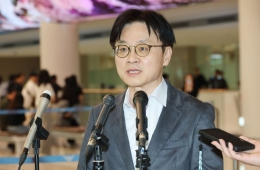
On the 4th, in Pocheon-si, Gyeonggi-do, Oh Seong-yeong, president of the National Health Club Directors Association, opened the door of his gym when the police arrived and inspected the interior of the gym. Photo by Yonhap News
View original imagePreviously, fitness center owners publicly protested the closure orders by holding so-called 'fitness center open protests,' opening their facilities despite government guidelines.
Also, on the 30th of last month, a petition titled "In the COVID era, limited and flexible operation of indoor sports facilities is necessary" was posted on the Blue House petition board, gaining over 200,000 signatures. Petitions regarding restrictions on indoor sports facilities such as fitness centers and Pilates academies continue to be submitted regularly.
Meanwhile, the government is expected to maintain this limited operation policy until the 17th. However, after the 17th, it plans to review guidelines to allow operations of prohibited facilities including indoor sports facilities such as fitness centers in the metropolitan area, karaoke rooms, and academies.
Hot Picks Today
 If You’re Worried About Market Swings: "Steady Cash Flow Even Amid Volatility" - Experts Recommend These ETFs
- No Bacteria Detected in Arisu After 24 Hours of Repeated Drinking from a Tumbler
- "We Can't Just Let Them Be Damaged Inside"... Samsung Electronics Removes 360,000 Wafers in Preparation for Strike
- Wife in $6.7 Million Debt Took Out $3 Million in Husband's Life Insurance, Poisoned Him... US Court: "She Can Never Be Released"
- "He's Handsome, It's Such a Pity?"... Lawyer Responds to Bizarre 'Appearance Evaluation' of High School Girl Murder Suspect
Son said, "We feel sorry and grateful as industries including indoor sports facilities, academies, and karaoke rooms in the metropolitan area are suffering livelihood difficulties due to prolonged closure orders," adding, "We plan to prepare related measures to allow operation while complying with quarantine rules."
© The Asia Business Daily(www.asiae.co.kr). All rights reserved.