"To Buy Baemin, Sell Yogiyo"... Fair Trade Commission Views Market Limited to Delivery Apps and Sees Coupang Eats as Less Competitive (Comprehensive)
Fair Trade Commission Grants 'Conditional Approval' for DH's Acquisition of Woowa Brothers
Baemin-Yogiyo Market Share 99%... Competition Restricted if Merger Occurs
Difficult to View Coupang Eats and Other Latecomers or New Entrants as Competitive Pressure
"Sell Yogiyo Within 6 Months... Extension of 6 Months Allowed if Unavoidable"

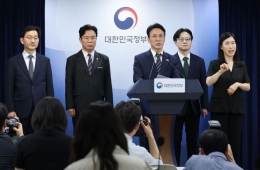
Chairman Jo Sung-wook of the Fair Trade Commission is giving a briefing on the DH-Woowa Brothers' corporate merger at the Government Complex Sejong on the 28th.
View original image[Asia Economy Reporters Joo Sang-don and Moon Chae-seok] The Korea Fair Trade Commission (KFTC) has finalized a corrective order requiring Delivery Hero (DH) to sell 'Yogiyo' if it wants to acquire Woowa Brothers (hereafter Woowa). The KFTC limited the relevant market to delivery applications excluding phone order markets, and found that the combined market share of DH and Woowa would reach 99%, thereby restricting competition in the delivery app market. The KFTC also viewed the competitiveness of latecomers such as Coupang Eats, which DH had argued, as weak. Ultimately, the KFTC judged that competition in the delivery app market would be restricted unless Yogiyo is divested.
On the 28th, the KFTC announced that it conditionally approved the merger in which DH acquires about 88% of Woowa's shares.
Chairman Cho Sung-wook of the KFTC said, "We judged that the concern over competition restriction affecting various stakeholders in the multi-sided market mediated by delivery app platforms?including restaurants, consumers, and riders?is significant. Therefore, we decided to impose a measure requiring DH to sell all of its 100% stake in DH Korea." He added, "This will maintain the competitive relationship between Baemin and Yogiyo, enhancing consumer welfare and promoting innovative competition, while allowing the merger between DH and Woowa to achieve synergy effects through cooperation between DH's technological capabilities and Woowa's marketing skills."
Previously, on December 13, 2019, DH signed a contract to acquire about 88% of Woowa's shares and filed a merger notification with the KFTC on December 30 of the same year.
During the review of this merger, the KFTC limited the relevant market to delivery apps. Chairman Cho explained, "Considering differences in function and utility, as well as substitutability from the perspectives of consumers and restaurants, we defined the market as 'delivery apps,' distinct from direct phone orders, franchise restaurant apps, and internet search services." He added, "Delivery apps are differentiated by various features such as providing information on general and franchise restaurants, user reviews and ratings, discount benefits, and convenient non-face-to-face payment."
Additionally, the KFTC noted that consumers who have used delivery apps tend to continue using them due to app lock-in effects, functional convenience, and discount benefits. Restaurants also tend to spend most of their advertising budget (85.9%) on delivery apps, reducing spending on other advertising methods such as flyers. These factors supported limiting the relevant market to delivery apps.
Based on this, the KFTC found that the DH-Woowa merger would restrict competition. The KFTC presumes competition restriction when a combined market share exceeds 50%, the merged entity is the market leader, and the gap with the second-largest competitor is at least 25% of its own share. Accordingly, the combined market share of the two companies was 99.2% based on 2019 transaction amounts, ranking first, and the gap with the second-ranked Kakao Order exceeded 25 percentage points, indicating presumed competition restriction.
The KFTC also considered that although Coupang Eats' market share has recently increased in some parts of Seoul, its nationwide market share remains below 5%. Therefore, the KFTC found insufficient evidence that Coupang Eats could exert sufficient competitive pressure nationwide against the merged entity.
Chairman Cho emphasized, "If a strong competitor engaged in discount promotion competition is removed, coupon discount promotions for consumers may decrease, or commission discount competition to attract restaurants may shrink, potentially leading to increased commissions for existing partner restaurants." He added, "We confirmed that even if commissions increase, restaurants are likely to continue using the merged entity's delivery apps given their significant sales proportion through these platforms."
Some have criticized the KFTC for interpreting the 'dynamic' nature of the delivery app market too narrowly, leading to the decision to require the full divestiture of Yogiyo shares. In response, Chairman Cho said, "Regarding whether Coupang Eats can exert nationwide competitive pressure against Baemin, we judged that there is not yet sufficient evidence." He continued, "We also considered whether new competitors would enter the market, but taking into account various contractual and other conditions, we judged that this is unlikely."
Based on this judgment, the KFTC ordered DH to sell all its shares in DH Korea to a third party within six months from the date of the corrective order. However, if unavoidable circumstances prevent the sale within this period, DH may apply for an extension of up to six months. In other words, DH must sell DH Korea within a maximum of 12 months. A KFTC official explained, "If the merged entity refuses to comply with the asset divestiture order, it can abandon the merger itself, but generally, companies tend to accept such KFTC asset divestiture orders." He added, "Otherwise, they may face substantial enforcement fines later."
The KFTC also imposed behavioral remedies to maintain the status quo until the sale is completed. This is to prevent deterioration in the quality and competitiveness of the Yogiyo delivery app service and to preserve the value of the divestiture assets. Specifically, these include: ▲ separation and independent operation of Yogiyo and other merged entity delivery apps ▲ prohibition of changes to the effective commission rates applied to restaurants ▲ mandatory use of promotion budgets at least equal to the same month of the previous year and prohibition of discrimination against consumers ▲ prohibition of changes to app connection/access speed, user interface, information items provided, and forced or incentivized switching to merged entity affiliated delivery apps ▲ prohibition of unfavorable changes to Yogiyo delivery riders' working conditions and inducement to Woowa ▲ prohibition of transfer and sharing of information assets.
Hot Picks Today
 "Now Our Salaries Are 10 Million Won a Month" Record High... Semiconductor Boom Drives Performance Bonuses at Major Electronic Component Firms
- Experts Already Watching Closely..."Target Price Set at 970,000 Won" Only Upward Momentum Remains [Weekend Money]
- "Heading for 2 Million Won": The Company the Securities Industry Says Not to Doubt [Weekend Money]
- Did Samsung and SK hynix Rise Too Much?... Foreign Assets Grow Despite Selling [Weekend Money]
- "Chanel Open Run? I Get a Free Pass"... The World of the Top 0.1% That Money Alone Can't Enter [Luxury World]
Chairman Cho said, "We judged that there is competition restriction in this merger and found no sufficient grounds for mitigation in the near future. Therefore, the KFTC must take measures to protect consumers and partner restaurants." He added, "If the purpose of the merger is not to pursue monopoly profits but to combine strengths to create new synergy, we expect DH to accept the KFTC's conditional approval."
© The Asia Business Daily(www.asiae.co.kr). All rights reserved.