Fostering Global No.1 in Semiconductors, Future Cars, and Biohealth... 110 Hydrogen Charging Stations to be Established Next Year (Comprehensive)
Hong Nam-ki Chairs the '1st Innovation Growth Big 3 Promotion Meeting'
"Up to 40% Tax Credit on Advanced Semiconductor R&D Expenses"

[Asia Economy Reporter Kwangho Lee] The government plans to establish 110 hydrogen charging stations by the first half of next year to expand the supply of eco-friendly vehicles. Additionally, it will offer up to a 40% tax credit on research and development (R&D) expenses to support investments in system semiconductors. The budget for this has been increased by 37% to 4.2 trillion won compared to this year’s 3.1 trillion won.
On the 21st, the government held the "1st Innovation Growth BIG3 Promotion Meeting" at the Government Seoul Office, chaired by Deputy Prime Minister and Minister of Strategy and Finance Hong Nam-ki, where they discussed the "Key Promotion Tasks by BIG3 Industry Sector." The BIG3 industries are system semiconductors, future cars, and biohealth.
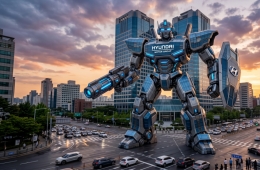
Deputy Prime Minister Hong stated, "The most urgent task to expand the supply of eco-friendly vehicles is the establishment of charging infrastructure." He added, "Up to 12 hydrogen charging stations will be additionally completed within this year, and more than 110 stations will be established by the first half of next year through administrative measures such as expanding inspection personnel and shortening procedures."
He continued, "To secure sites for charging stations, we will first identify 10 candidate locations in six cities and provinces including Gangwon and Gyeonggi from state-owned land, finalize the selection, and promptly proceed with land sale procedures." He emphasized, "Additionally, we will focus on discovering about 200 possible sites for hydrogen charging stations next year, including idle land owned by public institutions, gas stations, and LPG charging stations."
Furthermore, he added, "Along with securing sites, we will actively promote regulatory relaxation for building hydrogen charging stations in development-restricted zones, adjustment of permit authorities, introduction of special cases for charging station construction, and support for hydrogen fuel purchase costs of about 90 million won per charging station operating at a deficit."
The meeting also discussed regulatory innovation support measures for system semiconductors and biohealth.
Deputy Prime Minister Hong explained, "Regarding recent investments in semiconductor production facilities, we will promptly support infrastructure development such as water supply and wastewater treatment in consultation with local governments." He added, "Advanced semiconductor R&D investments will be added to new growth and core technologies under the Restriction of Special Taxation Act to apply preferential tax credits for R&D expenses."
The government plans to apply a preferential tax credit of 20-40% on semiconductor R&D expenses through amendments to the Enforcement Decree of the Restriction of Special Taxation Act, which is higher than the general R&D tax credit of 0-25%.
Regarding foundry expansion, the government will actively support investments through necessary procedures, considering that system semiconductor items are included in the investment guidelines of the policy-type New Deal Fund, which will be fully established from next year.
Deputy Prime Minister Hong said, "This year, we expanded the scope of gene therapy research and established guidelines for the use of health and medical data." He mentioned, "For pharmaceutical-medical device combination products, we will improve regulations by initially exempting GMP evaluation reviews for already approved medical devices in five field-discovered cases."

The government plans to first expand the BIG3 budget to 4.2 trillion won next year and focus on multifaceted policy support such as technology development and financial support including strengthened fund financing.
It will also review the core regulations of the BIG3 industries raised and discovered in the field, focusing on maximizing deregulation, including whether to maintain regulations.
Additionally, the government will accelerate the creation of a BIG3 industrial ecosystem focused on cooperation among companies, such as supporting the restructuring of about 470 internal combustion engine parts companies into future car parts companies and establishing a system semiconductor cooperation system linking fabless-foundry-demand companies.
At the same time, the government will proactively and intensively promote the establishment of basic infrastructure supporting the competitiveness of BIG3 industries, such as next-generation intelligent transportation systems (C-ITS) and K-1 million bio big data.
Hot Picks Today
 Cerebras Soars 70% on IPO Debut: Is Nvidia's Reign Ending as a New AI Semiconductor Power Emerges?
- After Surpassing 8,000 Points, Is Profit-Taking Underway?... Why Is the KOSPI Plunging?
- "Multi-Million Won Bonuses, Life Is Sweet"—Even Employee Reactions... SK hynix Overtakes Samsung to Claim No. 1 Spot
- "Gave in to the Momentary Temptation": Japanese Police Official Dismissed After Stealing 100 Million Won Next to Body
- "After Vowing to Become No. 1 Globally, Sudden Policy Brake Puts Companies’ Massive Investments at Risk"
Deputy Prime Minister Hong said, "The government aims to nurture the system semiconductor industry to establish a foundation for becoming the world’s number one in the foundry sector, future cars to become a country producing the world’s highest level of electric and hydrogen vehicles, and biohealth to develop K-Bio as one of the top five export industries. Ultimately, we will focus on fostering the BIG3 industries to secure world number one competitiveness."
© The Asia Business Daily(www.asiae.co.kr). All rights reserved.