Even if dismissed workers occupy and halt the car factory, there will be no way to stop it from next year onwards
Deleted Prohibition on Non-Worker Workplace Entry and Occupation in Labor Union Act
Possibility of External Persons Joining Unions... Inevitable Confusion Next Year

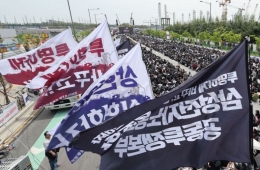
[Asia Economy Reporter Kiho Sung] #The non-regular workers' union of Korea GM lifted its occupation protest at the local office of Assemblyman Hong Young-pyo of the Democratic Party of Korea, which began on the 3rd, on the 10th. Coincidentally, this was the day after the amendment to the Labor Union Act was passed at the National Assembly plenary session. Assemblyman Hong was involved in negotiations among the Korea Development Bank, GM, and the labor union as the chairman of the Democratic Party's Korea GM Special Countermeasures Committee during the withdrawal of Korea GM's Gunsan plant in 2018. At that time, Assemblyman Hong's local office was also occupied by the union opposing the corporate split. The union, which inspected Assemblyman Hong's office, left a meaningful message saying "We will fight to the end" as they lifted the occupation protest.
The non-regular union members who participated in this occupation protest will be able to act as Korea GM union members starting next year. This is because the amended Labor Union Act allows even dismissed workers to join unions and engage in union activities. This is also why they expressed their determination to continue the struggle as they ended the occupation protest at the assemblyman's office. The passage of the Labor Union Act has thrown the automotive industry, which has yet to conclude wage and collective bargaining negotiations this year, into panic. An industry insider lamented, "Isn't there no law that forbids those who occupied the local office of a member of the National Assembly from occupying the workplace?"
◆ Korea GM Faces the Worst Situation
Korea GM, which suffered a loss of 25,000 vehicles due to a 15-day partial strike during this year's wage and collective agreement negotiations, has fallen deeper into trouble with the passage of the Labor Union Act. According to the automotive industry, the number of illegal dispatched workers at Korea GM's Bupyeong and Gunsan plants, whom the Ministry of Employment and Labor ordered to be directly employed, reaches 945. The non-regular workers filed lawsuits demanding direct employment against Korea GM and won both the first and second trials. Since they can join the union within the company, occupy the workplace as union members, and fight for reinstatement, there is practically no way to stop them. Initially, the government's draft of the Labor Union Act amendment reflected the economic sector's position by prohibiting the entry of non-workers into workplaces and including provisions banning the full or partial occupation of workplaces, but the Democratic Party deleted all these during the bill review process.
This issue is not limited to Korea GM. According to the Korea Automobile Manufacturers Association on the 11th, the loss from domestic automobile strikes from 2008 to 2018 amounted to 7.6 trillion won. This is equivalent to the investment amount for producing 500,000 hydrogen vehicles by Hyundai Motor and its partners by 2030. The situation this year is worse. Due to the COVID-19 pandemic and severe labor-management conflicts overlapping, domestic automobile production is at risk of falling below 3.5 million units for the first time in 16 years. Amid an already high-cost, low-efficiency production structure that lags behind the global automotive industry, if union risks are added next year, there is a widespread sense of crisis that the decline of the domestic automobile industry will be uncontrollable.
◆ External Personnel Joining Unions? ... The Butterfly Effect Caused by Deleting 'Dismissal'
The sense of crisis among finished car manufacturers is greater than ever. The Renault Samsung Motors union is expected to accelerate its affiliation with the Korean Confederation of Trade Unions (KCTU) due to the passage of this bill. This is because the possibility of KCTU activists joining unions has opened.
During the bill review process, the Democratic Party deleted the proviso clause in Article 2, Paragraph 4, Subparagraph (d) of the Labor Union Act, which stated, "If a dismissed person files an unfair labor practice relief application with the Labor Relations Commission, they shall not be interpreted as a non-worker until the Central Labor Relations Commission issues a retrial decision," to allow dismissed and unemployed persons to join unions. The problem arises from deleting the word "dismissal." Previously, the term "dismissal" limited union membership to those affiliated with or formerly affiliated with the workplace, but with this word removed, there is room for interpretation that even those not affiliated with the workplace can join unions. Because of this, there is no proper way to prevent senior organization personnel such as those from KCTU from joining unions and conducting upper-level organization activities within workplaces.
After the "Ssangyong Incident" in 2009, Ssangyong Motor's first union withdrew from KCTU. However, there are concerns that with the passage of the Labor Union Act, highly active and organized KCTU personnel may join the company's union and expand their activities.
Hot Picks Today
 "Now Our Salaries Are 10 Million Won a Month" Record High... Semiconductor Boom Drives Performance Bonuses at Major Electronic Component Firms
- Experts Already Watching Closely..."Target Price Set at 970,000 Won" Only Upward Momentum Remains [Weekend Money]
- "Heading for 2 Million Won": The Company the Securities Industry Says Not to Doubt [Weekend Money]
- 'Still Hesitant? If You're Wondering Whether KOSPI Will Rise, This Is the Number You Must Watch [Weekend Money]'
- Is It Really Like an Illness? "I Can't Wait to Go Again"—Over 1 Million Visited in Q1, Now 'Busanbyeong' Takes Hold [K-Holic]
Lee Jun-hee, head of the Labor Relations Legislation Team at the Korea Employers Federation, pointed out, "One of the problems with this bill is that it created too much room for interpretation," adding, "Because of this, situations seeking court rulings will increase, and confusion is inevitable until precedents accumulate."
© The Asia Business Daily(www.asiae.co.kr). All rights reserved.