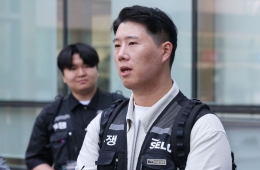
'Post-US Election International Relations' Choi Jong-geon, Vice Minister: "Pursuing Goals of Korean Peninsula Peace, Denuclearization, and Prosperity"
Ambassador Lee Soo-hyuk to the US, Ambassador Jang Ha-sung to China, and Other Key Ambassadors Attend Virtually... 100 National Representatives Question
'Public Diplomacy for Participation and Communication in the COVID-19 Era' 2020 Overseas Diplomatic Mission Chiefs Meeting

[Asia Economy Reporter Lim Cheol-young] The Ministry of Foreign Affairs held a session titled 'Public Diplomacy for Participation and Communication in the COVID-19 Era' on the 2nd, coinciding with this year's Overseas Missions Chiefs Meeting, to prepare for the post-COVID-19 era and strengthen communication with the public on major diplomatic issues.
This meeting was conducted online with about 100 public representatives selected and invited through an SNS contest on the highly public-interest topic of 'Prospects for International Relations after the U.S. Presidential Election,' along with academic experts and heads of overseas missions.
First Vice Foreign Minister Choi Jong-geun expressed gratitude to the public representatives who showed interest in our foreign policy and attended the meeting in his opening remarks, emphasizing that even after the official inauguration of the new U.S. administration, our government will steadfastly pursue the shared goals of establishing a peace regime on the Korean Peninsula, complete denuclearization, and prosperity.
In particular, Vice Minister Choi evaluated that the Republic of Korea and the United States have cooperated in various fields, including health security, based on deep trust and a strong alliance, and announced plans to further develop the ROK-U.S. alliance into a more future-oriented and mutually beneficial partnership. He also stated that cooperation issues will diversify into global challenges such as climate change, strengthening coordination with the international community, including the United States.
Heads of overseas missions from major countries including the U.S., China, Japan, Russia, ASEAN, Brazil, France, and Egypt, who attended the meeting, presented vivid opinions on the prospects for international relations after the U.S. presidential election from the frontline of diplomatic fields.
Ambassador Lee Soo-hyuk to the United States said, "I expect the Biden administration to focus on urgent domestic issues such as COVID-19 response and economic recovery before establishing specific foreign policies," and forecasted that the U.S. will restore its global leadership and strengthen cooperation with allies and friendly countries in response to various global challenges.
Ambassador Jang Ha-sung to China predicted that U.S.-China conflicts will continue for some time after the inauguration of the new U.S. administration, but explained, "Given the closely integrated global economic and trade structure and the transboundary issues such as COVID-19 that the world must jointly address, there is a possibility of enhanced dialogue between the U.S. and China in areas such as quarantine, economy, and climate change."
Ambassador Nam Kwan-pyo to Japan anticipated that the U.S.-Japan alliance will be further strengthened under the Biden administration's emphasis on alliances, and predicted that the U.S. and Japan will strengthen their response centered on ROK-U.S.-Japan cooperation regarding North Korea. Following this, Ambassador Lee Seok-bae to Russia analyzed that considering Biden's tough remarks on Russia, his tendency to emphasize values and alliances, and bipartisan anti-Russian sentiment in the U.S. Congress, the possibility of improvement in U.S.-Russia relations is low for the time being. However, he explained that positive changes are expected in bilateral and multilateral arms control areas, such as the extension of the New Strategic Arms Reduction Treaty (New START), pursuit of new arms control agreements, and the U.S. return to the Iran nuclear deal (JCPOA).
Additionally, Ambassador Lim Sung-nam to the ASEAN Mission forecasted that "amid the expanding influence of China within ASEAN, the Biden administration will show increased interest in the ASEAN region compared to before," and mentioned the need to develop cooperative projects linking our New Southern Policy Plus, the Indo-Pacific strategy, and the Belt and Road Initiative.
Ambassador Kim Chan-woo to Brazil explained the growing competition between the U.S. and China for influence in the Latin American region and expected that President-elect Biden, who has a deep understanding and interest in Latin America, will recognize Latin American countries as cooperative partners and adopt a reasonable Latin America strategy. Ambassador Yoo Dae-jong to France anticipated a significant improvement in Europe-U.S. relations, considering Biden's emphasis on alliances, multilateralism, and promoting solidarity among democratic countries, but also forecasted that "it will be difficult to rebuild a close Atlantic alliance as in the past, and efforts to pursue strategic autonomy within Europe will deepen."
Ambassador Hong Jin-wook to Egypt viewed that the U.S. strategic objectives in the Middle East will largely continue regardless of the change in U.S. administration, and especially expects the Biden administration to basically inherit the Obama administration's Middle East policy, including counterterrorism, seeking dialogue related to the Iran nuclear deal, and raising human rights and democracy issues.
During the Q&A session with public representatives, an opportunity was provided for heads of overseas missions to directly answer questions submitted in advance and asked live on-site by the public representatives.
Regarding questions about the direction of our foreign policy amid COVID-19 and U.S.-China conflicts, Ambassador Lee Soo-hyuk to the U.S. responded, "These situations pose challenges to our diplomacy, but considering the Biden administration's emphasis on alliances, the inauguration of the new U.S. government will have a positive impact on ROK-U.S. relations," and added, "Since the Biden administration's China policy has not yet been concretized, it is necessary to monitor future developments and establish our diplomatic direction accordingly."
In response to a question about whether our New Southern Policy will remain effective after the inauguration of the new U.S. administration, Ambassador Lim Sung-nam to the ASEAN Mission said, "Given that Tony Blinken, the nominee for U.S. Secretary of State, has emphasized the need to strengthen Mekong-centered cooperation and that the Biden cabinet shows great interest in cooperation with the ASEAN region, there will be a positive impact on our government's New Southern Policy Plus."
Hot Picks Today
!["Heading for 2 Million Won": The Company the Securities Industry Says Not to Doubt [Weekend Money]](https://cwcontent.asiae.co.kr/asiaresize/93/2025061015355092669_1749537351.jpg) "Heading for 2 Million Won": The Company the Securities Industry Says Not to Doubt [Weekend Money]
"Heading for 2 Million Won": The Company the Securities Industry Says Not to Doubt [Weekend Money]
- "Anyone Who Visited the Room Salon, Come Forward"… Gangnam Police Station Launches Full Staff Investigation After New Scandal
- "If You Use This Name for Your Grandchild, We'll Give You a 1 Billion Won Apartment"...A Couple Faces Conflict
- "Drink Three Cups of Coffee and Stay Up All Night Before the Test"... Manual of Insurance Planner Who Collected 1 Billion Won in Payouts
- Did Samsung and SK hynix Rise Too Much?... Foreign Assets Grow Despite Selling [Weekend Money]
Regarding the outlook for ROK-Japan relations after the inauguration of the new U.S. administration, Ambassador Nam Kwan-pyo to Japan replied, "Despite various difficulties, cooperation between Korea and Japan has continued," and added, "Since ROK-U.S.-Japan cooperation is expected to be emphasized after the Biden administration's inauguration, it is necessary to create conditions for the smooth resolution of historical issues between Korea and Japan."
© The Asia Business Daily(www.asiae.co.kr). All rights reserved.