Bank of Korea "This Year Per Capita National Income $31,000"…Second Consecutive Year of Decline (Comprehensive)
Q3 Economic Growth Rate Revised Upward from 1.9% to 2.1%

[Asia Economy Reporter Kim Eunbyeol] The economic growth rate for the third quarter of this year recorded 2.1%. This marks the first rebound since the COVID-19 pandemic and is the highest quarterly figure in 11 years. Corporate performance exceeded expectations thanks to the recovery in exports, and facility investment also improved, rising 0.2 percentage points from the preliminary figure (1.9%) two months ago to surpass 2%. However, the per capita Gross National Income (GNI) is expected to decline for the second consecutive year. Thanks to the strong won value, the per capita GNI will remain in the $30,000 range, but considering recent real economy conditions such as employment, it seems difficult for the public to feel a significant improvement in the economy. Per capita GNI is an indicator of the living standards of the people, calculated by dividing nominal GNI by the estimated population. The 'per capita GNI of $30,000' is generally recognized as the benchmark for entering advanced country status.
According to the '2020 Third Quarter National Income (Provisional)' released by the Bank of Korea on the 1st, the real Gross Domestic Product (GDP) growth rate for the third quarter was 2.1%. This is the highest since the third quarter of 2009 (3.0%) and a significant rebound from the previous quarter (-3.2%). The year-on-year growth rate was also revised upward from -1.3% to -1.1%. Unlike the preliminary figure announced based on surveys from July to August, this provisional growth rate includes data up to September. The nominal growth rate, reflecting price conditions, was 2.8% in the third quarter, the highest in about three years. Nominal GNI increased by 2.5% compared to the previous quarter.
Considering the negative growth in the first and second quarters, the annual GNI for this year is inevitably expected to decrease for the second consecutive year. The Bank of Korea expects the per capita GNI this year to be around $31,000, maintaining the $30,000 range but lower than last year's $32,115. Therefore, the per capita GNI, which entered the $30,000 range in 2017 and rose to $33,564 in 2018, will decline for two consecutive years. The only other time per capita GNI decreased for two consecutive years was during the global financial crisis in 2008 (-11.2%) and 2009 (-10.4%).
Park Seongbin, head of the National Accounts Division at the Bank of Korea's Economic Statistics Bureau, stated, "The nominal GNI growth rate for the first to third quarters this year is around 0.0%, and if the annual average won-dollar exchange rate does not exceed 1,205.9 won, the per capita GNI will exceed $31,000." Considering the recent dollar weakness and the exchange rate closing at 1,106.5 won the previous day, it means the per capita GNI in the $30,000 range will be comfortably maintained. Park added, "Last year, the decline in per capita GNI was due to sluggishness in key sectors like semiconductors and the rising won-dollar exchange rate, whereas this year it is due to the COVID-19 shock, so the nature is somewhat different. Next year, with the recovery in exports, increased facility investment, and the commercialization of COVID-19 vaccines leading to global economic recovery, we hope the per capita GNI will rebound."

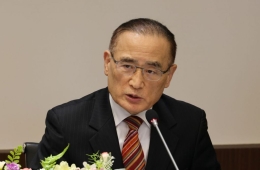
Park Sung-bin, Director of the National Accounts Department at the Bank of Korea, is presenting at the 2020 3rd Quarter National Income (Preliminary) Briefing held on the morning of the 1st at the Bank of Korea Sogong Annex in Jung-gu, Seoul.
View original imageExperts analyzed that under the current economic downturn, it is difficult for the public to feel the 'per capita GNI of $30,000.' Professor Ahn Donghyun of Seoul National University's Department of Economics said, "Defending the $30,000 mark is not very meaningful, and since it is determined by the exchange rate, the gap between $28,000 and $30,000 is not large. If per capita GNI decreases consecutively for last year and this year, it could be seen as a trend decline, so we need to watch carefully."
A positive aspect is that the GDP deflator, which is nominal GDP divided by real GDP, has recorded positive figures for two consecutive quarters. The GDP deflator for the third quarter rose 2.0% year-on-year, increasing from the second quarter's (1.2%) positive turnaround after six quarters. Unlike the Consumer Price Index, which only measures prices closely related to consumers, the GDP deflator reflects a comprehensive price level including the Producer Price Index, import/export price indices, exchange rates, and wages. Park explained, "The domestic deflator also rose by 1.1%, but this was influenced by the import deflator (-9.3%) falling more sharply than the export deflator (-5.2%). The drop in raw material prices improved trade conditions and reduced production costs, positively affecting corporate profitability."
Hot Picks Today
 "Now Our Salaries Are 10 Million Won a Month" Record High... Semiconductor Boom Drives Performance Bonuses at Major Electronic Component Firms
- Living the Homebody Dream? "I Was Shocked by My Spending" How to Cut Costs to 5,000 Won for Essentials [The Principles of Benefits]
- Is It Really Like an Illness? "I Can't Wait to Go Again"—Over 1 Million Visited in Q1, Now 'Busanbyeong' Takes Hold [K-Holic]
- "Heading for 2 Million Won": The Company the Securities Industry Says Not to Doubt [Weekend Money]
- Experts Already Watching Closely..."Target Price Set at 970,000 Won" Only Upward Momentum Remains [Weekend Money]
Meanwhile, the savings rate in the third quarter rose to 35.7% from 34.5% in the previous quarter. This was due to the gross national disposable income increasing by 2.3%, outpacing the final consumption expenditure increase of 0.4%. The total investment rate fell 1.8 percentage points from the previous quarter to 30.8%, affected by sluggish construction investment. Breaking down the third quarter GDP by expenditure items, private consumption was revised upward by 0.1 percentage points from the preliminary figure to 0.0%, as services (such as food and accommodation) decreased but non-durables (such as foodstuffs) increased. Facility investment rose 8.1%, 1.4 percentage points higher than the preliminary figure, thanks to increased purchases of semiconductor machinery and transportation equipment. Construction investment decreased by 7.3%, mainly in civil engineering, but was revised upward by 0.5 percentage points from the preliminary figure. Exports (16.0%) also rose 0.4 percentage points from the preliminary figure, marking the highest level since the first quarter of 1986 (18.4%).
© The Asia Business Daily(www.asiae.co.kr). All rights reserved.