Lee Heon, Head of the Corruption Investigation Office Recommendation Committee, Says "Declaring the End of the Committee's Activities for Legal Amendment Is Subject to Criticism"

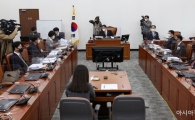
Attorney Lee Heon, a candidate recommendation committee member for the opposition party's Chief Public Prosecutor candidate, is attending the 3rd meeting of the Chief Public Prosecutor Candidate Recommendation Committee held at the National Assembly on the 18th. Photo by Yoon Dong-ju
View original image[Asia Economy Reporter Choi Seok-jin] Lee Heon, a lawyer and opposition party member of the Public Officials Corruption Investigation Office Chief Candidate Recommendation Committee (Recommendation Committee), criticized the committee’s declaration of the end of its activities without deciding on the final two candidates at the third meeting held on the 18th, calling it “a reprehensible act aimed at amending the law to nullify the opposition party’s veto power.”
In a statement sent to reporters late that afternoon, Lawyer Lee said, “At today’s third meeting of the Recommendation Committee, the opposition party’s recommendation members expressed the need for additional verification of the political independence of the candidates under review,” and “Since no candidate for the head of the Public Officials Corruption Investigation Office received approval from six or more members after three rounds of voting, I proposed to resume the committee meeting and discuss recommending candidates through re-nomination, review, and voting.”
He pointed out, “However, other recommendation members rejected the opposition’s proposal to resume the meeting on the grounds that ‘the structure of six out of seven votes under the Public Officials Corruption Investigation Office Act cannot achieve the committee’s purpose,’ as the proposal failed to reach one-third of the recommendation members, and declared the effective end of the committee’s activities.”
Lawyer Lee emphasized, “Opposition party recommendation members nominated more candidates for review than the ruling party members, proposed resuming the meeting, and exercised their voting rights as stipulated by the Public Officials Corruption Investigation Office Act from the standpoint of maintaining political neutrality and independence in their duties, hoping to recommend a candidate who can hold even the living power accountable.”
He added, “It is absurd to claim that they abused their voting rights or caused the effective end of the committee’s activities.”
Lawyer Lee argued that the two ruling party recommendation members, excluding the opposition members, along with the ex officio members?Minister of Justice Choo Mi-ae, Chief of the Judicial Administration Office Cho Jae-yeon, and Lee Chan-hee, President of the Korean Bar Association?rejected the opposition’s proposal to resume the meeting and declared the dissolution of the Recommendation Committee, intending to eliminate the opposition’s veto power through the law amendment desired by the government and ruling party.
He stated, “The ruling party, which forcibly passed the Public Officials Corruption Investigation Office Act through the fast track, declared the effective end of the Recommendation Committee to legislate to nullify the opposition’s veto power, which is a matter to be condemned by the public who either fear or expect the Public Officials Corruption Investigation Office,” and “Opposition party recommendation members express regret over the current situation and hope for the resumption of the committee.”
During the meeting, three rounds of voting were held, but no candidate received the approval of six or more recommendation members.
Following the first named vote, the second anonymous vote also failed to produce a candidate with six votes, leading to a third vote among the four candidates who received the most votes.
In these three rounds of voting, it was reported that two judge-origin candidates?lawyer Jeon Hyun-jung, recommended by Minister Choo Mi-ae, and Kim Jin-wook, senior researcher at the Constitutional Court, recommended by President Lee Chan-hee?each received five votes from recommendation members, while two former chief prosecutors?Lee Geon-ri, head of the Anti-Corruption Division of the Anti-Corruption and Civil Rights Commission, and Han Myung-kwan, lawyer at the Barun Law Firm, both recommended by President Lee?each received four votes.
© The Asia Business Daily(www.asiae.co.kr). All rights reserved.







