[2020 National Audit] 'Nuclear Phase-Out Criticism' Ahead of Wolseong Audit Announcement... KHNP Performance Under Scrutiny (Comprehensive)
NSSC & KHNP National Audit
Opposition: "KHNP Operating Profit Down 80%"
Ruling Party Focuses on Nuclear Plant Typhoon Safety
Government: "Nuclear Plant Decommissioning R&D from Next Year"

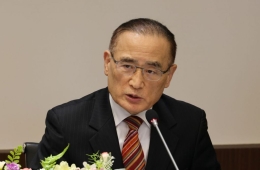
Jaehoon Jung, President of Korea Hydro & Nuclear Power, attended the National Assembly's Science, Technology, Information and Broadcasting and Communications Committee hearing on the 12th regarding the Nuclear Safety and Security Commission, wearing his mask properly. Photo by Dongju Yoon doso7@
View original image[Asia Economy Reporter Moon Chaeseok] As the Board of Audit and Inspection's audit report on Korea Hydro & Nuclear Power's early shutdown decision of Wolseong Unit 1 awaits only final approval, fierce debates over the government's nuclear phase-out policy unfolded during the National Assembly's audit.
Opposition Party Launches Fierce Attack on KHNP's Financial Deterioration and 'Wolseong Audit'
On the 12th, opposition lawmakers raised issues regarding government policy based on KHNP's worsening financial performance. According to the opposition, KHNP's net profit plummeted from approximately 2.47 trillion won in 2016 to 240 billion won last year.
Heo Eun-ha, a member of the People Power Party, diagnosed, "The radical nuclear phase-out policy has worsened KHNP's finances," adding, "The public opinion is largely negative about the nuclear phase-out due to rising electricity rates and concerns over the ultimate deterioration of national competitiveness."
In response, KHNP President Jeong Jae-hoon explained, "Corrosion was found on the internal steel plates (CLP) of the nuclear plant in 2016, and in 2017, voids appeared. Under the cooperation of the Nuclear Safety and Security Commission, the plant was shut down and investigated, which led to a decrease in net profit."
Hwang Bo-seung-hee, a People Power Party lawmaker, argued that maintaining nuclear power through social consensus should be considered.
Hwang said, "Since KHNP is a market-type public enterprise, if it has global competitiveness, it should maintain its principles even if the administration changes," adding, "Government policy is important, but we need to consider which direction is economically viable for the country and its people."
President Jeong expressed the view that "coexistence of nuclear power and renewable energy is absolutely necessary."

Criticism from the opposition regarding the 'early shutdown of Wolseong Unit 1' also continued.
Previously, KHNP's board decided to shut down Wolseong Unit 1 early due to insufficient economic feasibility. Opposition lawmakers demanded an audit by the Board of Audit and Inspection, claiming KHNP's economic evaluation was distorted, and the results are pending announcement.
Hwang said, "Although 700 billion won was invested to extend Wolseong Unit 1's operation, it was decided to shut it down early in June 2019 due to lack of economic feasibility," pointing out, "Leaving safety issues aside, the decision was reversed depending on the administration."
He continued, "KHNP decided that Wolseong Unit 1 was not economically feasible because power generation decreased and the sales price dropped. Logically, if the generation rate decreases, shouldn't the cost increase?" and asked, "Is this a political decision or not? Please answer yes or no."
President Jeong answered, "No."
When Hwang asked how many times he had visited the Blue House in 2018, President Jeong replied, "Only once for the inauguration greeting and never again." Hwang asked again, "Have you ever talked about Wolseong Unit 1's economic feasibility?" to which Jeong responded, "Not at all."
Ruling Party Questions Safety Management over Typhoon Shutdown and Voids
![[Image source=Yonhap News]](http://www.asiae.co.kr/news/img_view.htm?img=2020090406594861997_1599170388.jpg)
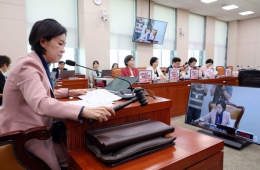
The ruling party focused on nuclear power plant safety management issues.
Jeon Hye-sook, a member of the Democratic Party of Korea, criticized that although Gori Units 3 and 4 and Shin-Kori Units 1 and 2 were shut down due to a typhoon, 50 follow-up measures prepared immediately after the 2011 Fukushima accident have not been properly implemented.
Um Jae-sik, chairman of the Nuclear Safety and Security Commission, responded, "The 50 measures involve reinforcing nuclear power plant facilities to prepare for national disasters and cannot be left unattended. We are continuously monitoring the progress and status of implementation."
President Jeong added, "This time, the 'instrument transformers' caused problems all four times, so we decided to invest 30 billion won to either bury all related equipment underground or apply gas insulation methods to prevent external influences."
According to data received by Lee Jang-seop, a Democratic Party lawmaker, a total of 332 voids were found in the containment buildings of 24 domestic nuclear reactors, an increase of 37 from last year.
This means holes were found in the walls that prevent radioactive materials from leaking out in case of an accident. Of these voids, 80% were concentrated in Hanbit Units 3 and 4.
Lee Yong-bin, also from the same party, raised suspicions of poor construction at Hanbit Units 3 and 4 and argued that the construction company, Hyundai Engineering & Construction, should bear the related costs.
Previously, KHNP sent a total of four related official letters to Hyundai Engineering & Construction from October 2018 to September this year and discussed sharing responsibility for the defects. In the most recent letter, KHNP proposed issuing a public apology regarding the defects at Hanbit Units 3 and 4.
President Jeong replied, "Although it is Hyundai Engineering & Construction's responsibility, the statute of limitations has passed, making legal compensation difficult. We sent a letter suggesting that Hyundai Engineering & Construction should at least take moral responsibility for Hanbit Units 3 and 4."
Government: "Nuclear Power Plant Decommissioning R&D to Proceed from Next Year"
![[Image source=Yonhap News]](http://www.asiae.co.kr/news/img_view.htm?img=2020091207471176764_1599864432.jpg)
The government announced it will proceed with nuclear power plant decommissioning research and development (R&D) as planned.
Chairman Um said regarding nuclear decommissioning R&D, "Currently, one related R&D project is underway," adding, "Together with relevant ministries, we plan to conduct decommissioning-related R&D through nuclear verification technology starting next year."
During the Nuclear Safety and Security Commission's audit by the National Assembly's Science, Technology, Information and Broadcasting Committee, Chairman Um responded to lawmaker Heo's criticism that "the NSSC has not conducted any nuclear decommissioning research" by acknowledging, "We admit there were shortcomings in terms of research and development."
He added, "However, it is important how to properly establish related regulatory systems and how to proceed when actual decommissioning is implemented."
When Democratic Party lawmaker Jeong Pil-mo pointed out, "The NSSC should manage the spent nuclear fuel as it has not even secured a research storage facility site," Um replied, "Management policies need to be established for the NSSC to operate permits and related systems."
He said, "The Ministry of Trade, Industry and Energy, the Ministry of Science and ICT, and the NSSC are conducting spent nuclear fuel R&D," and agreed that "long-term measures are necessary."
Regarding Jeong's remark that measures for site selection must be prepared before submitting the final decommissioning plan for Gori Unit 1, Um said, "It is impossible to approve the decommissioning plan review when the most significant parts are not yet finalized."
Hot Picks Today
 "Now Our Salaries Are 10 Million Won a Month" Record High... Semiconductor Boom Drives Performance Bonuses at Major Electronic Component Firms
- Living the Homebody Dream? "I Was Shocked by My Spending" How to Cut Costs to 5,000 Won for Essentials [The Principles of Benefits]
- Is It Really Like an Illness? "I Can't Wait to Go Again"—Over 1 Million Visited in Q1, Now 'Busanbyeong' Takes Hold [K-Holic]
- "Heading for 2 Million Won": The Company the Securities Industry Says Not to Doubt [Weekend Money]
- Experts Already Watching Closely..."Target Price Set at 970,000 Won" Only Upward Momentum Remains [Weekend Money]
Gori Unit 1, permanently shut down in June 2017, is the first nuclear power plant in Korea to undergo decommissioning. Currently, only a draft decommissioning plan exists. KHNP will submit the final plan to the government after collecting residents' opinions.
© The Asia Business Daily(www.asiae.co.kr). All rights reserved.