US Forces Korea, Unused Defense Cost-Sharing Funds Amount to Approximately 70 Billion Won
Unused funds totaled 67.88 billion KRW from 2014 to 2019
Most were for military facility improvements with unclear purposes

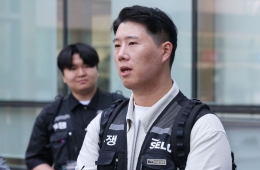
Representatives of the People's Joint Action, consisting of the Korean Confederation of Trade Unions, the Korean Progressive Alliance, and the Minjung Party, held a "1 Night 2 Days National Protest Action Group Declaration Press Conference in Response to the 5th Defense Cost-Sharing Negotiation" on the 16th in front of the U.S. Embassy at Gwanghwamun Square, Seoul. Photo by Kim Hyun-min kimhyun81@
View original image[Asia Economy Yang Nak-gyu, Military Specialist Reporter] It has been revealed that the so-called 'unused funds,' which are part of the defense cost-sharing funds paid by the South Korean government to the US Forces Korea but remain unspent, amount to approximately 70 billion KRW.
According to data submitted by the Ministry of National Defense to Jeon Hae-cheol, a member of the National Assembly's Foreign Affairs and Unification Committee from the Democratic Party of Korea, the unused funds generated during the 9th (2014?2018) and 10th (2019) defense cost-sharing agreements totaled 67.88 billion KRW. In 2017, about 14.5 billion KRW remained unused, approximately 20.4 billion KRW in 2018, and around 7.9 billion KRW was also unspent in 2019.
The defense cost-sharing funds allocated annually have been executed across three categories in line with the purpose of 'US troop stationing expenses': personnel costs, military construction costs, and logistics support costs, with approximate ratios of 40%, 40%, and 20%, respectively. While personnel costs are generally almost fully utilized, it has been analyzed that a significant portion of the budget allocated for military facility improvement is not spent each year. Last year, about 5.9 billion KRW of the unused funds were in the military facility improvement category, accounting for roughly 75% of the total.
In political circles, criticism has arisen that the US Forces Korea has not properly disclosed how it stores and reallocates the unused funds, labeling it a 'black box budget.' Representative Jeon stated, "The continuous occurrence of unused funds every year may indicate a structural problem in the cost-sharing agreement," and added, "Efforts are needed to prevent the generation of unused funds." Accordingly, there are calls within and outside the military to fully consider this reality when negotiating the next agreement.
Hot Picks Today
!["Heading for 2 Million Won": The Company the Securities Industry Says Not to Doubt [Weekend Money]](https://cwcontent.asiae.co.kr/asiaresize/93/2025061015355092669_1749537351.jpg) "Heading for 2 Million Won": The Company the Securities Industry Says Not to Doubt [Weekend Money]
"Heading for 2 Million Won": The Company the Securities Industry Says Not to Doubt [Weekend Money]
- "Anyone Who Visited the Room Salon, Come Forward"… Gangnam Police Station Launches Full Staff Investigation After New Scandal
- Audit Launched on Rebar Omission at GTX-A Samsung Station... Seoul City Says "Hyundai E&C Voluntarily Reported It"
- "Can't Even Turn On a Fan? How Will They Endure the Heat?"... Massive Blackout Hits the Philippines Amid Scorching Heat
- Did Samsung and SK hynix Rise Too Much?... Foreign Assets Grow Despite Selling [Weekend Money]
The US-South Korea defense cost-sharing negotiations reached a tentative agreement at the end of March to increase the current amount by 13%, which was escalated to the ministerial level and then to the White House, but negotiations have stalled since then after former US President Donald Trump rejected the proposal. While President Trump insisted on a 50% increase, it is known that the US proposed a compromise plan through Steven Biegun, Deputy Secretary of State, who visited Korea in July, to raise the existing cost-sharing amount of 1.0389 trillion KRW by 13% annually over three years. This proposal, which would have resulted in a total increase close to 50%, was ultimately rejected by the South Korean side, leading to a breakdown in talks. At the time, diplomatic circles assessed that President Trump was eager to conclude the defense cost-sharing negotiations before the presidential election to leverage it as a diplomatic achievement.
© The Asia Business Daily(www.asiae.co.kr). All rights reserved.