Second Day of Doctors' Strike, No Behind-the-Scenes Negotiations with Residents... Standoff Intensifies

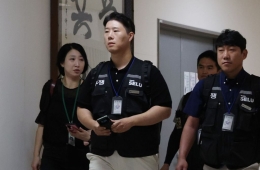
Residents opposing the government's expansion of medical school quotas are holding a 24-hour silent picket protest on the 23rd at Seoul St. Mary's Hospital, Catholic Central Medical Center in Seoul. Photo by Dongju Yoon doso7@
View original image[Asia Economy Reporter Kim Heung-soon] The medical community has entered the second day of a collective strike, opposing the government's four major medical policies: expansion of medical school quotas, establishment of public medical schools, pilot project for insurance coverage of Korean herbal medicine prescriptions, and promotion of telemedicine. Although opposition from residents and interns, who are the main force among young doctors, is intensifying, it is understood that there have been no behind-the-scenes talks since the government took a tough stance by issuing work commencement orders. The Korean Intern Resident Association (KIRA), which represents about 16,000 residents, has defined the government's moves as "pressure" and announced a tougher response by refusing to comply with the work commencement orders and maintaining collective action.
Seo Jae-hyun, spokesperson for KIRA, said on the 27th, "There was no negotiation with the government yesterday (26th), and there is no scheduled meeting today either," adding, "Pressure has begun mainly at hospitals where work commencement orders have been issued." He emphasized, "Our voices are not being reflected, and there is no channel to present our opinions. The dissatisfaction that had been accumulating continuously exploded during the excessive policy implementation process and came out of the hospitals. We are not afraid or worried about the government's pressure."
"Cut off from the outside, accepting disadvantages"
The residents have prepared detailed guidelines for collective action through an emergency response committee and decided not to comply with the government's work commencement orders. KIRA stated, "Whether the receipt of the work commencement order has been confirmed or just notified, we will not comply," and added, "The administrative orders and disadvantages resulting from this will be borne and responded to collectively by all 16,000 residents." They warned, "If even one resident suffers damage, Korean healthcare will lose all 16,000 residents."
The KIRA emergency response committee declared, "We will maintain picketing and collective action," and "To maintain united strength without being shaken by external factors, residents will be on 'blackout' in all daily activities." This means they will not answer any calls from unknown numbers or even telephone calls within their affiliated hospitals. In fact, the residents agreed to follow hospital guidelines only until 10 p.m. the previous day and to act according to KIRA's joint guidelines thereafter.
On this day, a "5th Young Doctors' Collective Action" was held, where resignation letters were submitted voluntarily by those who wished, and COVID-19 medical services, which had been staffed by residents, were converted to volunteer-based operations. Spokesperson Seo said, "Submitting resignation letters is an expression of personal will and is being done voluntarily," adding, "Almost all have submitted resignation letters after the work commencement orders." The residents also decided to refuse specialist qualification exams and intern exams. They agreed to accept additional training due to incomplete mandatory intern courses and insufficient resident training days.
"Withdraw or reach agreement on the four major medical policies"
Regarding the government's plans to expand medical school quotas and establish public medical schools, they demanded, "The ongoing policy implementation must be stopped or withdrawn," and "When reconsidered, discussions should start from scratch or the beginning, including consultations with the Korean Intern Resident Association, the Korean Medical Association, and the medical community."
On the pilot project for insurance coverage of Korean herbal medicine prescriptions and medical unification, they stated, "Parts related to Korean medicine must undergo thorough evaluation and analysis through scientific verification before the pilot project for insurance coverage is implemented," and "Medical unification must never be discussed until the medical community reaches an agreement, considering possible side effects."
Regarding telemedicine, although non-face-to-face treatment was exceptionally implemented during the COVID-19 pandemic, they hold the position that post-pandemic promotion requires consultation with the medical community, considering side effects and impacts on the medical field. Additionally, they argue that proposals made by KIRA regarding improvement of resident training environments, avoidance of certain specialties, and regional imbalance in medical policies should be reviewed, and a committee related to health and medical development plans should be established to discuss and proceed with all medical community members.
Hot Picks Today
 "Samsung and Hynix Were Once for the Underachievers"... Hyundai Motor Employee's Lament
- Samsung Enterprise Labor Union: "We Respect Court’s Injunction Decision... General Strike to Proceed on the 21st as Planned"
- "Was This Delicious Treat Enjoyed Only by Koreans?"... The K-Dessert Captivating Japan
- [Exclusive] With Budget Safeguard Gone, Digital Learning Center May Be Reduced or Disappear in Financially Weaker Local Governments
- "That? It's Already Stashed" Nightlife Scene Crosses the Line [ChwiYak Nation] ③
Spokesperson Seo said, "Even though all medical practices have been insured and covered, departments responsible for essential medical care receive less government support than the costs spent on medical practices," adding, "From the hospital's perspective, if revenue is not generated elsewhere, it is impossible to maintain those departments." He continued, "If the country values such noble work directly related to life so lowly, who would apply to those departments?" and insisted, "To foster essential medical fields, at least the cost of medical practices must be covered."
© The Asia Business Daily(www.asiae.co.kr). All rights reserved.