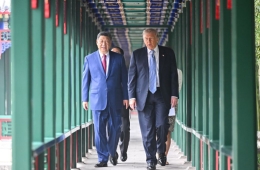
Excluding Minnocho... Tripartite Agreement as a 'Last Resort' to Overcome COVID-19 (Comprehensive)
President Moon Attends Economic and Social Council to Show Support
Major Labor Unions' Attendance Fails, Breaking 22-Year Grand Compromise
Questions Arise Over Proper Implementation of 'Half Agreement' on the Ground
Trillions in Budget Needed to Expand Employment Safety Net Remains a Challenge
![[Image source=Yonhap News]](http://www.asiae.co.kr/news/img_view.htm?img=2020072117345873053_1595320498.jpg)
[Asia Economy Reporter Kim Bo-kyung] On the 28th, the Economic, Social and Labor Council deliberated and approved a tripartite agreement to overcome the COVID-19 crisis with President Moon Jae-in in attendance, but it has been evaluated as a 'last resort.' On this day, President Moon attended the meeting for the first time since the launch of the Economic, Social and Labor Council to lend support to the tripartite agreement. However, with the exclusion of the Korean Confederation of Trade Unions (KCTU), doubts have been raised about whether the agreement will be properly implemented on the ground. Another challenge to be resolved is the fact that a huge amount of funding is required to promote the agreement.
The social dialogue body, the Economic, Social and Labor Council, held a plenary meeting with President Moon in attendance and deliberated and approved 11 agenda items, including the 'Tripartite Agreement to Overcome the COVID-19 Crisis.' Previously, Prime Minister Chung Sye-kyun led a one-point tripartite dialogue to overcome COVID-19, but after twists and turns, the outcome was achieved through the Economic, Social and Labor Council, a presidential advisory body. This is the first time President Moon has attended the plenary meeting since the Economic, Social and Labor Council's inauguration ceremony in November 2018.
President Moon said, "I have no doubt that today's agreement will be a solid foundation to overcome the unprecedented COVID-19 economic crisis," and added, "I am confident that the agreement, achieved by sharing pain a little at a time, will greatly help not only in protecting companies and jobs and achieving a rapid economic recovery but also in resolving economic inequality."
Attending the plenary meeting on this day were President Moon, Moon Sung-hyun, chairman of the Economic, Social and Labor Council, Hong Nam-ki, Deputy Prime Minister and Minister of Economy and Finance, Kim Dong-myeong, chairman of the Federation of Korean Trade Unions (FKTU), Sohn Kyung-shik, chairman of the Korea Employers Federation, Park Yong-man, chairman of the Korea Chamber of Commerce and Industry, and Lee Jae-gap, Minister of Employment and Labor. In the wake of COVID-19, the tripartite parties, including the two major trade unions, were expected to agree on national crisis response measures for the first time since the 1998 foreign exchange crisis, but with the absence of the KCTU, it ended as a 'half agreement.' Chairman Moon stated, "We will devote ourselves to social dialogue so that we can move toward a new wave of labor-management relations that coexist and cooperate, fitting the great transformation of the digital age."

The "Tripartite Agreement Ceremony for Overcoming the COVID-19 Crisis," which was scheduled to be held on the 1st at the Prime Minister's Official Residence in Jongno-gu, Seoul, was canceled due to the last-minute absence of the Korean Confederation of Trade Unions (KCTU). The tripartite parties had originally planned to sign an agreement that included strengthening employment retention and introducing nationwide employment insurance. The KCTU held a Central Executive Committee meeting from the morning to discuss whether to sign the agreement but ultimately decided not to attend the ceremony. The photo shows Prime Minister Jeong Sye-gyun and tripartite representatives attending the ceremony exchanging greetings. Photo by Kim Hyun-min kimhyun81@
View original imageThe agreement includes ▲ employment retention and corporate revitalization ▲ establishment of social safety nets for vulnerable groups ▲ expansion of quarantine and medical infrastructure to prevent infectious diseases. First, the special period for the employment retention subsidy, which raises the support level to up to 90% of the leave and furlough allowance for small and medium-sized enterprises, will be extended for three months until the end of September. However, from October 1, the employment retention subsidy will return to 67% of the leave-furlough allowance for SMEs and 50-67% for large corporations. The payment period for employment retention subsidies for special employment support industries such as travel, tourism, and performance sectors will be extended by 60 days, and additional industry designations will be considered.
Labor and management agreed to cooperate and share pain to overcome the COVID-19 management crisis. The management side will strive to overcome the crisis and maintain employment, and the labor side will actively cooperate with employment retention measures such as reduced working hours and furloughs. The Economic, Social and Labor Council will operate a special committee for six months to discuss follow-up measures and monitor the implementation of this tripartite agreement.
The government will expand social safety nets to protect vulnerable employment groups such as workers in special employment types (SETs). A roadmap for 'universal employment insurance' that covers all workers will be prepared by the end of this year. The government will actively promote the passage of legislation to include special employment types such as insurance planners and substitute drivers in employment insurance and will gradually expand the scope of employment insurance to include self-employed workers and others.
The issue is the funding plan. The government plans to establish a universal employment insurance system covering 21 million workers by 2025. Starting next year, the National Employment Support System will be implemented, providing job-seeking allowances of up to 3 million won to vulnerable employment groups such as youth, women with career interruptions, and the long-term unemployed. It is estimated that 3.2 trillion won will be required for the universal employment insurance system and 7.2 trillion won for support for vulnerable groups such as the National Employment Support System by 2025.
Hot Picks Today
!["Heading for 2 Million Won": The Company the Securities Industry Says Not to Doubt [Weekend Money]](https://cwcontent.asiae.co.kr/asiaresize/93/2025050713592847164_1746593968.jpg) "Heading for 2 Million Won": The Company the Securities Industry Says Not to Doubt [Weekend Money]
"Heading for 2 Million Won": The Company the Securities Industry Says Not to Doubt [Weekend Money]
- "Do We Need to Panic Buy Again?" War Drives 30% Price Surge... Even the Bedroom Feels the Impact
- [Breaking] Samsung Electronics Union: "Management Representative Negotiator Replaced... Labor-Management Meeting Scheduled"
- "Anyone Who Visited the Room Salon, Come Forward"… Gangnam Police Station Launches Full Staff Investigation After New Scandal
- Jay Y. Lee Bows His Head: "I Will Take All the Blame"... Apologizes for Samsung Labor-Management Conflict
The content of the labor-management agreement is not only theoretical and declarative but also uncertain whether it will be properly implemented on the ground, as the largest trade union, the KCTU, ultimately refused to endorse it. Professor Choi Young-gi of Hallym University said, "It is meaningful that the KCTU participated until the process of making the agreement, but the purpose of the one-point social dialogue has largely disappeared," and evaluated, "Bringing the labor-management agreement to the Economic, Social and Labor Council for approval should be seen as a 'last resort' to conclude the discussion." Professor Choi added, "Since the KCTU refused to endorse the agreement, it is difficult to guarantee whether the labor side will actively cooperate with the agreement's contents such as reduced working hours and furloughs on the ground."
© The Asia Business Daily(www.asiae.co.kr). All rights reserved.