Investigation Authority Adjustment, Police Reform, and the Truth Behind the Late Park Won-soon... The Test of 'Kim Chang-ryong Leadership'
Challenges Pile Up from Early Official Inauguration
Community Police Communication and Protection of Socially Vulnerable Groups
Focus on 'Preventive Policing' Activities

Kim Chang-ryong, the newly appointed Commissioner General of the National Police Agency, is attending the inauguration ceremony held at the National Police Agency in Seodaemun-gu, Seoul, on the 24th. Photo by Kang Jin-hyung aymsdream@
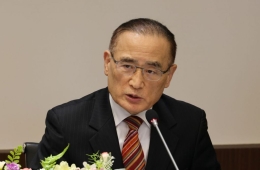
View original image[Asia Economy Reporter Lee Gwan-ju] The shoulders of Kim Chang-ryong, the newly appointed Commissioner General of the National Police Agency who officially took office as the head of 150,000 police officers, are heavy. This is because he has been entrusted with the important task of leading police reforms, including the completion of investigative structure reform and the introduction of the autonomous police system. As he faces major cases such as the late former Seoul Mayor Park Won-soon's sexual harassment allegations early in his term, there is a growing call for Commissioner Kim to demonstrate strong leadership.
A 'great transformation period' for the police is approaching, with the expected implementation of the prosecution-police investigation authority adjustment bill (amended Criminal Procedure Act) in the second half of this year. With the adjustment of investigative authority, prosecution-led investigation supervision will be abolished, and the police will have primary investigative authority and the right to conclude investigations. Although the police's investigative powers will increase, they must maintain fairness and neutrality while demonstrating swift and professional investigative capabilities.
The autonomous police system, promoted to disperse the potentially overgrown police power due to the adjustment of investigative authority, is also a major task of police reform. The related bill (the full revision of the Police Act), which was automatically discarded due to the expiration of the 20th National Assembly's term, is expected to be resubmitted and discussed in the 21st National Assembly. Especially since there is anxiety among frontline police officers about the introduction of the autonomous police system, Commissioner Kim's role in the stable management of the organization is expected to be important.
In addition, detailed reform tasks such as intelligence police reform and inspection reform are piling up. For Commissioner Kim's vision of a "respected and beloved police" to be realized, above all, the prompt advancement of reform tasks must accompany it. This is why attention is focused on what kind of leadership he will demonstrate in future police reforms.

Kim Chang-ryong, Commissioner of the National Police Agency, is communicating with staff during his first field visit since taking office on the 24th at the Yongjung Police Substation in Yongsan-gu, Seoul. Photo by National Police Agency
View original imageMeanwhile, the case related to former Mayor Park, which was a contentious issue from the National Assembly confirmation hearing, is expected to be a major issue Commissioner Kim will address early in his term. During the confirmation hearing, Commissioner Kim emphasized fact-finding based on law and principles. It is said that the establishment of a dedicated task force at the Seoul Metropolitan Police Agency regarding this case was influenced by Commissioner Kim's intentions. Although the sexual harassment accusation case itself must be closed as "no prosecution" due to the death of the accused, clear truth-finding through police investigation is required amid ongoing controversies such as allegations of complicity and leaks of accusation details.
Earlier, on the 24th, Commissioner Kim made his first field visit after taking office by visiting the Yongjung Police Substation of the Yongsan Police Station in Seoul to encourage staff, followed by a visit to the Yongsan District Integrated Support Center for Families in Crisis to discuss proactive detection of child abuse and strengthening community cooperation. This is interpreted as a move to strengthen communication with local police, who are at the forefront of public safety, and to actively protect socially vulnerable groups.
Hot Picks Today
 "Now Our Salaries Are 10 Million Won a Month" Record High... Semiconductor Boom Drives Performance Bonuses at Major Electronic Component Firms
- Experts Already Watching Closely..."Target Price Set at 970,000 Won" Only Upward Momentum Remains [Weekend Money]
- "Heading for 2 Million Won": The Company the Securities Industry Says Not to Doubt [Weekend Money]
- Prime Minister Kim Minseok: "Samsung Electronics Strike Could Cost Up to 1 Trillion Won per Day, 100 Trillion Won Total... Tomorrow's Talks Are the Last Chance" (Comprehensive)
- "Chanel, Chef's Table, and Open Runs? I Get a Free Pass"... The World of the Top 0.1% That Money Alone Can't Access [Luxury World]
In line with this, Commissioner Kim's public safety policy is expected to focus on "preventive police activities." Through proactive police activities, he aims to alleviate public anxiety factors. In his inaugural speech, Commissioner Kim presented the theme of "the safest country, a respected and beloved police," emphasizing that "as a 'reliable neighbor police' closest to the people, we must establish a seamless social safety net based on meticulous risk management to create an environment where people can feel safe from various crimes and accidents around their daily lives."
© The Asia Business Daily(www.asiae.co.kr). All rights reserved.