What Are the Views of Ruling Party Leadership Candidates on the Administrative Capital Relocation?
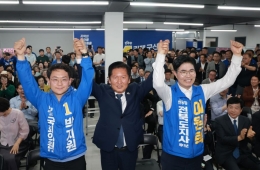
[Asia Economy Reporter Kang Nahum] As the relocation of the administrative capital emerges as the biggest issue in the political arena, candidates for the Democratic Party leadership have also emphasized the necessity of completing the administrative capital. However, their opinions differ on specific implementation plans.
![[Image source=Yonhap News]](http://www.asiae.co.kr/news/img_view.htm?img=2020071608120763552_1594854727.jpg)
First, former lawmaker Kim Boo-kyum envisions creating a metropolitan 'co-prosperity city' comparable to the Seoul metropolitan area to establish a foundation for local autonomy. He argued that the Busan-Ulsan-Gyeongnam region should be developed into a 'Southeast Mega City' to promote a virtuous cycle of regional New Deal projects in transportation, logistics, manufacturing, regional finance, regional education, and talent development. He also proposed that Daegu-Gyeongbuk be developed into an integrated new airport and integrated metropolitan administrative city, while Gwangju-Jeonnam-Jeonbuk should be developed into a blue economy, renewable energy such as wind power, and tourism-cultural belt.
On the 24th, on a radio program, former lawmaker Kim said, "It is necessary to form several metropolitan economic zones nationwide so that people there can design their lives and continue living without necessarily flocking to the Seoul metropolitan area," adding, "In that regard, the administrative capital will be the very first step."
![[Image source=Yonhap News]](http://www.asiae.co.kr/news/img_view.htm?img=2020072117232273039_1595319802.jpg)
Representative Park Jumin argued that the relocation of the administrative capital should be accompanied by strengthening educational infrastructure. He said that ten key universities should be networked to provide education at the same high level as the Seoul metropolitan area. On the same day, appearing on a radio show, Representative Park said, "Investing about 2.4 to 3 trillion won annually in key universities to raise educational standards and networking these universities is one option," adding, "It would be fine to call these key universities the so-called 'Korean University'." He continued, "Proper decentralization will be achieved by linking this with the relocation of public institutions and providing benefits such as employment."
When asked by the host whether he was advocating for the abolition of Seoul National University, Representative Park replied, "It is somewhat different in nuance, but it could be considered including that."
![[Image source=Yonhap News]](http://www.asiae.co.kr/news/img_view.htm?img=2020072310394076529_1595468380.jpg)
Representative Lee Nak-yeon did not present specific plans regarding the relocation of the administrative capital but hinted at completing it within his term if elected party leader. This appears to reflect awareness of his weakness as a '7-month party leader.' The day before, he said, "If I become the leader, it would be best if a conclusion (on relocating the administrative capital to the provinces) can be reached during my 7-month tenure," adding, "Since this proposal was put forward responsibly by the ruling party, we must do whatever it takes to realize it."
Hot Picks Today
 "Now Our Salaries Are 10 Million Won a Month" Record High... Semiconductor Boom Drives Performance Bonuses at Major Electronic Component Firms
- Wallets Open Wide on Big News...300 Trillion Won Heads to the U.S., "Tax Breaks" Fail to Keep Funds at Home
- "Hope You Enjoy the 'Welfare' for Bereavement of Children"... Ridicule of Strike Non-Participants Intensifies Union Conflict at Samsung Electronics
- "Heading for 2 Million Won": The Company the Securities Industry Says Not to Doubt [Weekend Money]
- Experts Already Watching Closely..."Target Price Set at 970,000 Won" Only Upward Momentum Remains [Weekend Money]
Representative Lee also emphasized dialogue between the ruling and opposition parties as a condition for the success of the administrative capital relocation. He stated, "We must engage in dialogue between the ruling and opposition parties aiming for full relocation. I think that during the dialogue process, slightly different options may emerge. It would be good to approach the dialogue with such a flexible attitude."
© The Asia Business Daily(www.asiae.co.kr). All rights reserved.