EU Recovery Fund, Marathon Negotiations Enter Fifth Day... "Agreement Expected Soon"
The meeting scheduled for the 17th-18th extended until the 21st
Final tug-of-war over subsidy scale and fund details
Evaluated as a test of 'solidarity' for the EU, divided by COVID-19
![[Image source=AP Yonhap News]](http://www.asiae.co.kr/news/img_view.htm?img=2020072109463471635_1595292394.jpg)
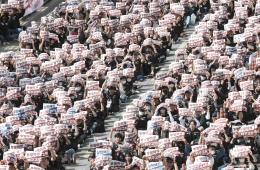
[Asia Economy Reporter Jeong Hyunjin] European Union (EU) leaders are engaged in marathon negotiations for five days over a 750 billion euro (approximately 1,031.5 trillion KRW) recovery fund to respond to the impact of the novel coronavirus disease (COVID-19), and on the 21st (local time), they are in a final tug-of-war. Charles Michel, the President of the EU Council, proposed a subsidy amount of 390 billion euros, which was a key agenda item, and discussions are underway including detailed matters such as budget and execution criteria.
According to Bloomberg and others, Michel proposed at the ongoing EU summit in Brussels, Belgium, to reduce the subsidy portion of the recovery fund from the initially suggested 500 billion euros to 390 billion euros, with the remaining 360 billion euros to be provided as low-interest loans. It also included that member states receiving support must obtain approval from the majority of EU member states for their fund usage plans, and that fund support is linked to compliance with the rule of law and responses to climate change.
After five days of discussions since the 17th, this was an attempt to narrow differences among member states. Exhausted from overnight talks, Michel made this proposal and the meeting is continuing in the afternoon. The previous day, the leaders raised their voices until 6 a.m., continuing their disagreements over the recovery fund.
Before the afternoon meeting, Michel told reporters, "I know the last stage is always the hardest," but added, "I believe an agreement is possible." German Chancellor Angela Merkel also said, "After long talks last night, we have laid the framework for a possible agreement," and "It is ongoing, and I hope an agreement will be reached today."
One foreign media outlet reported, "EU leaders are expected to soon reach an agreement on the COVID-19 recovery package."
◆ Why Are EU Member States Fighting? = The reason the EU summit, originally scheduled for two days, was extended to five days was due to disagreements over the proportion of subsidies that do not require repayment or interest payments. The European Commission proposed that 500 billion euros of the total 750 billion euro recovery fund be allocated as subsidies. Germany, France, Italy, Spain, and others expressed their agreement.
However, Northern European countries including the Netherlands, Austria, Sweden, and Denmark argued that subsidies should be limited to a maximum of 350 billion euros, leading to a deadlock in negotiations. They insisted that the responsibility of countries receiving funds should be strengthened, with preconditions such as budget and labor market reforms required when funds are received.
![[Image source=AP Yonhap News]](http://www.asiae.co.kr/news/img_view.htm?img=2020072109464771637_1595292407.jpg)
Ultimately, as both sides reached a deadlock, Michel proposed a subsidy amount of 390 billion euros, which reportedly received a positive response. Bloomberg stated, "All government officials expect the newly proposed plan to be accepted," but added, "It remains uncertain whether agreement can be reached on other aspects of fund support conditions, such as responses to climate change."
One of the issues currently under discussion is the 'rebate.' A rebate is a partial return of financial contributions to the EU, a measure created in 1984 by then British Prime Minister Margaret Thatcher to partially compensate for the UK's large budget contributions. The so-called 'Frugal Four' countries, including the Netherlands, proposed this, and foreign media report that it is likely to be included in the recovery fund plan. Bloomberg reported that through this, Denmark, Germany, the Netherlands, Austria, and Sweden could receive 52.8 billion euros back over seven years.
Another issue is whether 'compliance with democracy' should be included as one of the fund conditions. Hungary and Poland have stated that if this condition is included, they will reject the entire fund plan. Hungarian Prime Minister Viktor Orb?n requested changes to this requirement, but Michel's proposal was released without any changes. Other specific conditions related to climate change and legal compliance promises are also under discussion.
◆ "Exposure of Lack of Trust"... Is EU Solidarity on the Test Bench? = This summit is being seen as a test for the EU. The world’s attention was focused on whether the EU, which showed signs of division during the COVID-19 crisis, could establish a large-scale recovery fund to protect the Eurozone, its common market. This came amid growing voices questioning solidarity due to the Eurozone financial crisis, immigration issues, and Brexit (the UK’s withdrawal from the EU).
EU member state leaders, meeting face-to-face for the first time in five months while wearing masks, showed various scenes of conflict and anger in the meeting room, including shaking hands in frustration. After repeated opposition from Dutch Prime Minister Mark Rutte, Chancellor Merkel and French President Emmanuel Macron stormed out of the meeting room, and Macron reportedly slammed his fist on the table during the meeting, shouting "useless obstruction."
Hot Picks Today
 "Samsung and Hynix Were Once for the Underachievers"... Hyundai Motor Employee's Lament
- After Topping 8,000 Instead of Hitting 10,000... KOSPI Plunges—When Will It Rebound?
- "They Said It's Impossible to Get—Already Selling for Triple the Price: Crowds Worldwide Line Up for $600 Luxury Watch"
- [Breaking] Court Partially Grants Samsung Union Injunction... "Maintain Normal Operations"
- "That? It's Already Stashed" Nightlife Scene Crosses the Line [ChwiYak Nation] ③
The Guardian daily assessed, "The heated EU summit exposed a lack of trust among the leaders," and added, "It is unusual for such longstanding Eurozone members to harbor such animosity and clash." The Guardian also noted, "The longer EU leaders stay in Brussels, the higher the political cost of leaving without any agreement," and warned, "Failure to reach an agreement will weigh heavily on the EU."
© The Asia Business Daily(www.asiae.co.kr). All rights reserved.