'Overcoming COVID-19' Labor-Management-Government Grand Compromise Fails... Business Community's High Expectations Dashed
"Unexpected Situation... It's Regrettable"
Hope for Possibility of Further Discussions
Concerns Over Impact on Minimum Wage Negotiations

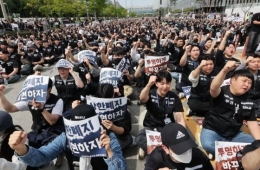
The 'Tripartite Agreement Ceremony for Overcoming the COVID-19 Crisis,' scheduled to be held on the 1st at the Prime Minister's Official Residence in Jongno-gu, Seoul, was canceled due to the last-minute absence of the Korean Confederation of Trade Unions (KCTU). The tripartite parties were originally set to sign an agreement that included strengthening employment retention and introducing nationwide employment insurance. The KCTU held a central executive committee meeting from the morning to discuss whether to sign the agreement but ultimately decided not to participate in the ceremony. The photo shows the venue of the canceled agreement ceremony on that day. Photo by Kim Hyun-min kimhyun81@
View original image[Asia Economy Reporter Kiho Sung] The business community could not hide its bewilderment over the failure to reach an agreement at the tripartite representative meeting (tripartite meeting). In particular, the disappointment is greater considering the heightened expectations, for the first time since the 1998 International Monetary Fund (IMF) foreign exchange crisis, with the participation of the government, business sector, and labor sector to overcome the novel coronavirus disease (COVID-19) crisis. While the business community hopes for further discussions, it also expresses concerns that this could affect future labor-management relations, including the upcoming minimum wage negotiations.
An official from the Korea Employers Federation said, "Until this morning (the 1st), there was an expectation that the government, businesses, and labor could reach a major agreement for the first time in 22 years," adding, "The cancellation of the agreement ceremony was an unexpected situation. There is nothing I can say except that it is regrettable." He continued, "The agreement prepared this time was not focused on the employers' side but contained content that the tripartite would cooperate on employment retention, business revitalization, and expansion of social safety nets to overcome the COVID-19 crisis," adding, "It was a big framework showing cooperation among the tripartite in this severe crisis, so it is regrettable that it failed."
Although the agreement ceremony was canceled due to the absence of the Korean Confederation of Trade Unions (KCTU), the business community is not giving up on resuming negotiations. They plan to achieve a grand tripartite compromise through additional discussions via official and unofficial channels. Another economic organization official emphasized, "Although the agreement ceremony failed, there is still hope that an agreement can be reached in the future," and added, "We will actively engage in further discussions."
Meanwhile, separate from the tripartite meeting, the business community is also expressing concerns about next year's minimum wage discussions. The KCTU recently announced a position that next year's minimum wage should be 10,770 won, which is 25% higher than this year. This represents a 25.4% increase from this year's hourly wage of 8,590 won. However, the business sector opposes this, citing difficulties in raising wages due to the impact of COVID-19.
Hot Picks Today
 Cerebras Soars 70% on IPO Debut: Is Nvidia's Reign Ending as a New AI Semiconductor Power Emerges?
- "After Vowing to Become No. 1 Globally, Sudden Policy Brake Puts Companies’ Massive Investments at Risk"
- "Nothing Has Changed": Union Rejects Samsung's Proposal... Further Talks Fail as Strike Proceeds
- "Mom, Isn't It Comfortable Living With Me?"... 'Unexpected Result' Shows Increased Drinking Out of Frustration
- "He's Handsome, It's Such a Pity?"... Lawyer Responds to Bizarre 'Appearance Evaluation' of High School Girl Murder Suspect
An official from the business community said, "The failure of the agreement may strengthen hardline voices within the labor sector," adding, "There are concerns that the power struggle between labor and management over the minimum wage and company-level wage negotiations could be prolonged."
© The Asia Business Daily(www.asiae.co.kr). All rights reserved.