Government Initiates Drive to Improve Corporate Governance

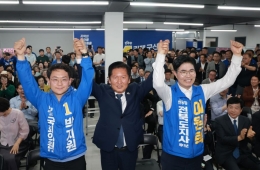
The person on the left is Kim Tae-nyeon, Floor Leader of the Democratic Party of Korea, and the person on the right is Cho Sung-wook, Chairman of the Korea Fair Trade Commission. Photo by Yoon Dong-joo doso7@
View original image[Asia Economy Reporter Moon Chaeseok] The so-called 'chaebol reform,' known as 'corporate governance improvement,' is a key agenda that both the government and financial markets are striving to realize. The rationale is to separate ownership and management of large corporations to enhance management expertise and prevent the arbitrary actions of the controlling family. The government has chosen a direction toward much stronger 'administrative regulation strengthening of the controlling family' rather than encouraging expanded responsible investment by companies or restraining the voting rights of trustees.
A representative example is the Fair Trade Commission's announcement to expand the scope of regulations on private interest appropriation. The Fair Trade Commission stated that it will amend the law to expand the regulatory targets from 'controlling family ownership of 30% or more (20% or more for unlisted companies)' to 'controlling family ownership of 20% or more (both listed and unlisted companies), and companies where the controlling family holds 20% or more ownership that in turn holds more than 50% ownership in another company.' As a result, the number of regulated companies will increase from 210 (as of the 1st of last month) to 591. Hyundai Glovis, SK, and others will be newly included.
If the private interest appropriation regulation expands as the Fair Trade Commission intends, the notion that 'those who unfairly channel profits to the controlling family will be punished' is likely to spread widely. This is a much stronger punitive measure than pressures such as the Stewardship Code (guidelines for institutional investors' voting rights) and the 3% rule (limiting the controlling shareholder's voting rights to 3% when appointing auditors) applied in the financial sector. Many in the financial investment industry, including pension funds and institutional investors, welcome this, expecting a reduction in management uncertainty.
A securities firm researcher specializing in governance said, "Some mistakenly think institutional investors in the financial investment industry are 'pro-chaebol,' but that is far from the truth," adding, "Many investors view the arbitrary management by the controlling family as a far more serious 'Korea discount' factor than North Korea's military provocations."
The controversy is intense. Many view the government's and ruling party's push to amend the Fair Trade Act and Commercial Act as an infringement on corporate autonomous management and a violation of the constitutional principle of a market economy. The business community fears that stripping companies of their voting rights defense will leave them defenseless against attacks from foreign activist funds and corporate raiders. Memories of Elliott Management attacking Hyundai, Sovereign Asset Management targeting SK, and Carl Icahn probing KT&G are vivid. The business community often uses the phrase "a tilted playing field," criticizing the government's rapid and harsh enforcement of governance improvement policies.
Hot Picks Today
!["Not Everyone Can Afford This: Inside the World of the True Top 0.1% [Luxury World]"](https://cwcontent.asiae.co.kr/asiaresize/93/2026051507261063923_1778797570.png) "Not Everyone Can Afford This: Inside the World of the True Top 0.1% [Luxury World]"
"Not Everyone Can Afford This: Inside the World of the True Top 0.1% [Luxury World]"
- While All Eyes Were on Samsung and Hynix, This Company Surged 50% to New Highs in Four Days [Weekend Money]
- "Now Our Salaries Are 10 Million Won a Month" Record High... Semiconductor Boom Drives Performance Bonuses at Major Electronic Component Firms
- "Sold Out Everywhere" The Surprising Story of the 'Purple Gold' Philippine Yam That Has Captivated the World [Delicious Stories]
- Experts Already Watching Closely..."Target Price Set at 970,000 Won" Only Upward Momentum Remains [Weekend Money]
The head of the competition authority's determination to separate ownership and management is firm. Fair Trade Commission Chairman Cho Sung-wook diagnosed in a media interview that domestic large corporations' governance is not yet advanced. Chairman Cho pointed out, "Governance improvement systems are often operated merely in formality, lacking effectiveness, and especially independent board-centered management is still insufficient," adding, "Many outside directors of domestic large corporations are socially connected to current management or controlling shareholders, so they are not free from the influence of the controlling family."
© The Asia Business Daily(www.asiae.co.kr). All rights reserved.