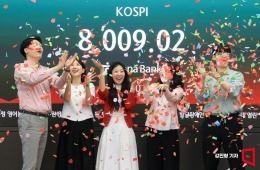
[Good Morning Stock Market] 'High Point Debate' KOSPI... Will It Shift from Cyclical Stocks to Growth Stocks?
Focus on Growth Stocks in Low Interest Rate and Pause Market
Profit Estimates Lag Behind Index Rise Speed
Pay Attention When Q2 Estimates Are Adjusted
[Asia Economy Reporter Minji Lee] Despite concerns over the second wave of infections of the novel coronavirus disease (COVID-19), major global stock markets are showing strong gains fueled by optimism. In the securities industry, investments in cyclical stocks such as Samsung Electronics, Hyundai Motor, POSCO, and KB Financial have increased since mid-May, but as debates over the KOSPI's peak intensify, interest in growth stocks is expected to rise again.
![[Good Morning Stock Market] 'High Point Debate' KOSPI... Will It Shift from Cyclical Stocks to Growth Stocks?](http://www.asiae.co.kr/news/img_view.htm?img=2020061216094091885_1591945781.jpg)
◆ Seojung Hoon, Researcher at Samsung Securities = The anticipation of economic activity resuming in earnest since mid-May has contributed to the stock market's upward momentum. Industries hit hard by COVID-19 have become attractive targets for investors seeking bargain purchases, maintaining their upward trend. However, as the rapid rotation of gains continues, signs of overheating are being detected in various parts of the market.
In such a situation, investors who had invested based on vague expectations are inevitably withdrawing. It remains unclear whether the first wave of COVID-19 infections has truly ended before concerns about a second wave arise. While the May U.S. non-farm payroll surprise raised hopes for a V-shaped recovery, considering the previous declines, it is still too early to discuss a full recovery. In fact, it took 10 years after the financial crisis to accumulate 20 million jobs.
Interest rates are expected to remain low for a considerable period. At the June FOMC, the Federal Reserve (Fed) announced it would maintain zero interest rates until 2022 and continue implementing quantitative easing worth $1,200 billion.
In conclusion, since entering June, untact-related stocks that took a breather are expected to show relative strength. The rotation into cyclical value stocks, which recently saw notable capital inflows, is likely to continue until meaningful improvements in economic indicators and the calming of COVID-19 in major countries are confirmed.
Untact-related stocks, which exhibit growth characteristics, are expected to alleviate much of the high PER burden through the lowered interest rates. Unlike traditional manufacturing and service industries, their sales have been less affected by COVID-19, which is a factor that can significantly improve supply and demand. Additionally, it is advisable to pay attention to domestic internet, gaming, biotech, and secondary battery sectors.
◆ Kim Dongwan, Researcher at Eugene Investment & Securities = The high valuation of the KOSPI is a burden for investors. The KOSPI will surpass its peak (2,267 points) since June 2019 with only about a 6% increase. However, earnings estimates are at about 89% of the peak during the same period. Due to the unusually rapid fluctuations in the index caused by COVID-19, earnings estimates have not kept pace with the index's rapid rise.
Hot Picks Today
 As Samsung Falters, Chinese DRAM Surges: CXMT Returns to Profit in Just One Year
- "Most Americans Didn't Want This"... Americans Lose 60 Trillion Won to Soaring Fuel Costs
- Trump’s Approval Rating Drops to 37%, Lowest Since Return to Office
- Samsung Union Member Sparks Controversy With Telegram Post: "Let's Push KOSPI Down to 5,000"
- "Why Make Things Like This?" Foreign Media Highlights Bizarre Phenomenon Spreading in Korea
Generally, earnings estimates respond 1 to 2 months slower than the index. Since 2010, the correlation between the index and earnings estimates when compared simultaneously is 0.81, but when narrowed to 1 to 2 months, it rises to 0.84. Considering that earnings estimates from January to February have the highest explanatory power for the index level, if securities firms adjust their earnings forecasts, the valuation burden could be somewhat alleviated. Although concerns about the KOSPI's high valuation are growing, it is necessary to increase attention from late June when the Q2 earnings preview begins.
© The Asia Business Daily(www.asiae.co.kr). All rights reserved.