[Interview] Kang Min-jung, the First Former Teacher Turned National Assembly Member, "The National Assembly Must Understand Educational Sites"
25 Years as a Middle School Teacher
"Expanding Innovation Schools, Free Tuition at Regional National Universities, and Private School Reform to Create Happy Education for Children"

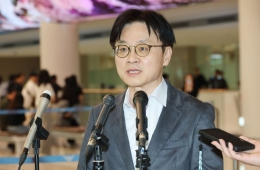
Kang Min-jung, elected member of the Open Democratic Party. Photo by Yoon Dong-joo doso7@
View original image[Asia Economy Reporter Wondara] "I believe that if education had been different, our society could have had many more BTS (Bangtan Sonyeondan). I have been reflecting on whether our society has given children enough opportunities to blossom their talents in music, sports, research, or other fields."
Kang Min-jung, elected member of the Open Democratic Party, said in an interview with Asia Economy at the party office on the afternoon of the 19th, "Education should create an environment where children can fully express their outstanding qualities," adding, "However, the National Assembly has so far failed to resolve the excessive competition in entrance exams and has repeatedly enacted harmful reforms without understanding the actual situation on the ground."
Kang served as a history and social studies teacher at middle schools for 25 years. For the last four years before running for office, she worked at an innovative school. She is the first 'pure' ordinary teacher to become a member of the National Assembly, not a head of an educational organization, professor, or foundation official. As she advocated for 'education where children are happy' during the election period, Kang’s own children graduated from alternative schools and specialized high schools and are currently finding their own paths.
Kang said, "The biggest problem I felt in the education field is that our society engages in a 1-to-99 competition over entrance exams," adding, "The popularity of the drama 'Sky Castle' likely reflected parents’ consensus that such reforms are necessary."
She foresees that expanding innovative schools and university reforms can solve these problems. Kang said, "Many children enter departments they have never seen before based on their grades, but in innovative schools, they learn how to study subjects they are interested in, so even after entering university and after employment, there are many cases of 'genuine advancement' where they achieve greater results in their fields." She continued, "The current fierce competition for entrance exams is probably because people think they must enter a few prestigious universities to get good jobs," emphasizing, "If we innovate the curricula of regional flagship national universities and make tuition free to attract good talent, the competition to enter a few elite universities will also decrease."
As a prerequisite for improving the quality of education on the ground, Kang also pointed out the need for reform in private schools. She said, "The proportion of private schools in the current education field is too high," adding, "Many private schools have problems that make it embarrassing to call them educational institutions." She explained, "Current laws allow private school foundations to wield excessive power. The 2007 revision of the Private School Act shortened the restriction period preventing those who committed private school corruption from returning to the foundation. This should be strengthened to prevent their return."
Hot Picks Today
 No Bacteria Detected in Arisu After 24 Hours of Repeated Drinking from a Tumbler
- "We Can't Just Let Them Be Damaged Inside"... Samsung Electronics Removes 360,000 Wafers in Preparation for Strike
- "Up to 100 Trillion Won in Losses Feared, It's Not About Second Place but Catastrophe"... Industry Minister: 'Emergency Mediation Unavoidable If Samsung Strike Occurs'
- Wife in $6.7 Million Debt Took Out $3 Million in Husband's Life Insurance, Poisoned Him... US Court: "She Can Never Be Released"
- "He's Handsome, It's Such a Pity?"... Lawyer Responds to Bizarre 'Appearance Evaluation' of High School Girl Murder Suspect
Kang’s ambition also includes expanding political participation in education. She said, "Democratic citizenship seems distorted by factionalism, as if only certain people possess it. But politics is not the exclusive domain of a privileged few; it is part of everyday life," adding, "I will create a legal basis to guarantee mock election education so that children recognize election days not as 'days off' but as part of their lives, and to ensure teachers’ political participation."
© The Asia Business Daily(www.asiae.co.kr). All rights reserved.