Proposal for 'Digital Green Special Zones' in Changwon, Dangjin, Samcheok, etc... GS Launches 'Wind Power Shareholder Movement'

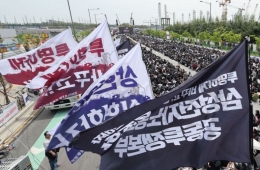
On the 21st, a civil society press conference urging the "21st National Assembly to address the climate crisis and ecological crisis" is being held at Gwanghwamun Square, Jongno-gu, Seoul. Photo by Moon Honam munonam@
View original image[Asia Economy Reporter Park Cheol-eung] A proposal has been made to establish 'Digital Green Special Zones' across the country, including Dangjin in Chungnam and Changwon in Gyeongnam, which are experiencing employment crises. GS, a company engaged in wind power generation, suggested the 'National Wind Power Plant Shareholder Movement.' This is a blueprint for the 'Green New Deal' put forward by a leading domestic energy organization and is likely to be discussed at the government and ruling party negotiation table.
The Energy Transition Forum announced these plans at a press briefing on the 19th titled 'Green New Deal Government Policy Proposal and Project Promotion Direction.' The organization includes figures from academia, industry, and politics, with Park Won-soon, Mayor of Seoul; Won Hee-ryong, Governor of Jeju; and Yoo Seung-min, member of the Future United Party, serving as advisors. Yang Yi-won-young, a Democratic Party elected official who served as the forum's secretary-general, and Kim Sung-hwan, head of the Democratic Party's New Deal Task Force, are advisory committee members.
Han Byung-hwa, a research fellow at Eugene Investment & Securities and a forum director, proposed in his presentation that "to maximize the effect of the Digital New Deal, a budget of 4 trillion won from 2021 to 2024 should be allocated equally to four new industry special zone projects, with 1 trillion won each." This includes government and local government subsidies for new or expanded factories, tax benefits, and incentives for new employment.
As 'Green Data Special Zones,' he mentioned Gimhae in Gyeongnam, where some financial institutions have expressed interest, and Dangjin, which can be linked to the construction of renewable energy complexes following the closure of coal power plants. Research fellow Yoo explained, "Not only companies with high power consumption data centers such as Naver and Kakao, but also major domestic financial institutions and large corporations are highly likely to participate, and global overseas companies like Amazon, Microsoft, and Google can build mega data centers in Korea as the basic conditions are met."
For 'Green Remodeling,' which involves converting old buildings into energy-efficient ones, Changwon was cited due to serious employment issues caused by the downturn in Doosan Heavy Industries and the machinery industry.
Additionally, Ulsan or Gyeongnam was proposed as a 'Digital Mobility Special Zone,' and Sinan in Jeonnam, Samcheok in Gangwon, and Yeongdeok in Gyeongbuk were suggested as candidates for the 'Digital Clean Energy Special Zone.' This is because these areas have a high proportion of solar and wind installations or can be developed as renewable energy-linked complexes to replace canceled nuclear power plant sites.
Research fellow Han proposed accelerating the execution of the subsidy budget set until 2022 by next year to activate 'Green Mobility,' introducing subsidies for exchanging old cars for electric vehicles, and implementing mandatory electric vehicle sales policies.
Wi Jin, head of GS Wind Power Division, stated, "Good energy consumption can make the people, companies, and the country prosperous again, and ultimately create a virtuous cycle framework to become an energy-independent nation," and introduced the 'National Wind Power Plant Shareholder Movement.'
He suggested that 70% of the shares in wind power plants be financed through project financing (PF) such as pension fund investments, and the remaining 30% be participated in by the public, local residents, local governments, and companies. Financial support is necessary, and for the public shares, the proposal targets low-income groups and youth. The financial investment is expected to reach 7.875 trillion won, with induced investment effects from companies and bond investments estimated at 44.625 trillion won.
Wi said, "In the short term, it can stimulate the local economy and energy transition, and in the long term, it can foster renewable energy companies, increase national income, and achieve energy independence."
Lee Sung-ho, senior researcher at the Korea Energy Technology Evaluation Institute, proposed installing 100kW-scale solar power facilities at about 10,000 schools nationwide with budget support and installing agrivoltaics on 1% of the total arable land area. He also suggested rapid grid reinforcement for small-scale solar power generation and the construction of large-scale renewable energy power grid infrastructure.
Hong Jong-ho, co-chair of the Energy Transition Forum and professor at Seoul National University Graduate School of Environmental Studies, said, "Experiencing the environment becoming cleaner due to the economic activity contraction caused by the pandemic has made us recognize the importance of a virtuous cycle structure between the economy and the environment," adding, "Most of the areas where fiscal investment should be made for the Green New Deal are smart social overhead capital (SOC) projects with significant industrial ripple and employment inducement effects."
Hot Picks Today
 "Buy on Black Monday"... Japan's Nomura Forecasts 590,000 for Samsung, 4 Million for SK hynix
- "Plunged During the War, Now Surging Again"... The Real Reason Behind the 6% One-Day Silver Market Rally [Weekend Money]
- Even After the 'Tax,' High Profits Remain... Korea Emerges as a Premium Market [ChwiYakGukga]②
- "Samsung and Hynix Were Once for the Underachievers"... Hyundai Motor Employee's Lament
- "That? It's Already Stashed" Nightlife Scene Crosses the Line [ChwiYak Nation] ③
© The Asia Business Daily(www.asiae.co.kr). All rights reserved.