Incheon Environmental Groups Demand "Closure of All Yeongheung Thermal Power Plant Facilities by 2030"
Withdrawal of LNG Power Plant Plan... Urging Promotion of Energy Efficiency Projects
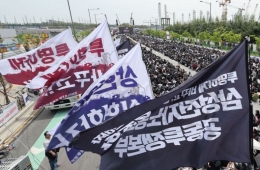
![The Incheon Environmental Movement Union is holding a protest demanding the shutdown of Yeongheung Thermal Power Plant Units 1 and 2. 2018. 11.7 [Photo by Incheon Environmental Movement Union]](http://www.asiae.co.kr/news/img_view.htm?img=2020051214453832190_1589262338.png)
The Incheon Environmental Movement Union is holding a protest demanding the shutdown of Yeongheung Thermal Power Plant Units 1 and 2. 2018. 11.7 [Photo by Incheon Environmental Movement Union]
View original image[Asia Economy Reporter Park Hyesook] Environmental groups in the Incheon area have called for the closure of all facilities at the Yeongheung Thermal Power Plant by 2030 and the withdrawal of the liquefied natural gas (LNG) replacement construction plan under the 9th Basic Plan for Electricity Supply and Demand.
The Incheon Environmental Movement Federation, Incheon Green Union, and Catholic Environmental Solidarity issued a statement on the 12th, saying, "We welcome the decision to close Units 1 and 2 of the Yeongheung Thermal Power Plant, which environmental groups have continuously demanded," but emphasized, "It is necessary to decide to close Units 3, 4, 5, and 6 by 2030, not to close Units 1 and 2 by 2034."
Korea South-East Power, which operates the Yeongheung Thermal Power Plant, recently held a board meeting and decided to completely shut down Units 1 and 2, which use coal as fuel, around 2034, the 30th year since their commissioning, and convert to LNG power generation. This is in line with the government's eco-friendly energy policy to eliminate coal-fired power plants to address fine dust and greenhouse gas issues.
However, environmental groups pointed out, "If the government is to implement the Paris Climate Agreement, it will not be able to operate gas power plants in the long term, making LNG power plants useless assets," and "Investing in LNG power plants in an environment where the cost of solar and wind power generation is decreasing is anachronistic."
They also argued, "Given that the carbon reduction budget to limit global warming to 1.5 degrees Celsius is expected to be exhausted within eight years at the current trend, it is not right to operate for the full 30-year lifespan and then replace with LNG power generation."
According to these groups, Incheon is an area where solid fuels such as coal cannot be used under the 'Air Quality Preservation Act.' However, when Units 3 and 4 were expanded, the government created an exception clause in Article 15, Paragraph 3 of the 'Notice on the Use of Clean Fuels, etc.' to allow coal use.
According to the Korea Electric Power Corporation's electricity statistics bulletin last month, an analysis of the 2019 electricity self-sufficiency rate showed that Incheon's electricity self-sufficiency rate was 247%, the highest among 17 cities and provinces. Incheon's electricity consumption was 24,281 GWh, while its power generation was 63,200 GWh, about 2.5 times higher. However, despite serving as an energy supply base for the metropolitan area, Incheon has been criticized for not voicing the region's concerns.
The environmental groups explained, "In 2016, the UK decided to phase out coal-fired power plants by 2025, and Scotland also stopped operating its last coal-fired power plant in the same year after 115 years of operation," adding, "Many countries such as China, the United States, and Germany are expanding clean renewable energy."
They continued, "COVID-19, various infectious diseases, and the normalization of fine dust stem from the climate and ecological crisis. The current domestic energy system is nothing but a boomerang threatening human survival," urging, "The Ministry of Trade, Industry and Energy and Korea South-East Power should establish and implement demand-centered green new deal policies such as energy efficiency projects instead of supplier-centered LNG power plant construction plans."
The Yeongheung Thermal Power Plant in Ongjin County, Incheon, supplies 20% of the metropolitan area's electricity. It is the only large-scale flexible coal power plant in the metropolitan area, with a total generation capacity of 5,080 MW.
Hot Picks Today
 "Buy on Black Monday"... Japan's Nomura Forecasts 590,000 for Samsung, 4 Million for SK hynix
- "Plunged During the War, Now Surging Again"... The Real Reason Behind the 6% One-Day Silver Market Rally [Weekend Money]
- Even After the 'Tax,' High Profits Remain... Korea Emerges as a Premium Market [ChwiYakGukga]②
- "Samsung and Hynix Were Once for the Underachievers"... Hyundai Motor Employee's Lament
- "That? It's Already Stashed" Nightlife Scene Crosses the Line [ChwiYak Nation] ③
Korea South-East Power started operating Units 1 and 2 with a total capacity of 1,600 MW in 2004, followed by Units 3 and 4 (1,740 MW) in 2008 and Units 5 and 6 (1,740 MW) in 2014. There were plans to build Units 7 and 8, but they were scrapped due to opposition.
© The Asia Business Daily(www.asiae.co.kr). All rights reserved.