Trump Displays Leadership in 'Defense Cost-Sharing Negotiations'?, Agreement Gap Exceeds 4 Months... US-South Korea Standoff Intensifies
Trump "Korea Agrees to Pay More to the U.S." VS Korean Government "Negotiations Ongoing"
Special Law Supporting Livelihood of Korean Workers at USFK Passed in National Assembly...Unanimous Approval
Urgent Issue Resolved, but Negotiations Expected to Prolong
![[Image source=Yonhap News]](http://www.asiae.co.kr/news/img_view.htm?img=2020050200010216078_1588345262.jpg)
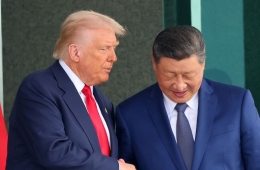
[Asia Economy Reporter Lim Cheol-young] After U.S. President Donald Trump rejected the tentative agreement reached by the South Korea-U.S. defense cost-sharing negotiation team, he recently stated that "South Korea has agreed to pay more money to the U.S. for defense cooperation," sparking an ongoing off-the-record verbal exchange surrounding the negotiation process. Immediately following the remarks, a senior White House official told Voice of America (VOA) that "negotiations with South Korea are ongoing, and President Trump has made it clear that U.S. allies worldwide, including South Korea, need to contribute more," leading to speculation that Trump has employed his characteristic art of the deal.
Trump's remarks came during an interview with foreign media on the 29th of last month (local time). Without specifying an exact amount, he said, "South Korea has agreed to pay more. They are paying more than when I took office." This came just nine days after he pressured South Korea to pay a higher share of defense costs by stating at a regular White House briefing on the 20th, "I rejected South Korea's proposal."
Previously, Trump had outright rejected the tentative agreement between South Korean and U.S. working-level officials, which included a 13% increase in the contribution compared to the previous year and an extension of the negotiation cycle to five years. The U.S. side initially demanded $5 billion?more than five times the existing defense cost-sharing amount?in early September last year, later lowering it to around $4 billion during negotiations. However, there were continuous criticisms both domestically and internationally that the U.S. was demanding an unreasonably high increase.
◆Trump Displays Negotiation Dominance? South Korean Government Denies, Saying "Negotiations Ongoing"= Recently, Trump's actions appear to strongly suggest an attempt to assert dominance in the negotiations by mentioning that South Korea agreed to pay more money right after rejecting South Korea's proposal. Analysts interpret this as an effort to pressure South Korea by making a significant increase in defense cost-sharing a foregone conclusion, while also intending to influence defense cost negotiations with Japan and NATO.
However, the South Korean government immediately refuted President Trump's claims. A senior Blue House official explained, "Defense cost-sharing negotiations are still ongoing," and "Nothing has been agreed upon." He emphasized, "The basic principle of negotiations is that nothing is agreed upon until everything is agreed upon." A Foreign Ministry official also stated regarding Trump's remarks, "There is nothing to explain about the progress of the negotiations." This situation contrasts with the previous occasions when the U.S. State Department and Department of Defense repeatedly denied South Korean government officials' remarks about an imminent agreement made between March 31 and April 1 (Korean time).
Given the U.S. pressure, it is unlikely that the South Korean government will immediately submit a revised proposal with a higher increase. Foreign Minister Kang Kyung-wha, attending the National Assembly Foreign Affairs and Unification Committee plenary session on the 28th of last month, responded to a question from Democratic Party lawmaker Ki Dong-min asking, "Is it true that President Trump rejected the 13% increase proposal?" by saying, "President Trump publicly said so himself. We believe that amount was the highest possible for us." She added, "We are striving to reach an agreement at a reasonable level that the National Assembly can approve."
Following this, Defense Minister Jeong Kyeong-doo attended the National Assembly Defense Committee plenary session on the 29th and responded, "Although the media reported a 13% increase in the contribution rate, that is not an exact figure," adding, "We are making great efforts to reach a mutually beneficial agreement among allies."

Defense Minister Jeong Kyeong-doo and Foreign Minister Kang Kyung-wha are entering the conference room on the 11th at the Government Seoul Office in Jongno-gu, Seoul, to attend the Cabinet meeting held via video conference with the Sejong Government Complex. Photo by Kang Jin-hyung aymsdream@
View original image◆Negotiations Enter Prolonged Phase... Forced Unpaid Leave for Korean Workers at U.S. Forces Korea= As defense cost-sharing negotiations have again reached a deadlock, the possibility of a prolonged agreement gap has increased. The 11th Special Measures Agreement (SMA) between South Korea and the U.S. has already been in a gap state for over four months and is entering its fifth month. Some speculate that if Trump deems a resolution unhelpful for his re-election, he may delay concluding the defense cost-sharing negotiations until November.
Meanwhile, innocent Korean workers employed by the U.S. Forces Korea have been exposed to livelihood threats. The U.S. Forces Korea Command has forcibly implemented unpaid leave starting from the 1st of last month for about 4,000 Korean workers, roughly half of the 8,500 Korean employees. After face-to-face negotiations in January, South Korea proposed resolving the Korean workers' wages first, but the U.S. side insisted on a comprehensive settlement and rejected this proposal.
Fortunately, a special law to support the livelihoods of Korean workers at U.S. Forces Korea, promoted by the government and the National Assembly, passed the plenary session on the 29th of last month with unanimous approval from all 185 members present. The special law includes provisions to provide support payments if the defense cost-sharing agreement ends and Korean employees of the U.S. Forces Korea do not receive wages due to the agreement gap. The government's support amount is expected to be around 1.8 to 1.98 million KRW per month, approximately 60% of the average monthly salary at the time of unpaid leave. This opens a path to support the livelihoods of thousands of Korean workers during the agreement gap.
The unanimous passage of the special law is seen as beneficial for future defense cost-sharing negotiations. A Defense Ministry official told reporters on the 1st, "All 185 members present at the National Assembly plenary session voted in favor, which is considered very unusual," adding, "Such unanimous support is interpreted as strengthening the negotiation position."
However, aside from concluding the defense cost-sharing negotiations, this issue cannot be fundamentally resolved. Moreover, serious cracks could emerge in the South Korea-U.S. alliance and joint defense posture. A diplomatic source analyzed, "Progress has been made in extinguishing the urgent fire of livelihood threats to Korean workers, but ultimately, a negotiation settlement is necessary," adding, "This turmoil may lead to a reevaluation of the South Korea-U.S. alliance and joint defense posture."
Hot Picks Today
 No Bacteria Detected in Arisu After 24 Hours of Repeated Drinking from a Tumbler
- "We Can't Just Let Them Be Damaged Inside"... Samsung Electronics Removes 360,000 Wafers in Preparation for Strike
- "Up to 100 Trillion Won in Losses Feared, It's Not About Second Place but Catastrophe"... Industry Minister: 'Emergency Mediation Unavoidable If Samsung Strike Occurs'
- Wife in $6.7 Million Debt Took Out $3 Million in Husband's Life Insurance, Poisoned Him... US Court: "She Can Never Be Released"
- "He's Handsome, It's Such a Pity?"... Lawyer Responds to Bizarre 'Appearance Evaluation' of High School Girl Murder Suspect
![[Image source=Yonhap News]](http://www.asiae.co.kr/news/img_view.htm?img=2020040110580653048_1585706287.jpg)
© The Asia Business Daily(www.asiae.co.kr). All rights reserved.