Foreigners Returning? Samsung Electronics 'Buy' After 8 Weeks VS KOSDAQ Weight Falls Below 10%
[Asia Economy Reporters Song Hwajeong and Ko Hyeonggwang] Since the outbreak of the novel coronavirus disease (COVID-19), foreign investors who had been continuing their sell-off in the domestic stock market have turned to 'buying' Samsung Electronics after 8 weeks, raising interest in whether foreigners are returning. However, in the KOSDAQ market, the foreign investors' market capitalization holding ratio has fallen below the 10% level, and the selling pressure remains, suggesting that a full return will take some time.
According to the Korea Exchange on the 13th, foreign investors purchased a net 233.6 billion KRW worth of Samsung Electronics last week, making it the most bought stock. Following a purchase of 52.7 billion KRW on the 7th, they continued net buying for four consecutive days with 95.3 billion KRW on the 8th, 5.1 billion KRW on the 9th, and 25.6 billion KRW on the 10th. This is the first time in over two months since February 7 that foreigners have net bought Samsung Electronics for four consecutive days. On a weekly basis, it is the first net purchase of Samsung Electronics in 8 weeks. Until last week, foreign investors had maintained a selling trend in the domestic stock market for 9 consecutive weeks, during which Samsung Electronics was the most sold stock. The selling scale reached 6.8359 trillion KRW. The total net selling by foreigners during this period was 20.2199 trillion KRW, with Samsung Electronics accounting for about 34% of the total.
As foreign investors who had been persistently selling Samsung Electronics have turned to net buying, expectations for a shift to foreign buying in the domestic stock market are growing. In particular, changes in foreign investor supply and demand are expected due to the oil production cut agreement. The decline in oil prices has been cited as one of the main reasons for foreign selling, as Middle Eastern funds, which are highly dependent on oil, withdrew due to the drop in international oil prices. OPEC+ (a coalition of OPEC and 10 major oil-producing countries) held an emergency video conference on the 12th and agreed to cut oil production by 9.7 million barrels per day (excluding gas condensate) for two months from May 1 to the end of June. Labor Gil, a researcher at NH Investment & Securities, said, "The production cut agreement among major oil-producing countries could explore the possibility of changes in foreign investor supply and demand due to rising oil prices."
However, due to factors such as economic slowdown, it is analyzed that foreigners will not return in a short period. Researcher Noh said, "Concerns about recession due to weakening economic indicators remain, and short-term market dollar liquidity tightening has not completely disappeared, so more time is needed before a net buying shift by foreigners," adding, "It is reasonable to expect the production cut agreement to be a factor slowing down foreign net selling."
In the KOSDAQ market, the foreign investors' market capitalization holding ratio has fallen below 10%, and the selling pressure remains. As of the closing price on the 10th, foreign investors held 22.1403 trillion KRW out of the KOSDAQ market capitalization of 224.2625 trillion KRW. The share ratio based on market capitalization is 9.87%. This is the first time in about 3 years and 5 months since October 25, 2016 (9.99%) that the foreign share ratio in KOSDAQ has fallen below 10%.
The foreign share ratio in KOSDAQ peaked at 14.50% on January 15, 2018, and has been declining since. This year, it peaked at 11.10% on April 20 and gradually decreased, falling below 10% on the 8th of this month (9.97%), and has remained in the 9% range for three consecutive days since. Foreign investors have net sold 2.6842 trillion KRW in the KOSDAQ market over the past year, with 65% of that amount, 1.738 trillion KRW, sold this year alone.
The stock most sold by foreigners in the KOSDAQ market over the past year is Celltrion Healthcare, totaling 817.9 billion KRW. Helixmith (327.7 billion KRW) and Ananti (234.5 billion KRW) also saw sell-offs in the 200 to 300 billion KRW range. Medytox (182.4 billion KRW), Seegene (153.2 billion KRW), Patron (96.8 billion KRW), SFA (92.5 billion KRW), Mezzion (91.4 billion KRW), and HLB (91.0 billion KRW) were also among the top net sold stocks.
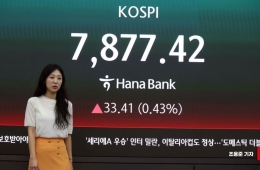
In the KOSPI market, with a market capitalization of 1,251 trillion KRW, foreign holdings have decreased to 464 trillion KRW, with a share ratio dropping to 37.14%. Before the spread of COVID-19, the share ratio hovered around 39% in January but gradually fell to the 37% range.
Hot Picks Today
 At President Lee's Call to "Give Enough to Shock," Whistleblower Rewards Become a Real Lottery
- If a Samsung Electronics Employee with a 100 Million Won Salary Receives a 600 Million Won Performance Bonus, Taxes Total 247.19 Million Won
- Lived as Family for Over 30 Years... Daughter-in-Law Cast Aside After Husband's Death
- "Who Is Visiting Japan These Days?" The Once-Crowded Tourist Spots Empty Out... What's Happening?
- Park Minshik Shaves Head: "I Will End Han Donghoon's Predatory and Parasitic Politics"... Ongoing Calls for Conservative Consolidation in Busan Buk-gu Gap within PPP
Lee Kyungmin, a researcher at Daishin Securities, said, "The outflow of funds by foreign investors is largely influenced by psychological factors," adding, "Foreign investors react sensitively to global financial market trends, and considering that the direction of the domestic stock market is determined especially by their supply and demand, the adjustment of the domestic stock market due to COVID-19 is inevitable."
© The Asia Business Daily(www.asiae.co.kr). All rights reserved.