GS Geonseol Trusts New Businesses Despite Challenges in Housing and Plant Sectors
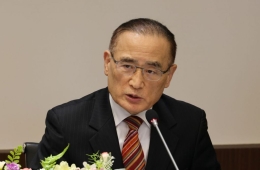
[Asia Economy Reporter Jang Hyowon] GS Engineering & Construction is fervently investing in new businesses under the leadership of President Heo Yunhong. This is to overcome the stagnant housing market and plant industry conditions.
Recently, the housing market has contracted due to various regulations such as the government's 'price ceiling on pre-sale prices.' The plant business is also facing an uncertain future due to the sharp drop in international oil prices. As a result, the market is paying close attention to whether GS E&C's new business investments will become a growth engine or a stumbling block.

◆Order Backlog 'No Issues'
GS E&C posted separate financial statements last year with sales of 9.4851 trillion KRW, a 19.5% decrease compared to the previous year. Operating profit and net profit for the same period were 680.9 billion KRW and 441.5 billion KRW, down 30.6% and 26.2%, respectively.
Looking in detail, sales in the plant division dropped 28.4% from 4.1536 trillion KRW in the previous year to 2.9745 trillion KRW, significantly impacting the overall sales decline. The plant division's net loss also surged from 81.7 billion KRW in 2018 to 180.2 billion KRW last year. The increased fixed cost burden due to the termination of the Ruwais Refinery (RRW) project in the United Arab Emirates was the cause.
Sales in the architecture and housing division, famous for the apartment brand 'Xi,' also decreased. Sales in this division were 5.5955 trillion KRW, down 13.5% from 6.4672 trillion KRW in the previous year. This was because planned pre-sales were postponed to this year due to the price ceiling regulation. Last year, 16,616 housing units were pre-sold, and 25,641 units are planned for pre-sale this year.
GS E&C's business segments as of last year were architecture and housing (59%), plant (31.4%), infrastructure (9.1%), and others (0.5%). Until 2015, the plant business held the largest share, but from 2016, the plant market declined while the apartment pre-sale market improved, expanding housing supply and reversing the sales share.
The plant division is expected to remain sluggish this year as well, with international oil prices falling to the $20 range. Middle Eastern countries reduce capital expenditures such as plant facility expansions when profitability worsens due to falling oil prices.
On the other hand, although the housing division experienced some disruptions in pre-sale plans due to COVID-19, it is expected that supply will be released all at once once the pandemic subsides. Additionally, the price ceiling regulation was delayed by three months, providing some leeway.
Despite decreased performance, the order backlog increased. The order backlog can be reflected in future sales and is a leading indicator of future profits. GS E&C's order backlog last year was 41.8372 trillion KRW, up 5.4% from 39.692 trillion KRW the previous year. New orders also remained in the 10 trillion KRW range following 2018.
◆Success or Failure of New Business Investments is 'Key'
GS E&C's financial condition is at a sound level. As of last year, GS E&C's debt ratio was 205.6%, down 26.4 percentage points from 232% the previous year. The current ratio was 134.9%, ranking mid-level among the top five construction companies.
However, net borrowings, which subtract cash equivalents from total borrowings, increased considerably. GS E&C's net borrowings last year were 753.4 billion KRW, a 746.5% increase from 89 billion KRW the previous year. Cash remained unchanged, but corporate bonds and long-term borrowings increased significantly.
Last year, GS E&C issued corporate bonds worth 320 billion KRW with an interest rate in the 2% range and foreign currency bonds worth 114 billion KRW. Long-term borrowings also increased by 104% year-on-year, with about 200 billion KRW in won-denominated loans from HSBC and YK Gaepo, and 150 billion KRW in foreign currency loans from the Export-Import Bank of Korea.
The reason for increasing borrowings is interpreted as to proceed with new investments. At the end of last year, Heo Yunhong, eldest son of GS Group Chairman Heo Changsoo, took the helm of GS E&C management. Since 2018, President Heo has been in charge of the new business division and is focusing on new business investments to overcome the construction industry downturn.
Looking at GS E&C's cash flow from investing activities last year, there was a net outflow of 634.4 billion KRW, about three times the 240.2 billion KRW of the previous year. In particular, acquisition of equity securities in affiliates increased by 246.9% to 376.4 billion KRW compared to the previous year.
In fact, on the 20th (local time), GS E&C acquired the German modular company 'Danwood' for 180 billion KRW. It is also entering the Indian solar power and secondary battery recycling businesses. Additionally, President Heo plans to strengthen investment capabilities by establishing an asset management company called 'Zibesco.'
Experts advise examining the return on invested capital (ROIC) and other factors to verify the synergy between capital investments and construction business. Chae Sangwook, a researcher at Hana Financial Investment, said, "It is necessary to observe the efficiency of capital investments (ROIC) executed since the end of last year and the connection or synergy between capital investments and current business. In that sense, the new president's actions are important." According to financial information provider FnGuide, GS E&C's ROIC decreased from 41.0% in 2018 to 28.1% in the third quarter of last year. ROIC is the ratio of after-tax operating profit to operating assets, and a higher value indicates more efficient capital investment.
Hot Picks Today
 "Now Our Salaries Are 10 Million Won a Month" Record High... Semiconductor Boom Drives Performance Bonuses at Major Electronic Component Firms
- Experts Already Watching Closely..."Target Price Set at 970,000 Won" Only Upward Momentum Remains [Weekend Money]
- Prime Minister Kim Minseok: "Samsung Electronics Strike Could Cost Up to 1 Trillion Won per Day, 100 Trillion Won Total... Tomorrow's Talks Are the Last Chance" (Comprehensive)
- Did Samsung and SK hynix Rise Too Much?... Foreign Assets Grow Despite Selling [Weekend Money]
- Is It Really Like an Illness? "I Can't Wait to Go Again"—Over 1 Million Visited in Q1, Now 'Busanbyeong' Takes Hold [K-Holic]
© The Asia Business Daily(www.asiae.co.kr). All rights reserved.