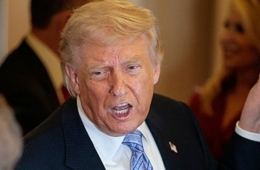
Lee Hae-chan, leader of the Democratic Party of Korea, is attending the Supreme Council meeting held at the National Assembly on the 11th and delivering opening remarks. Photo by Yoon Dong-joo doso7@
View original image[Asia Economy Reporter Jeon Jinyoung] There is much controversy surrounding Lee Hae-chan, leader of the Democratic Party of Korea, and his policy to ban the reinstatement of independent candidates. Lee himself was elected as an independent in the last general election and later rejoined the party, leading to criticism of "naeronambul" (double standards: "If I do it, it's romance; if others do it, it's an affair").
On the 16th, at a high-level strategy meeting held at the National Assembly, Lee stated, "If someone preparing to run in the April 15 general election within our party leaves the party after failing to receive nomination and runs as an independent, they will be permanently expelled."
Lee also said, "There are cases in the Honam region where candidates run under other parties and, after being elected, campaign to join or rejoin our party. In such cases, entry or reinstatement will also be prohibited."
Regarding this decision, Kang Hoon-sik, senior spokesperson for the Democratic Party, explained, "This is not about individual candidates," adding, "Such (independent candidacy) trends are not limited to one area but are present in several places, so an overall standard was established."
This policy by Lee appears to be a response to the surge of independent candidates defying party nominations. In fact, Moon Seok-gyun, former standing vice-chairman of the Gyeonggi Uijeongbu Gap district committee, who was involved in controversy over 'constituency inheritance,' reversed his decision not to run and decided to run again. Min Byung-doo, who was cut off in the nomination process, also announced plans to run as an independent in Dongdaemun. Additionally, Oh Je-se, excluded from nomination in Cheongju Seowon, North Chungcheong Province, is also considering running as an independent.
However, since Lee himself ran as an independent and later rejoined the party in the last general election, some within the party criticize this as "naeronambul." During the 20th general election, Kim Jong-in, then leader of the Democratic Party's emergency committee, excluded 21 lawmakers including Lee Hae-chan, Kang Ki-jung, Noh Young-min, Jung Cheong-rae, and Kim Hyun from nominations under the pretext of "eliminating pro-Roh factionalism." Lee responded by saying, "Politics should not be conducted that way," left the party, and ran as an independent. He criticized, "Decisions of a political party must have justification. There must be a procedure to accept results through an agreed-upon method."
There are also concerns that the 'ban on reinstatement' card could be overturned at any time. This is because depending on the rival party's performance, even a single seat could become crucial. In fact, in the last general election, the predecessor of the United Future Party, the Saenuri Party, allowed mass reinstatement. Ahead of that election, Won Yoo-chul, then floor leader of the Saenuri Party, firmly stated that "it is extremely difficult for independent winners to be reinstated, like a camel passing through the eye of a needle," referring to lawmakers who left due to nomination disputes and ran as independents. However, after the Saenuri Party was relegated to the second-largest party due to election defeat, it accepted seven independent lawmakers including Yoo Seung-min back into the party.
Hot Picks Today
 "Buy on Black Monday"... Japan's Nomura Forecasts 590,000 for Samsung, 4 Million for SK hynix
- "Plunged During the War, Now Surging Again"... The Real Reason Behind the 6% One-Day Silver Market Rally [Weekend Money]
- "We're Now Earning 10 Million Won a Month"... Semiconductor Boom Drives Performance Bonuses at Major Electronic Component Firms
- Last Year, Net Profit of Securities Firms' Overseas Subsidiaries Rose from $270 Million to $450 Million
- Experts Are Already Watching Closely..."Target Stock Price 970,000 Won" Now Only the Uptrend Remains [Weekend Money]
Moreover, since Lee's term will end shortly after the general election, there is a possibility that the ban on reinstatement will fizzle out. A political insider predicted, "If the Democratic Party wins against the United Future Party by a large margin, there will be no need to accept the re-entry of independent winners, but if not, this policy will lose its effectiveness after Lee's term ends."
© The Asia Business Daily(www.asiae.co.kr). All rights reserved.