Five Major Financial Holding Companies in Crisis Response "Full Business Review"
COVID-19 Spread in the New 3-Low Era... Biggest Threat Since Financial Crisis
Emergency Meetings Convened One After Another... Swift Response Measures Underway

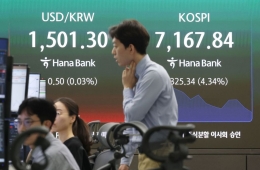
[Asia Economy Reporter Jo Gang-wook] The heads of South Korea's five major financial holding companies?Shinhan, KB, Hana, Woori, and NH?have emphasized a sense of crisis amid an emergency situation, swiftly responding by ordering a comprehensive review of their groups' business directions. This comes amid diagnoses that the so-called 'new three lows era'?low growth, low inflation, and low interest rates?is becoming entrenched, and growing concerns that the global spread of the novel coronavirus infection (COVID-19) could pose the greatest threat since the 2008 global financial crisis.
According to the financial sector on the 12th, the chairmen of the five major financial holding companies have recently convened emergency meetings one after another, emphasizing the seriousness of the crisis and ordering the prompt preparation of countermeasures. In particular, the two heads of NH Nonghyup Financial and Woori Financial have ordered a full review of this year's business plans.
Kim Kwang-soo, chairman of NH Nonghyup Financial, stated, "The overall economic situation has worsened more than expected," and announced a policy to review the business plans set at the end of last year. This is due to significant downside concerns such as the economic recession amid the COVID-19 situation and the possibility of further base rate cuts. Initially, NH Nonghyup Financial set this year's target at about 1.73 trillion won, approximately 50 billion won less than last year's 1.7796 trillion won. However, due to the recent rapid changes in the management environment, it is expected that a downward revision of this year's net profit target will be inevitable.
Son Tae-seung, chairman of Woori Financial, said, "Risks to the economic and business environment are increasing due to unforeseen circumstances," and ordered a re-examination of this year's management strategy and financial management direction. He also requested a review of risk factors for each subsidiary, including the economic and financial industry impacts caused by COVID-19. Woori Financial plans to revise this year's management strategy if necessary, depending on the progress of the situation and the results of the review.
The heads of Shinhan, KB, and Hana Financial also preside over emergency management meetings daily, receiving reports on the rapidly changing economic situation and emphasizing that the entire group is in an emergency.
Cho Yong-byeong, chairman of Shinhan Financial, shared a sense of crisis at an executive meeting on the 6th with holding company executives and CEOs of affiliates, emphasizing "close communication among group companies is important in difficult situations" and stressing 'One Shinhan.' This is Cho's management philosophy to leverage each affiliate's top expertise while creating strong synergy as one Shinhan. He particularly urged management to respond promptly to voices from the field and to make revolutionary improvements to existing work processes.
Yoon Jong-kyu, chairman of KB Financial, ordered daily monitoring and reporting of economic and financial markets, industry trends, and market risk indicators amid rapidly changing market conditions. Yoon instructed, "Prepare countermeasures according to the situation if abnormal signs occur." Earlier, KB Financial established a 'Group Emergency Management Committee' centered on Yoon, with CEOs of seven affiliates participating. This is to provide company-wide support for the COVID-19 situation and to prepare swift and practical countermeasures for the emergency.
Kim Jung-tae, chairman of Hana Financial, raised his voice, saying, "Let's overcome the crisis with a spirit of sacrifice in this difficult financial environment and lay the foundation for growth." He shared awareness of the deteriorated financial environment due to global trade frictions causing sluggish growth, government regulatory tightening, and the entry of new competitors, urging all employees to do their best in their respective positions.
The reason why the heads of each financial holding company are emphasizing the emergency situation is that they share the perception that the impact of this incident will be an 'unprecedented crisis.' The government's real estate loan regulations have frozen the loan market, and non-interest income has inevitably been hit by incidents such as derivative-linked funds (DLF) and Lime Asset Management. In particular, concerns are spreading that insurance companies may face a wave of bankruptcies due to negative margins caused by ultra-low interest rates and limits on returns from managed assets. Moreover, as the number of small and medium-sized enterprises and self-employed individuals affected by the COVID-19 outbreak increases, there are even forecasts that prolonged crisis will lead to a surge in marginal companies, worsening banks' asset soundness.
Hot Picks Today
 "Samsung and Hynix Were Once for the Underachievers"... Hyundai Motor Employee's Lament
- KOSPI Plunges After Hitting 8000; When Will the Rebound Come?
- "They Said It's Impossible to Get—Already Selling for Triple the Price: Crowds Worldwide Line Up for $600 Luxury Watch"
- "Children Should Be Cared for at Home by Their Mother"...Opinion Reversed for the First Time in 18 Years
- "That? It's Already Stashed" Nightlife Scene Crosses the Line [ChwiYak Nation] ③
International credit rating agency Moody's warned, "The spread of COVID-19 may cause disruptions in many domestic industries, which could lead to an expansion of asset quality risks for some banks exposed to these impacts." Additionally, Euler Hermes, the world's largest trade credit insurer affiliated with Allianz, predicted, "Due to increased economic uncertainty, there is a risk that corporate bankruptcies originating in Asia could spread to companies worldwide."
© The Asia Business Daily(www.asiae.co.kr). All rights reserved.