Deployment of Cheonghae Unit to Hormuz Strait
"Decision to Partially Expand Operational Scope"
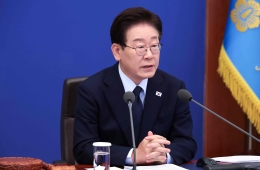
Ahn Gyu-baek, Chairman of the National Defense Committee of the National Assembly

The Cheonghae Unit will be dispatched to the Strait of Hormuz to conduct independent operations.
On the 21st, the Ministry of National Defense announced, "Considering the current situation in the Middle East, our government has decided to temporarily expand the deployment area of the Cheonghae Unit to ensure the safety of our citizens and the freedom of navigation for vessels."
The Wang Geon ship (4,400 tons), the 31st Cheonghae Unit, which is rotating missions at Muscat Port in Oman, will expand its operational area to the Strait of Hormuz to carry out its mission. The Wang Geon is composed of 300 personnel, including a boarding and inspection team made up of special forces (UDT) soldiers and an aviation unit operating maritime operation helicopters (Lynx).
The photo shows the Wang Geon ship departing from the Busan Naval Operations Base in 2018. Photo by Navy.
National Defense Committee Chairman Ahn Gyu-baek (Democratic Party) stated on the 21st, "I received a report from the Ministry of National Defense that it has been decided to expand the deployment of the Cheonghae Unit, which was dispatched to the Aden Bay area, to some regions (including the Strait of Hormuz)."
After hearing the Ministry of National Defense's briefing on current issues at the Defense Committee Chairman's office that day, Chairman Ahn explained to reporters, "When the dispatch consent bill was passed last year, it was stated that the scope of dispatch could be expanded in case of emergency," adding, "There have been 18 precedents, such as during the Libya incident or when Koreans were detained on a ship, where the operational scope was expanded."
The government's decision to independently dispatch troops, without participating in the US-led International Maritime Security Construct (IMSC, the Strait of Hormuz Security Coalition) headquartered in Bahrain, appears to be a comprehensive consideration of the Korea-US alliance and relations with Iran.
The atmosphere for independent dispatch by the government was sensed from the Standing Committee meeting of the National Security Council (NSC) at the Blue House on the 16th. While the NSC had stated in the meeting on the 9th that "ways to closely cooperate with the international community in the Middle East region were also reviewed," the wording changed in the materials on the 16th to "reviewed measures to protect the lives and property of citizens and companies and to ensure the safe and free navigation of ships."
On the same day, Presidential Chief of Staff Noh Young-min appeared on CBS Radio's 'Sisa Jaki with Jung Kwan-yong' and said regarding the deployment to the Strait of Hormuz, "There has been no decision to dispatch troops as part of the IMSC." Noh added, "However, in relation to the recent situation in the Middle East, we are reviewing measures to protect the lives and property of our citizens and companies and to ensure the safe and free navigation of our ships," and "considerable progress has been made internally."
The United States has repeatedly requested the Korean government to participate in the joint defense of the Strait of Hormuz. US Ambassador to Korea Harry Harris mentioned in a media interview on the 7th, "Korea also obtains a lot of energy resources from the Middle East," and expressed hope that "Korea would send troops there."
However, our government decided on an independent dispatch. It seems to have accepted the US request in some form to firmly maintain the strongest diplomatic relationship, the Korea-US alliance. If participating in the security coalition, there is a high possibility of conducting operations within the Strait of Hormuz. But in the case of independent dispatch, the situation changes. Japan, which previously decided on an independent dispatch, set its operational area outside the Strait of Hormuz.
Of course, considering the safety of citizens and companies and the crude oil supply situation, deployment to the Strait of Hormuz cannot be ruled out. The government's justification for "securing the safety of citizens" has increased as Iran shot down a Ukrainian passenger plane near its capital, Tehran.
In this regard, Japan's position is not different from ours. Japan concluded to send one Maritime Self-Defense Force escort ship and a P3C patrol aircraft to operate independently not in the Strait of Hormuz but in the Gulf of Oman, the northern Arabian Sea international waters, and the Aden Bay international waters. Japan may have also used dispatch as leverage in the defense cost-sharing issue. Japan's share of the US Forces Japan stationing costs amounts to 946.5 billion yen (about 10.3 trillion won) over five years from 2016 to next year. This is based on an agreement between the two countries during the Barack Obama administration, which expires at the end of March 2021. Negotiations for a new agreement will intensify from next year.
Hot Picks Today
 "Samsung and Hynix Were Once for the Underachievers"... Hyundai Motor Employee's Lament
- After Topping 8,000 Instead of Hitting 10,000... KOSPI Plunges—When Will It Rebound?
- "They Said It's Impossible to Get—Already Selling for Triple the Price: Crowds Worldwide Line Up for $600 Luxury Watch"
- Song Unseok: "6.3 Local Elections to Check Lee Administration's Unilateral Rule... Only a Strong Public Warning Can Stop Reckless Governance"
- "That? It's Already Stashed" Nightlife Scene Crosses the Line [ChwiYak Nation] ③
It is also possible to analyze that our government intends to take preemptive measures regarding the deployment to the Strait of Hormuz to use it as leverage in the difficult Korea-US defense cost-sharing negotiations. Contributing to stabilizing the Middle East situation while staying out of the US-led "joint defense" can be read as a kind of "compromise" considering relations with Iran.
© The Asia Business Daily(www.asiae.co.kr). All rights reserved.