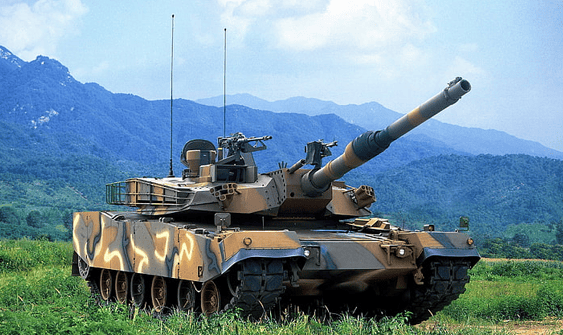
As the defense industry continues to boom, Hyundai Wia is considering selling its defense business division, a segment it has operated for over 50 years.
According to the investment banking (IB) industry on April 20, Hyundai Wia is reviewing the sale of its defense business division to Hyundai Rotem and has already begun working-level preparations, aiming to complete the transaction within the year. Hyundai Wia has stated, "We are considering it, but nothing has been finalized." In this edition of M&A Insights, we examine the reasons behind Hyundai Wia’s decision to divest its thriving defense business and the assessment of the securities industry.
Half a Century in Defense, a “Core Asset” Now Considered for Sale

Hyundai Wia’s defense division has been active since the company’s inception in 1976, focusing on large-caliber artillery such as the K9 self-propelled howitzer barrel and the main gun for the K2 tank. Defense sales nearly doubled from 223 billion won in 2023 to approximately 400 billion won last year, with an operating profit margin (OPM) reaching 10%.
While the division accounts for only 5% of Hyundai Wia’s total sales, it generates 20% of its operating profit, making it a core business unit. As the company begins to recognize revenue from the second round of K2 orders, it has secured visibility for annual growth exceeding 10%.
This sale can be seen as part of restructuring within the Hyundai group. By consolidating defense capabilities under Hyundai Rotem, Hyundai Wia can focus on automotive parts and future businesses. Currently, Hyundai Rotem manufactures the K2 tank chassis and turret, while the main gun, a key component of firepower, is supplied by Hyundai Wia. If Hyundai Rotem acquires the defense business division, it will achieve vertical integration for the tank and self-propelled howitzer firepower systems, boosting its package competitiveness in export bids.

Yoo Jiwoong, an analyst at Daol Investment & Securities, stated, "Since around 2020, Hyundai Wia has been continuously integrating fragmented business units and upgrading its business structure. Excluding the defense business, the operating margin of the automotive parts segment remains at only about 2%. This sale is significant because it can improve asset efficiency and accelerate a shift toward a future-industry-focused portfolio."
It is also notable that this is an additional restructuring review just nine months after last July’s sale of the machine tool business. Kim Kwiyun, an analyst at Daishin Securities, said, "If the sale materializes, Hyundai Wia will be able to secure additional cash following the sale of the machine tool business. If the division is sold at a reasonable value, it could lead to increased funding, expanded investment in new businesses, and a rise in corporate value as results become visible."
From 370 Billion to 880 Billion Won... Valuation Varies by Method

The key issue is the sale price. Daishin Securities noted, "Since both Hyundai Wia and Hyundai Rotem are listed companies, the sale price will be determined fairly in accordance with the Capital Markets Act, the Fair Trade Act, and shareholder value." The value of Hyundai Wia’s defense business division is estimated at a minimum of 370 billion won and up to 880 billion won, depending on the valuation method. Applying a 50% unlisted discount to the domestic defense industry’s 12-month forward PER (price-to-earnings ratio) average of 35.6 times, the value is around 550 billion won; based on the EV/EBITDA (enterprise value to earnings before interest, taxes, depreciation, and amortization) multiple, the valuation could reach up to 880 billion won.

Using the DCF (discounted cash flow) method, which calculates corporate value by discounting expected future cash flows to present value, the division is valued at around 400 billion won. Analyst Kim added, "If the sale price exceeds Daishin Securities’ estimate of 370 billion won, expectations for expansion into new businesses will remain valid."
The secured funds are expected to be directed toward thermal management systems (TMS) and industrial robots. Analyst Yoo commented, "Hyundai Wia has presented plans to expand strategic investments between 2026 and 2028, with a strong likelihood of focusing on TMS and industrial robots." TMS, a core component group that controls battery and powertrain temperatures in electric and hybrid vehicles, is a field directly linked to vehicle efficiency and performance.
1 Trillion Won for Thermal Management, 400 Billion Won for Robots... Betting on Future Businesses

The goal for the thermal management business is to expand from about 100 billion won last year to 1 trillion won by 2030. The industrial robot business, focused on automated guided vehicles (AGV), autonomous mobile robots (AMR), and collaborative robots, is also planned to grow from the current annual 100 billion won to 400 billion won by 2028. Analyst Yoo projected, "For the thermal management segment, there is potential to expand beyond Hyundai Motor Group to other OEMs (original equipment manufacturers) and applications, making it a core driver of mid- to long-term growth."
Securities firms have set different target stock prices. Reflecting the possibility of the defense sale, Daol Investment & Securities set a target price of 140,000 won, while Daishin Securities set it at 105,000 won. The closing price on April 17 was 83,200 won. Analyst Yoo emphasized, "The current PBR (price-to-book ratio) is 0.6 times, and the value of future businesses such as robots and thermal management, which have been intensively fostered since 2020, is not yet fully reflected."


There are also short-term risk factors. Analyst Kim noted, "The Iran war and the fire at a parts supplier in Daejeon could lower domestic plant utilization rates and impact second-quarter results. The sale of a high-margin business division is also expected to have a negative short-term effect on performance."
As the Korean defense industry enjoys a boom, the market is closely watching whether Hyundai Wia will sell its defense business and bet on thermal management and robots, and what results this decision will yield in 2027-2028.
-

Reporter Kim Daehyun kdh@asiae.co.kr
-
Edit Kim Inwook kiminuki@asiae.co.kr
© The Asia Business Daily(www.asiae.co.kr). All rights reserved.



![[Battleground Preview] Seoul Han River Belt: Opposition Judgment vs. Real Estate Sentiment](https://cwcontent.asiae.co.kr/asiaresize/304/2026042211350336008_1776825304.jpg)