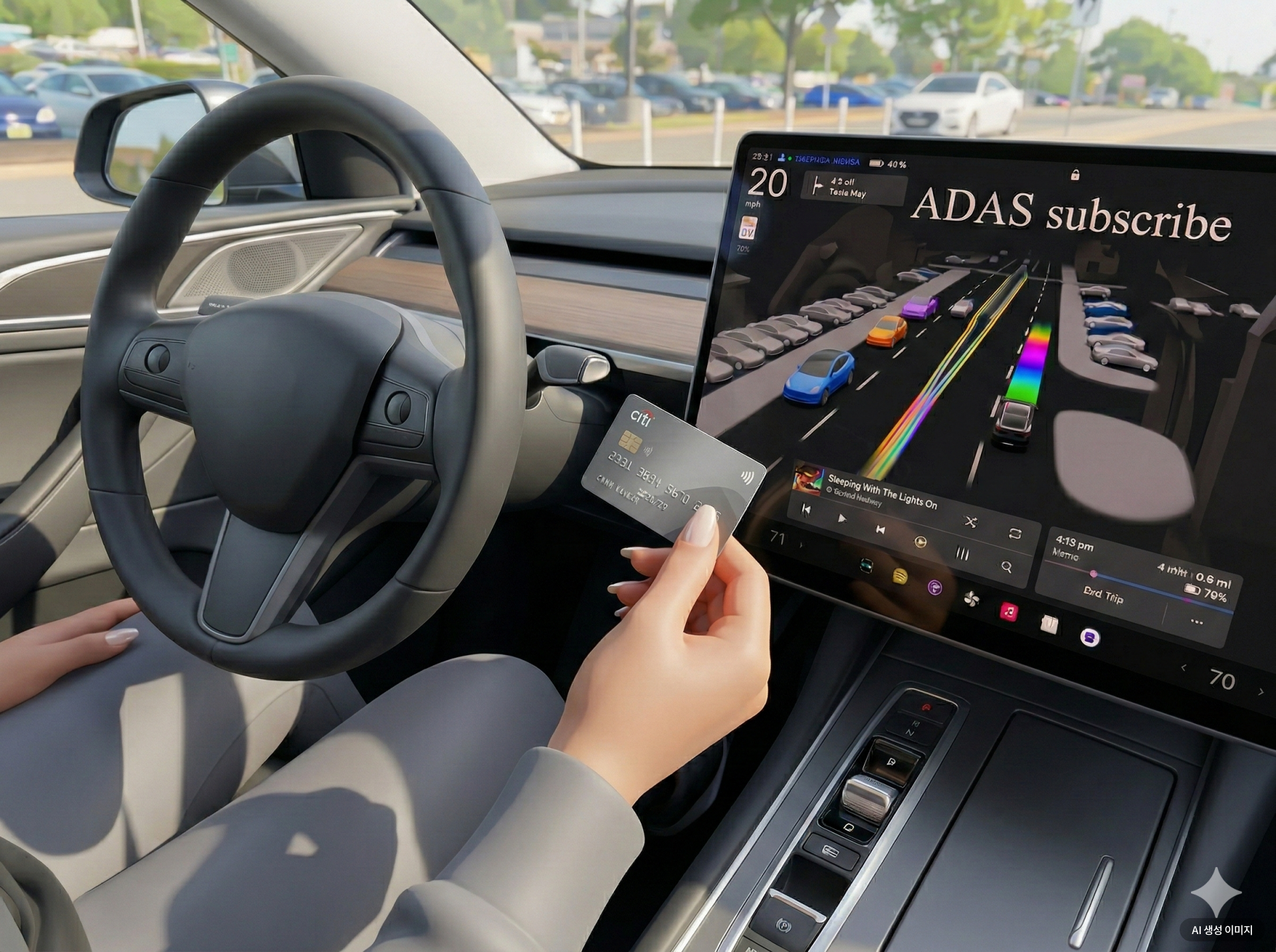
The balance of competition in the Advanced Driver Assistance System (ADAS) market is shifting. In the past, "technological prowess," demonstrated through sensor precision and algorithm performance, was the key focus. Now, however, the decisive factors are how frequently these features are used and how much revenue they can generate.

According to the results of a recent survey conducted by Boston Consulting Group (BCG) and Bosch, which polled approximately 3,000 vehicle owners across seven countries—Korea, the United States, China, Japan, the United Kingdom, Germany, and France—more than half of consumers indicated they are willing to pay extra for the latest ADAS features.
However, the actual usage rates fell short of expectations. As a result, automakers now see encouraging consumers to use their ADAS functions more frequently in daily life as a crucial key to future success.
![[EuraCarCar] Emptying Wallets for Advanced Features in New Cars... Just Subscribing for Convenience and Safety](http://www.asiae.co.kr/news/img_view.htm?img=2026022616133554648_1772090015.jpg)
To be specific, 56% of drivers worldwide responded "yes" to the question, "Would you be willing to pay more for a vehicle equipped with the most advanced driver assistance features?" Meanwhile, 24% were neutral, and 20% said "no."
By country, 60% of Korean respondents answered "yes," with 26% neutral and 23% "no," figures similar to the global average. In contrast, 85% of Chinese respondents said "yes," significantly surpassing the global average. This suggests that, moving forward, highlighting ADAS features will become a key strategy for automakers aiming to target the Chinese market.

However, actual ADAS usage patterns were less proactive than anticipated. Many drivers tended to use ADAS only under specific conditions—such as in congested traffic on highways or during long-distance travel—rather than at all times. In other words, while vehicles are equipped with these features, "conditional use" rather than everyday utilization is the norm.
BCG commented on this, stating, "Although ADAS has already become fairly widespread, the industry’s challenge now is how much daily usage experience can be accumulated." While consumer awareness is high, a lack of understanding about the features and previous malfunction experiences are significant barriers to continuous activation.
The report especially emphasized that the focus of competition is shifting from showcasing technological power to increasing reliability. In the early stages, having the most advanced features was important, but now, stable operation and consumer trust are directly linked to profitability.
In fact, some consumers who experienced unnecessary interventions or system errors ended up disabling these functions. The report viewed this not as a simple technical issue, but as a risk that could undermine the entire monetization structure.


The Korean market is not much different from these trends. While interest in and expectations for advanced features remain high, there is still a strong tendency to use them only in specific situations rather than continuously. At the same time, price sensitivity is high, making the balance between perceived value and cost a core variable for securing profitability.
The report predicts that strategies surrounding the revenue model for ADAS will be restructured. Responses to the question, "Which payment method do you prefer for ADAS?" varied by country, purchasing method, and generation.
By country, most nations showed a majority preference for a one-time payment (included in the vehicle price), but in Korea, only 41% favored a one-time payment. Instead, 27% answered that both one-time payment or monthly subscription were acceptable, 18% said it depends on the function, and 14% preferred a monthly subscription.
![[EuraCarCar] Emptying Wallets for Advanced Features in New Cars... Just Subscribing for Convenience and Safety](http://www.asiae.co.kr/news/img_view.htm?img=2026022710075455602_1772154474.jpg)
Additionally, the younger the age group, the higher the acceptance of monthly subscription models. Only 7% of baby boomers aged 60 or older preferred monthly subscriptions, whereas 21% of millennials indicated a preference for monthly subscriptions.
Based on these findings, the report projects that strengthening customer education, designing intuitive user interfaces, and providing transparent pricing and package structures will become major competitive factors in the future. ADAS has now become a basic feature in most vehicles. Going forward, establishing monetization strategies based on consumer trust remains a key challenge for the automotive industry.
-

Reporter Lee Seungjin promotion2@asiae.co.kr
-
Edit Bae Byoungmin wuhaha@asiae.co.kr
© The Asia Business Daily(www.asiae.co.kr). All rights reserved.