"Isn't that the Korean brand BTS V advertises?"

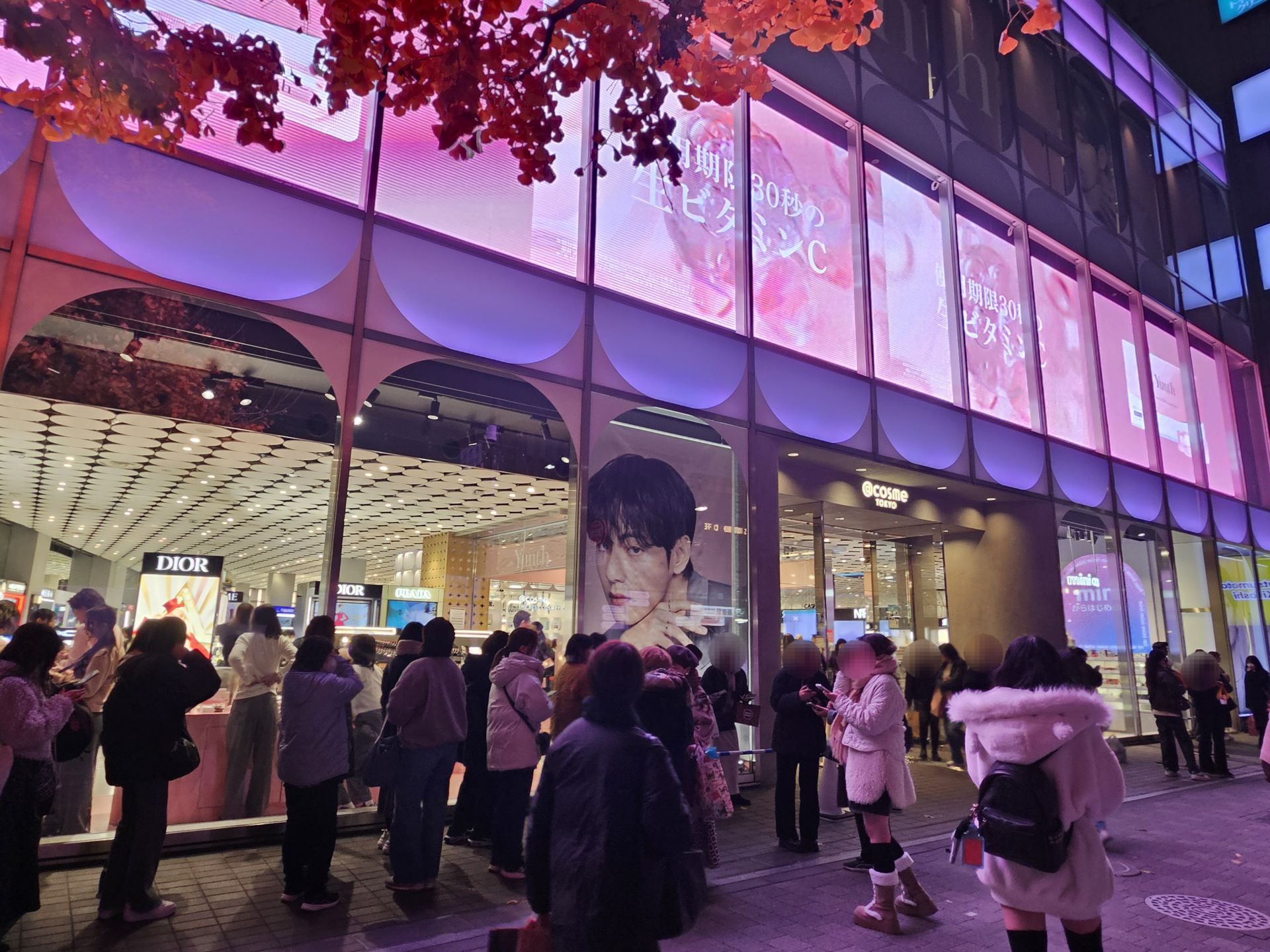
Line waiting for the 'Yunth' pop-up in front of @cosme Tokyo on the 12th of last month. Photo by Jaehyun Park
원본보기 아이콘Last month, Japan's largest beauty select shop, @cosme TOKYO, was bustling with a line of people waiting to enter the pop-up store of the Japanese beauty brand 'Yunth'. Located in Harajuku, a shopping district frequently visited by Millennials & Gen Z in Japan as well as tourists, the store featured a giant photo of BTS member V, catching the eyes of visitors. Yunth appointed V as its ambassador on October 29 last year. As a result, some visitors mistakenly thought Yunth was a K-Beauty brand. Even the pop-up staff referred to it as a "Korean brand." At the pop-up, Ms. Shibata (22) said, "I thought it was a Korean brand because V is the model," expressing her surprise. As K-Beauty gains popularity in Japan, some local brands are even being mistaken for Korean cosmetics.
"Every K-Cosmetics Welcome"... Korean Cosmetics Hit It Big with 'Value for Money'

In fact, at Matsumoto Kiyoshi Shibuya, one of Japan's three major drugstores, K-Beauty brands occupied about 10 out of 30 cosmetics displays, and at Hands Shibuya, they accounted for about half. Especially at Mega Don Quijote Shibuya, which is popular among tourists, over 80% of the cosmetics shelves were filled with K-Beauty products. These products highlighted ingredients such as 'PDRN' and rice germ, and used Korean language on the packaging to leverage K-Beauty in their marketing. K-Beauty products like Romand and Torriden were also easily found at convenience stores such as Lawson, FamilyMart, and 7-Eleven.
Since 2020, when the COVID-19 pandemic broke out, Korean cosmetics have been selling rapidly in Japan. During the pandemic, social distancing led to increased viewership of global video platforms like Netflix, YouTube, and TikTok, which boosted affinity for Korea through K-Pop and K-Dramas, in turn driving demand for K-Beauty. At the time, the phrase "Every K-Cosmetics Welcome" became popular.
With overseas travel restricted, Japanese consumers flocked to online shopping malls like Qoo10 Japan that sold Korean cosmetics, and even traditionally closed-off local distributors began offering K-Beauty products in offline stores. Later, major brands such as Anua and TirTir launched aggressive influencer marketing campaigns locally, resulting in huge success as K-Beauty established itself as "value for money" cosmetics in Japan.
K-Beauty Surpasses 'Beauty Powerhouse' France... Offering Price, Design, and Ingredients


According to the Korea Cosmetic Industry Institute, K-Beauty exports to Japan reached a record high of $1.08747 billion last year. Since 2022, Korean cosmetics have overtaken France to become the number one imported cosmetics in the Japanese market.
Ms. Shiori (32), whom we met at @cosme Tokyo, said, "I first learned about K-Beauty through social media. I know all the K-Beauty brands displayed here. Compared to Japanese cosmetics, the prices are lower, so I can try various products, and above all, Korean products are cute." Ilie Mendoza (31), a tourist from the Philippines, while putting several Dalba mist serums in her basket, explained, "A contestant from 'Physical: 100 Asia' used Dalba mist serum and their skin improved, so it's become explosively popular in the Philippines. My daughter and her friends asked me to buy some, so I picked up several." She added, "Korean products have good ingredients like collagen and the quality of sheet masks is high."
"I Even Wear K-Brands"... Both Mothers and Daughters Are Enthusiastic About K-Fashion

The 'Hieta' store on the 4th floor of Parco Department Store in Shibuya, Tokyo, Japan. Even during weekday mornings, the footsteps of women in their teens and twenties continued. Photo by Jaehyun Park
원본보기 아이콘The popularity of K-Beauty is expanding to K-Fashion. Hyundai Department Store opened a permanent store on the 4th floor of Parco Department Store in Shibuya, Tokyo, known as the "street of youth." This location operates pop-ups introducing new Korean fashion brands every two weeks; last month, K-Fashion brands ORR and Hieta were featured. At that time, the ORR store saw a steady stream of female customers in their 40s.
After successfully hosting K-Fashion pop-ups since 2024, Hyundai Department Store was offered a permanent location by the department store. Ms. Megumi (41), whom we met at the ORR store, was holding a shopping bag with a coat and said, "K-Fashion has good design and quality, and is 10-15% cheaper than Japanese brands, making it reasonable. However, there still aren't many K-Fashion brand stores in Japan, which is disappointing."
Spread by SNS and Word of Mouth... "I Buy from Musinsa"
Recently, K-Fashion has shown great growth potential in the Japanese online market. As Millennials & Gen Z who are comfortable with smartphones increasingly use Korean fashion platforms, the trend is growing. In Japan, the "Oshikatsu" (fan activity) culture gives influencers strong influence, and as they frequently wear Korean fashion, this leads to "Ditto consumption" (celebrity-following consumption). Ms. Momo (20), whom we met at a K-Fashion pop-up, said, "When I buy clothes, I often imitate the looks worn by influencers or am influenced by idols. Korean brands feel trendy in their design, so I often refer to photos of my favorite celebrities wearing them."
In Japan, K-Fashion brands are first discovered by late teens to early twenties through Korean social media, and then the trend spreads to mothers in their 50s. Among those in their 30s and 40s, K-Fashion is quickly spreading through word of mouth at work. Ms. Aoba (21) said, "Since COVID-19, I've been buying clothes online. I learned about Korean brands online, and these days I mainly shop on Musinsa."
According to global market research firm Statista, the Japanese fashion market is worth about 72 trillion won (approximately $50.6 billion), more than twice the size of Korea's. As a result, fashion platforms such as Musinsa and W Concept are opening pop-up stores locally to promote K-Fashion brands. Han Sanghun, head of The Hyundai Global Team at Hyundai Department Store, explained the reason for entering the Japanese market: "With the domestic fashion market saturated and brands feeling limited in their growth, we saw an opportunity as the number of foreign customers steadily increased after opening The Hyundai Seoul."
Kim Hyunju, head of brand marketing at Musinsa Japan, said, "Korean culture is trending across K-Food, K-Fashion, and K-Beauty. Among locals, there is even talk of wanting to acquire Korean nationality."
Korean Town's 'Tteokbokki and Chicken Restaurants' Packed with Customers


Around Shin-Okubo Station in Shinjuku, Tokyo's largest Korean town, Korean signboards such as Dongdaemun Yeopgi Tteokbokki, Sulbing, Sinchon Seolleongtang, Hong Kong Banjeom, and Nene Chicken are everywhere, and Korean supermarkets, chicken restaurants, and street food stalls are packed with customers. In particular, the 'Yoajeong' store, which went viral on social media, had lines of mostly female customers in their teens and twenties. Rino (16), whom we met there, said, "I ordered exactly what I saw on TikTok. I first encountered Korean food through dramas, and Korean cuisine feels unique and sophisticated."
At some Korean supermarkets, "Biyotte" yogurt from Seoul Dairy Cooperative was distributed without official import approval. Seoul Dairy has not yet received an import food notification approval for Biyotte from the quarantine office under Japan's Ministry of Health, Labour and Welfare. Due to delayed quarantine procedures, some Korean supermarkets distributed the product through unofficial channels.
However, K-Food has not yet penetrated as a staple for home meals. In most local Japanese supermarkets, aside from popular products like Milkis, Bong Bong, and Buldak Bokkeum Myeon, it is difficult to find Korean products in the processed foods section. Kim Hyungwoo, Head of Operations at CJ Food Japan, commented, "Most Japanese cuisine is sweet and mild, but Korean food has a wide spectrum of flavors, including spicy and salty. I believe that while people just haven't experienced K-Food yet, once they do, demand could increase significantly."
-

Reporter Park Jaehyun now@asiae.co.kr
-
Edit Lee Seonju sjlee109@asiae.co.kr
© The Asia Business Daily(www.asiae.co.kr). All rights reserved.