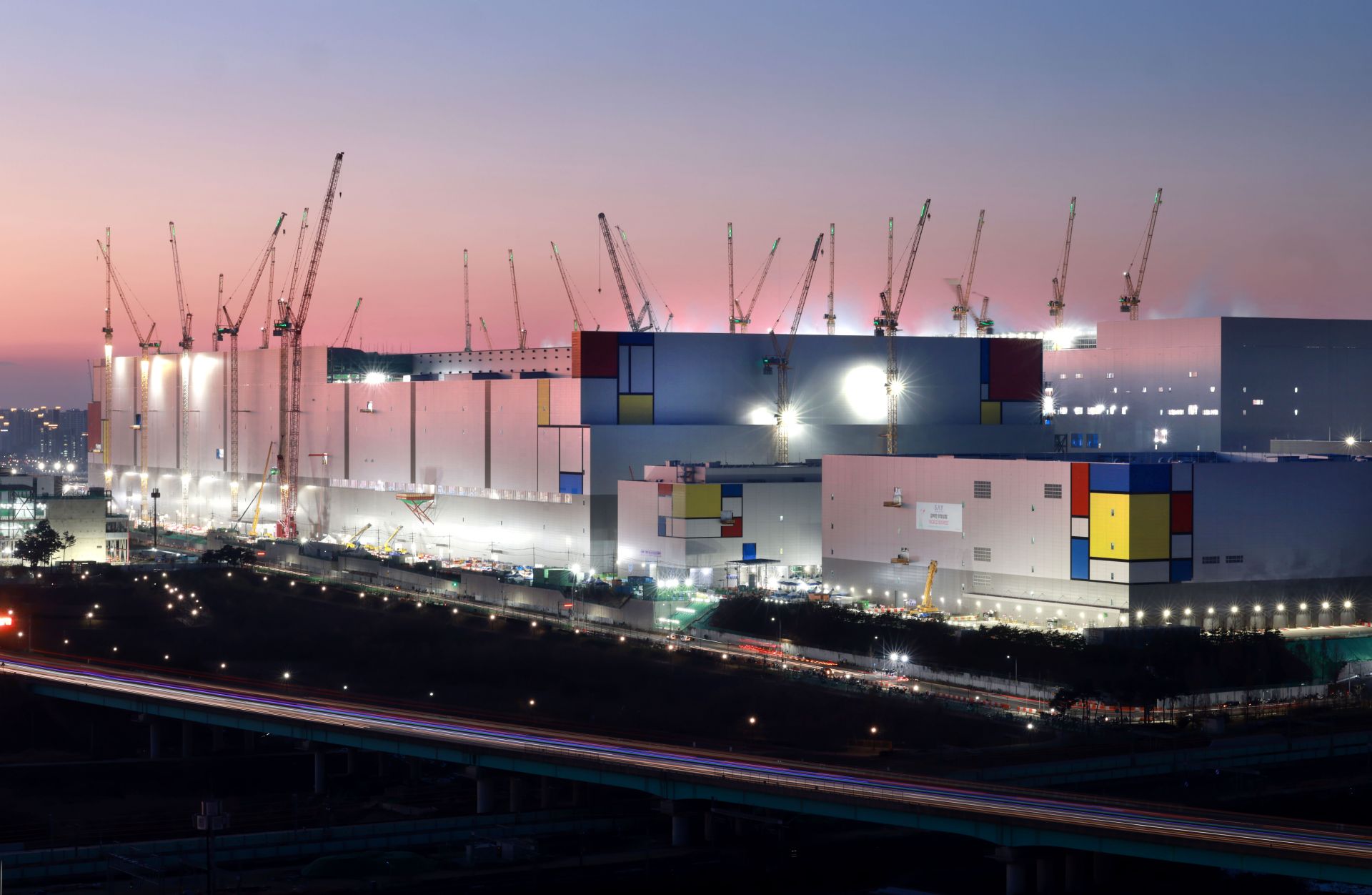
Samsung Electronics Foundry, which has signed a large-scale artificial intelligence (AI) chip supply contract with Tesla, is expected to raise its factory utilization rate to 60-70% within this year. The strategy is to increase utilization rates, mainly for mature processes, in order to offset fixed costs and improve profitability. This move is interpreted as an effort to secure the capacity to compete with Taiwan's TSMC in advanced processes such as 2nm (1nm = one billionth of a meter).
Expected to Expand from 50% Last Year to 60-70% This Year
According to the semiconductor industry on January 21, Samsung Foundry's fab utilization rate, which remained at around 50% last year, is expected to exceed 60% in the first half of this year. After winning orders for Nvidia's 8nm graphics processing units (GPUs) used in Nintendo's game consoles in Japan last year, it is also reported to have recently secured Intel's platform controller hub (PCH) volumes. There are even predictions that the fab utilization rate could rise to over 70% within the year.
Samsung plans to focus on improving profitability until the Tesla chip supply is fully underway. An industry insider commented, "Although overshadowed by the memory boom, the foundry business has been steadily securing significant clients and strengthening its fundamentals," adding, "If Tesla chips are supplied to the market and prove their performance, this could be a turning point where clients who have been deprioritized by TSMC switch to Samsung."

The key to foundry profitability is utilization rate. Due to high fixed costs, any idle production lines immediately lead to losses. Last year, Samsung Electronics supplemented its business roadmap and accelerated profitability improvements by focusing on yield enhancement and expanding orders for mature processes. In the third quarter of last year, Samsung Electronics' Device Solutions (DS) division posted an operating profit of 7 trillion won, with the memory business generating 7.7 trillion won in profit, while the foundry and System LSI divisions posted a loss of about 700 billion won. The fourth quarter, not yet disclosed, is estimated to show a memory operating profit of 18 trillion won and a non-memory loss of 1 trillion to 1.5 trillion won. Compared to the first half of last year, when quarterly losses exceeded 2 trillion won, the trend of performance improvement is clear.
Tesla's Next-Generation 'AI6' Chip to Begin Mass Production in 2028
Additionally, expectations for Samsung Foundry have grown after Elon Musk, CEO of Tesla, recently announced that the design of the new 'AI5 (3nm)' chip is in its final stages, and the next-generation 'AI6 (2nm)' chip design is in its early phase. Samsung Electronics signed a 23 trillion won supply contract for the AI6 chip with Tesla in July last year and also agreed to participate in AI5 production. Considering the design cycle of about nine months, the next-generation AI6 chip is expected to complete its design by the end of the year and enter mass production in 2028. While the AI5 volumes, to be split with TSMC and others, are relatively small, they are expected to serve as a meaningful reference for advanced processes in the market.

Some point out that Samsung Electronics is trapped in a "second-choice position." The Financial Times (FT), in a column on January 16, stated, "Samsung makes products that are chosen when the first-choice option is unavailable," evaluating that Samsung is riding the "slipstream" of semiconductor benefits. This is interpreted to mean that Samsung is only benefiting from companies in the foundry market that could not secure chip production from TSMC and are turning to Samsung as an alternative.
Raising Utilization Rate to Improve Profitability... Securing Capacity to Compete with TSMC
However, in the semiconductor industry, there is also an assessment that Samsung's strategy of prioritizing "profitability improvement" is realistically valid, given that the market share gap has widened tenfold. An industry insider said, "In a situation where the market share gap is extreme, it is a realistic judgment to buy time to catch up with the industry leader," adding, "Since Samsung is already in discussions with big tech companies such as Google and AMD, there is a strong possibility that the market landscape after 2nm will change."
-
Reporter Jang Heejun junh@asiae.co.kr
-
Edit Lee Kijae happylee17@asiae.co.kr
© The Asia Business Daily(www.asiae.co.kr). All rights reserved.