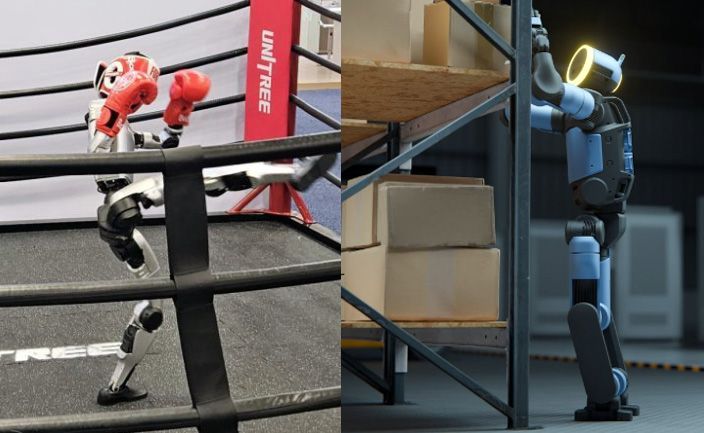
The robot leaps toward a person, delivers a flying kick, and then jumps up to smash a watermelon with a spinning kick.
A tall robot, standing at 1.8 meters, and a relatively smaller robot even engage in kickboxing matches.
They mimic human movements, wash dishes, put canned drinks in the refrigerator, operate vacuum cleaners, and even bring water, fruit, and other snacks to people-handling all sorts of household chores.
All of these are robots developed by Unitree Robotics, a leading Chinese robotics company.
"Our ultimate goal is to have robots working alongside people in the home. Within the next 5 to 10 years, robots will become essential assistants for humans."
At CES 2026, the world's largest electronics and IT exhibition, which concluded on January 9, 2026 (local time), Gary Xia, Marketing Manager at Unitree Robotics, shared this outlook on the future of humanoid robots.
Unitree: "Boxing is an extreme test... Targeting the market with cost-effectiveness"
At this exhibition, Unitree Robotics put its bipedal robot 'G1', capable of AI learning, at the forefront. G1 captivated visitors at the booth by showcasing dynamic performances such as boxing and dancing.

On the 6th (local time), the robot G1 is demonstrating boxing at the Unitary booth in the North Hall of the Las Vegas Convention Center (LVCC) during CES 2026 in the United States. Photo by Jun Park.
원본보기 아이콘The reason Unitree taught its robots to box was not simply to provide entertainment, but to test the limits of 'practicality.' Xia explained, "For humanoid robots to be deployed in real factories and homes, they must be able to handle all the rough movements found in human environments. Boxing serves as a kind of test that pushes robots into extreme work environments."
He especially emphasized the 'mobility' and 'stabilization' abilities demonstrated through boxing.
The key to commercialization, he said, is how quickly a robot can get back up after being hit or losing balance and falling to the ground. Unitree will begin full-scale customer deliveries of the G1 in April, leveraging its overwhelming price competitiveness at just over 20 million won.
Atlas: "More economic impact than 'kung fu'... Mass production experience sets us apart"
In contrast, South Korea is taking the most practical approach.
Boston Dynamics, the robotics subsidiary of Hyundai Motor Group, expressed confidence when competing with Chinese robotics firms.
While Chinese companies focus on robots mimicking human actions, Atlas is said to deliver performance beyond humans, such as joints that rotate 360 degrees, making it more suitable for real industrial sites.
For example, to work on objects behind it, Atlas can rotate only its torso 180 degrees, moving differently from humans and thereby increasing efficiency.
Jack Jakowski, Head of Atlas Development at Boston Dynamics, met with reporters on January 7, 2026 (local time), the second day of CES 2026, at the Hyundai Mobis business meeting room in the Las Vegas Convention Center. He said, "Chinese companies are actively entering the robot market, but I hope they will focus more on what kind of work robots can actually perform in industrial settings."
He added, "I don't think simply walking around or showing off 'kung fu' on site brings any economic benefit. To replace humans in complex operational work, we are leading this market by maintaining a significant hardware advantage."

Se-wook Oh, Executive Director and Head of Robotics Promotion at Hyundai Mobis (left), and Jack Jakowski, Head of Atlas Development at Boston Dynamics, are being interviewed by the press on the second day of CES 2026, the world's largest home appliance and IT exhibition, on the 7th (local time) at the Hyundai Mobis business meeting room in the Las Vegas Convention Center. Hyundai Motor Group.
원본보기 아이콘Se-wook Oh, Executive Director and Head of Robotics Promotion at Hyundai Mobis, also stated, "Chinese companies are focusing on mimicking human actions, but in contrast, Boston Dynamics' Atlas demonstrates 'superhuman' performance on actual mass production lines."
They have decided to address the chronic issue of hallucination in artificial intelligence (AI) through collaboration with Google. On January 5, 2026 (local time), the day before CES opened, Boston Dynamics and Google DeepMind announced a strategic partnership. The two companies plan to combine Gemini, which possesses intelligence, with Atlas, which possesses physical capabilities.

On the second day of CES, January 7 (local time), the robot Atlas demonstrated parts transportation at the Hyundai Motor booth at the Las Vegas Convention Center (LVCC) in Nevada, USA. Photo by Yonhap News
원본보기 아이콘Korean Airobot: "Starting with the most practical approach"
South Korea is also responding collectively through 'K-Alliance Max', led by the Ministry of Trade, Industry and Energy. Airobot, a leading Korean robotics company, presented a blueprint for manufacturing innovation at this CES by demonstrating 'Alice M1' moving items on a factory conveyor belt.

Eom Yunseol, CEO of Aerobot, is giving an interview to The Asia Business Daily at the Unitree booth in the North Hall of the Las Vegas Convention Center (LVCC) during CES 2026 on the 6th (local time). Photo by Park Juni.
원본보기 아이콘Eom Yunseol, CEO of Airobot, emphasized, "Rather than simply following the United States and China, Korea needs its own practical approach."
Alice M1 has localized 60% of its components, establishing a stable supply chain, and has been recognized for its technological prowess as a partner of Nvidia.

Eom Yunseol, CEO of Airobot, demonstrated Airobot's Alice M1 moving items in a factory at the Humanoid Alliance joint pavilion of 'K-Alliance Max' in the North Hall of the Las Vegas Convention Center (LVCC) during CES 2026 on the 6th (local time). Photo by Park Joonyi.
원본보기 아이콘Airobot is currently conducting proof-of-concept (PoC) trials with several companies and plans to begin full-scale deployment of robots in actual manufacturing sites starting in 2027, beginning with an initial batch of 20 units this year.
Which robot do you think will change the world more?
-

Reporter Park Joonyi giver@asiae.co.kr
-

Reporter Jun Youngjoo ange@asiae.co.kr
-
Edit Kim Inwook kiminuki@asiae.co.kr
© The Asia Business Daily(www.asiae.co.kr). All rights reserved.




![[Real-life Finance] Jeonse Shortage Persists...Tenants Should Secure Renewal Rights and Apply for Phase 3 New Town Housing](https://cwcontent.asiae.co.kr/asiaresize/304/2025062709264424349_1750984005.jpg)