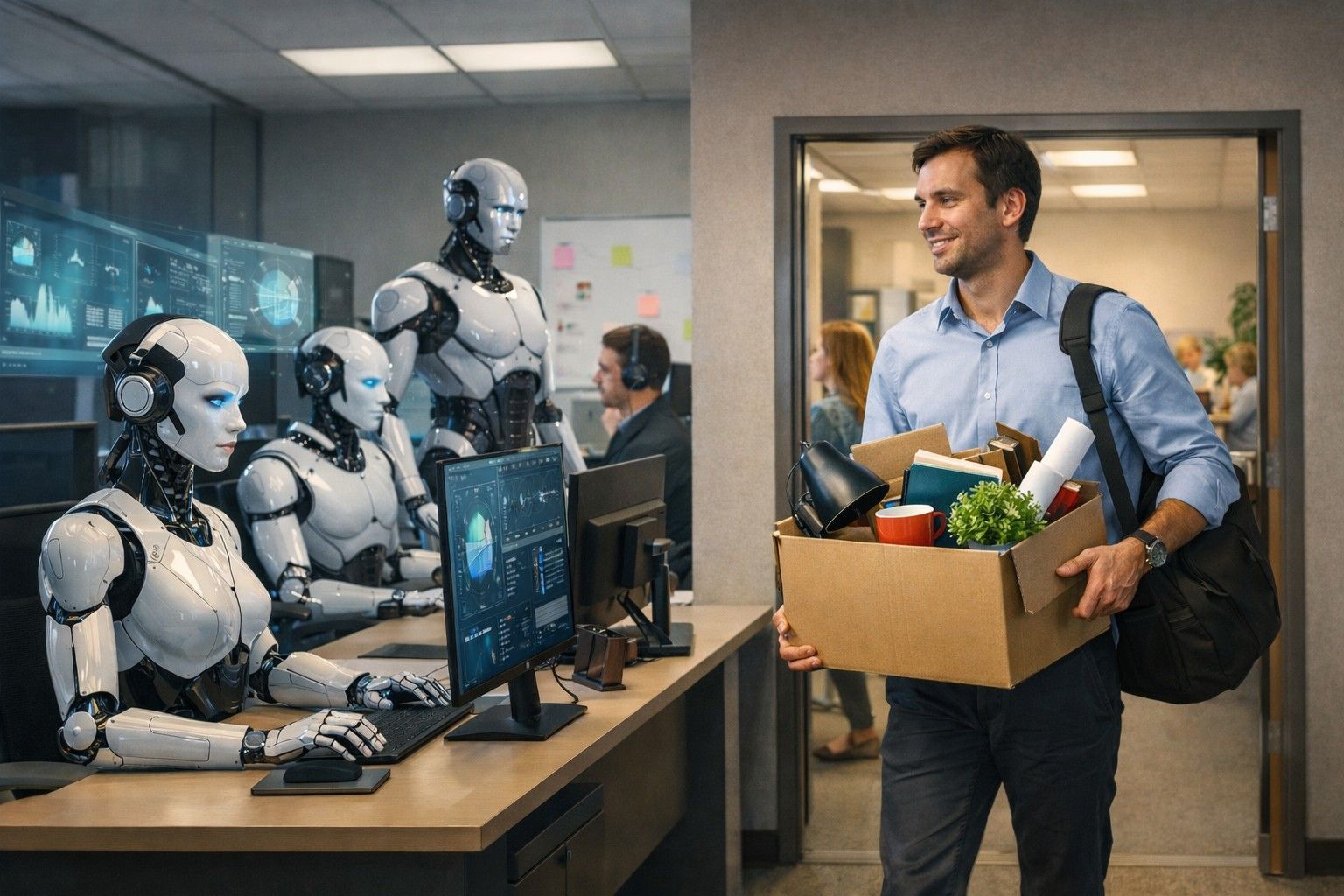

As artificial intelligence (AI) enters industrial sites, companies are increasingly focusing on shifting employee roles and reallocating work. While concerns are mounting that the spread of AI will lead to mass unemployment, companies are changing their workforce management strategies to maximize the benefits of AI. A growing trend is for AI to handle repetitive and standardized tasks, while humans are responsible for reviewing results, making decisions, and taking accountability.
"Shift to Support and Supervision Roles" 37.8%...Only 9.5% "Subject to Workforce Reduction"
In a survey conducted by The Asia Business Daily from December 8 to 19, targeting human resources, strategy, organization, and planning department staff at Korea's top 100 companies, 37.8% of 74 responding companies said that after adopting AI, employees previously performing certain tasks shifted from their original work to focus on support and supervision roles. This means that while AI has become the main agent for task execution, jobs have shifted to areas that AI cannot handle.
Twenty companies, or 27.0%, responded that employees took on new roles after retraining. Thirteen companies, or 17.6%, said that employees naturally moved to other departments or positions. In total, more than half of the companies indicated that staff were reassigned to other roles within the organization following AI adoption.

Image of a humanoid robot model under development by Persona AI. The Asia Business Daily DB
원본보기 아이콘On the other hand, only seven companies, or 9.5%, said that employees became subject to workforce reduction through organizational restructuring or contract adjustments. Only six companies, or 8.1%, responded that employees were left in standby positions without new assignments after being removed from their previous roles. This suggests that the introduction of AI is leading to organizational adjustments by changing job content and roles, rather than immediately reducing headcount.
29.7% Reassigned Based on Mid-to-Long-Term Strategy...Only 14.9% for Cost Reduction
This perception is also reflected in the criteria for workforce reassignment. The most common factor companies considered when reallocating employees after AI adoption was the need to restructure job functions according to mid-to-long-term strategies, cited by 29.7%. Whether employees possessed the necessary skills for their new roles accounted for 25.7%, while 20.3% considered whether reassignment would address manpower shortages or work gaps.
Fewer companies saw AI adoption primarily as a means of cost reduction or workforce downsizing. Only 14.9% prioritized labor or operating cost savings, and just 9.5% said they first considered whether current tasks could be replaced by AI-the lowest response rate.

Changes Spread First in Office and Administrative Areas: 74.3%...Automation of Work Only 14.9%
The area where changes appeared first after AI adoption was document production, such as drafting and summarizing reports. Of the 74 companies surveyed, 39.2% selected this category. Twenty-six companies, or 35.1%, said that basic tasks like repetitive data entry or organizing materials had been automated. In total, 74.3% of companies reported changes in office and administrative areas, such as document creation and data organization.

Only 14.9% of companies said that real-time processing tasks, such as responding to customer or internal inquiries, were automated after AI adoption. Additionally, 10.8% responded that the weight of decision-making tasks increased as AI enhanced decision support functions. This suggests that the use of AI for management decisions or decision support has not yet become widespread.
AI Increases Work Speed and Efficiency...Human Roles in Review, Judgment, and Accountability Become More Important
Experts predict that AI will focus on handling the front end of tasks to increase speed and efficiency, rather than replacing humans. This means the roles of people-reviewing, judging, and taking responsibility for AI-generated results-will become even more important.
Park Jongcheol, President of Woori Management Research Institute, emphasized, "The ability to utilize AI is becoming a key criterion for workforce management in the future," adding, "To respond to these changes, companies need to implement systematic job retraining and skill transformation at the organizational level."
IndexAI Era, Jobs Are Changing
- "Will AI Get Me Fired? I’m Moving to Another Team Instead"
-
Reporter Park Soyeon muse@asiae.co.kr
-

Reporter Park Joonyi giver@asiae.co.kr
-
Edit Kim Yumi ymkim91@asiae.co.kr
© The Asia Business Daily(www.asiae.co.kr). All rights reserved.