2 trillion KRW scale battery supply contract
Equivalent to 8% of last year's sales
Equivalent to 8% of last year's sales
by Shim Seongah
by Choi Yujeong
Published 08 Dec.2025 14:46(KST)
Updated 08 Dec.2025 14:53(KST)
LG Energy Solution has secured a battery supply contract worth 2 trillion KRW with Mercedes-Benz in Germany. This is the first major order since Mercedes-Benz Chairman Ola Kallenius visited Korea last month. Notably, this deal is seen as LG Energy Solution diversifying its portfolio from high-end models to include mid- and low-priced models. As a result, the company is being recognized for launching a full-scale counteroffensive against Chinese batteries, which have been dominating the European and global markets.
On December 8, LG Energy Solution announced that it had signed a contract with Mercedes-Benz AG to supply electric vehicle batteries worth 2.06 trillion KRW. This amount is equivalent to 8% of last year’s sales, which totaled 25.6196 trillion KRW. The batteries will be supplied to North America and Europe, and the contract period runs from March 1, 2028, to June 30, 2035.
An LG Energy Solution representative stated that, due to discussions with the client, no additional details beyond the public disclosure can be revealed regarding the contract.
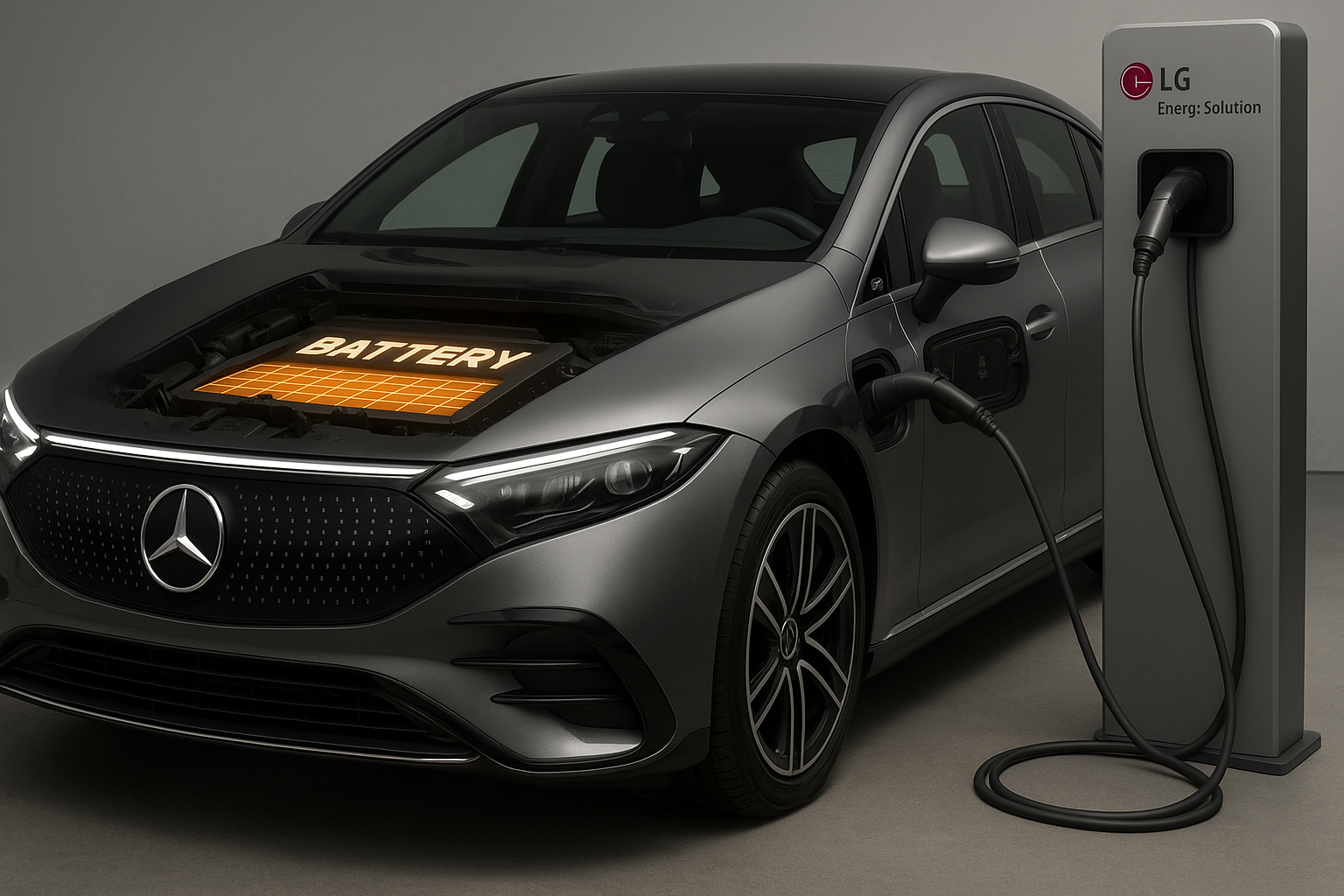
This contract follows three large-scale battery supply agreements announced last year and this year, further demonstrating that the two companies are establishing themselves as key partners in the electric vehicle market.
Industry experts believe this battery supply contract is highly likely to involve batteries for mid- and low-priced electric vehicle models. Last month, Mercedes-Benz unveiled a major electrification strategy, announcing plans to launch more than 40 new models globally by 2027. To achieve this, batteries are required for a wide range of segments, from premium to entry-level models. Considering that the three previous large-scale supply contracts between the two companies all involved high-performance, high-end cylindrical 46-series batteries, it is now being analyzed that this latest contract is likely for batteries to be used in mid- and low-priced models.
The domestic battery industry expects that LG Energy Solution’s supply contract will serve as a turning point to regain lost market share in the European and global electric vehicle markets, which had been dominated by Chinese companies leveraging low prices. It is true that the market share of Korean batteries in Europe has gradually declined due to aggressive pricing and local expansion by Chinese firms. However, with LG Energy Solution’s successful penetration into the premium automotive brand Mercedes-Benz, the industry anticipates that it will be able to expand its influence in the European and global markets going forward.
Last month, Mercedes-Benz Chairman Kallenius visited LG Group and met with key executives from LG Energy Solution, LG Electronics, and other affiliates to discuss ways to strengthen cooperation in future mobility businesses. At the time, Chairman Kallenius stated, "Together with LG, Mercedes-Benz shares a vision based on innovation, quality, and sustainability," adding, "By combining the strengths of both companies, we are creating vehicles that set new standards for the global automotive industry."
Previously, the two companies announced large-scale battery supply contracts totaling approximately 150 gigawatt-hours (GWh) last year and this year. In October last year, they agreed to supply a total of 50.5 GWh of batteries to North America and other regions. In September this year, they signed deals to supply 75 GWh to the United States and 32 GWh to Europe. Although specific products and contract details were not disclosed at the time, the industry speculated that the batteries were cylindrical 46-series (46 mm diameter) models. In particular, it was evaluated that LG Energy Solution overcame competition from Chinese companies such as CATL and Farasis, which had an advantage in price competitiveness, by leveraging its 46-series technology to secure these contracts.
Shim Seongah heart@asiae.co.kr
Choi Yujeong yjchoi@asiae.co.kr
© The Asia Business Daily(www.asiae.co.kr). All rights reserved.