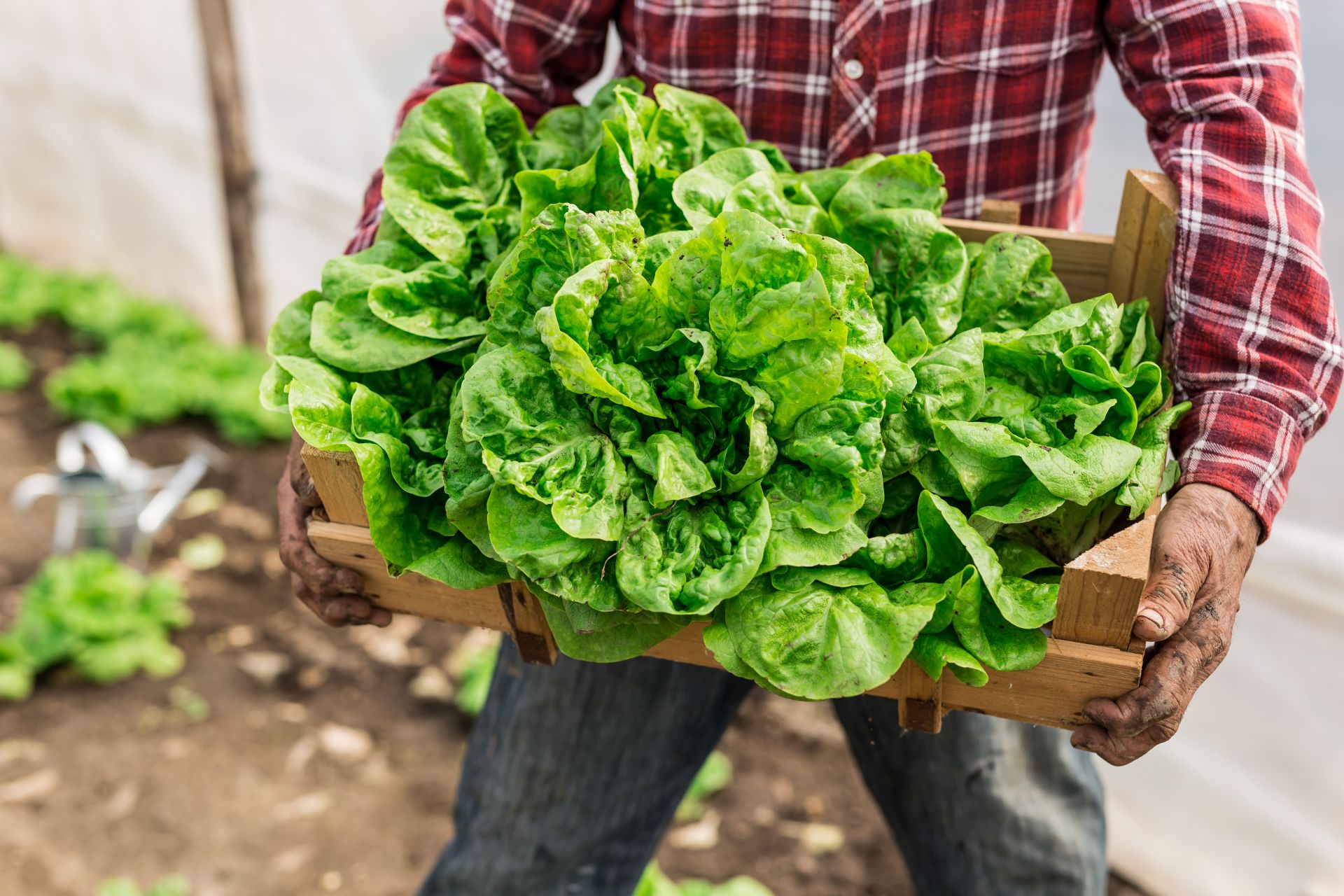

#On July 17 last year, in the midst of the monsoon season, at the Garak-dong Agricultural and Marine Products Wholesale Market in Songpa-gu, Seoul, Lee Kyungmin (43, alias), a lettuce farmer from Chungnam Province, sold boxes of green lettuce (4 kg each) for 88,300 won per box at the fruit and vegetable auction. This was the highest auction price for any of the lettuce Lee shipped between May and December of the same year. The auction price for lettuce, which had been 9,800 won per box at the previous auction, soared ninefold in just one day.
At that time, there was widespread expectation that prices would skyrocket due to a combination of heavy rain and sweltering heat, which reduced the lettuce yield (the ratio of marketable produce to total production) and led to shortages in supply. However, for the next two weeks, the winning bid price hovered around 20,000 won per box, dropping to less than one-third or one-fourth of the peak price. Lee pointed out, "The fundamental reason agricultural prices fluctuate so wildly every year lies not in abnormal weather, but in the irrational distribution structure of agricultural products."
Unstable Income... Young Farmers Can't Even Cover Production Costs

This year marks Lee's sixth year as a young returning farmer. After working as an office worker in Seoul for more than a decade, he switched to farming in 2020. Driven by the dream of rural life and the appeal of cultivating his own land and earning income from the crops he harvested through hard work, he decided to take on a new challenge in his late 30s. He gained confidence by completing 100 hours of training to receive government support for young returnees to farming.
Through a lecture by a senior farmer who grows strawberries, Lee learned that operating three greenhouses of 661 square meters (about 200 pyeong) each could generate an annual income of 70 to 80 million won, and even after deducting all related expenses, more than 50% would remain as profit. He judged that this level of income, while not abundant, would be sufficient for a rural lifestyle.
Lee overcame the COVID-19 pandemic and established three lettuce greenhouses covering 200 pyeong, but recently he has become increasingly disillusioned with farming. Despite leveraging his youth and enterprising spirit by adopting smart farm systems and working with great enthusiasm, the lettuce he worked so hard to cultivate failed to fetch fair prices, and the wide price fluctuations made his income unstable. He said, "There is a lot of talk outside about how abnormal weather is causing poor harvests and soaring vegetable prices, but in reality, it is rare for farmers to actually receive high prices for their products-maybe once or twice a year," adding, "When I see the price tags set at the wholesale market, which is virtually the only sales channel for small-scale farmers, I am infuriated."
In fact, a review of Lee's shipment records over the past year, obtained by The Asia Business Daily, reveals the harsh reality faced by young farmers: auction prices fluctuate repeatedly, and their income falls short even of the minimum cost of living set by the government.
"Harvested at the Same Time..." Fluctuating Auction Prices at Wholesale Markets


The lettuce Lee harvested was auctioned off at 12,500 won per box (4 kg, premium) on July 10 last year. That day, Lee auctioned seven boxes, earning a total of 87,500 won. The next day, the auction price rose to 15,500 won per box, but with only five boxes (20 kg) harvested, his daily income was just 77,500 won.

The bigger issue is the volatility of auction prices. On July 12, the auction price for Lee's lettuce soared to 35,900 won per box. But the next day, it plummeted to 9,800 won. Lee said, "How much difference in quality could there be for lettuce harvested around the same time?" He continued, "As in these examples, it is all too common for auction prices to be cut in half or drop even further within a day or two." He added, "When I raise objections to the wholesale corporations, they make excuses like 'the lettuce is too wet' or 'the leaves are too thin,' and take a high-handed attitude, asking if I want to 'refuse the auction' (an auction term meaning to reject the winning bid)."
Lettuce Bought Cheap from Producers, Sold Expensively to Consumers

Meanwhile, during the same period, the retail price of lettuce for consumers did not fluctuate as much. According to KAMIS (Korea Agricultural and Fishery Products Distribution Information System), operated by the Korea Agro-Fisheries & Food Trade Corporation, the retail price of green lettuce for two weeks in mid-July last year ranged from a minimum of 2,035 won to a maximum of 2,540 won per 100 grams. Converted to the 4 kg auction weight, this means lettuce was sold to consumers for between 81,400 won and 101,600 won, a difference of just over 20,000 won.
Wholesale prices for agricultural products, once set, are typically reflected in retail prices with a lag of about one week to ten days. During the same period, the prices set by intermediate wholesalers who buy at auction and sell to small businesses ranged from a minimum of 42,940 won to a maximum of 58,200 won, a difference of only 15,000 won, showing a relatively gentle fluctuation. Moreover, while intermediate wholesalers' prices gradually declined toward the end of July, retail prices remained higher than they had been two weeks earlier.
If we assume that the distribution costs incurred as products pass through the wholesale market to the consumer remain the same, it means that lettuce bought cheaply from producers was ultimately sold expensively to consumers. From the farmers' perspective, it is only natural to question why only auction prices fluctuate wildly while retail prices remain high for an extended period, and where the difference goes. Lee said, "When auction prices are high for a day or two, I suspect that prices are intentionally set lower in the following days to 'average out the unit price.'"
Monthly Income of 1.33 Million Won... Less Than the Minimum Cost of Living

From January to August this year, Lee received about 12.8 million won for the agricultural products he auctioned, a 16.9% decrease from the 15.4 million won earned over the same eight-month period from May to December last year. After deducting the 4-5% commission paid to the wholesale corporations, as well as transportation and handling costs to deliver the products to the wholesale market, the actual amount Lee took home was 10.8 million won, or an average of 900,000 won per month. This is less than the minimum cost of living for a single-person household this year (1.43 million won). This figure even includes the income from selling cauliflower, which has a relatively higher unit price. Focusing only on lettuce, Lee received a total of 9.59 million won over eight months this year through auctions.
During this period, Lee shipped a cumulative total of 1,004 boxes of lettuce. This means the average price per box was 9,552 won. He said, "The amount I receive after the auction is not my actual income, as I still have to deduct production costs and the wages of workers I hire for shipping," adding, "Considering all these costs, I would need to receive at least 15,000 won per box just to break even, but in reality, the more I sell, the more I lose."
President Lee Jaemyung, at a field meeting with young farmers last September, promised, "The government will support young farmers so that they can overcome difficulties and become the driving force of K-Agriculture."
However, the reality for returning farmers is harsh. According to the 2024 Survey on the Status of Returning to Farming and Rural Migration, released by the Ministry of Agriculture, Food and Rural Affairs in March, the average income in the first year after returning to farming is 27.96 million won, and the fifth-year income is 36.21 million won, an increase of 31.1%. This figure includes not only agricultural income but also non-agricultural income, government subsidies, and temporary irregular income. The annual income earned solely from farming is 16 million won, or an average of 1.33 million won per month, which is insufficient to cover the average monthly living expenses of 1.94 million won for returning farmers.
Young Farmers Endure by Taking Side Jobs and Cutting Costs

Lee supplements his income not only by growing lettuce but also by obtaining various certifications-such as for drones, forklifts, excavators, and electrical work-and taking on side jobs. He also works part-time at the local agricultural cooperative, sorting produce. Since it is difficult to cover production costs through farming alone, he reduces expenses by enlisting the help of acquaintances during lettuce harvest and hiring a minimum number of foreign workers, who are paid lower wages.
He said, "Young farmers are at least somewhat better off because they are used to obtaining information online, so they can frequently monitor government and local government support programs and expect additional agricultural income through subsidies." Nevertheless, the economic burden of debt remains. He is currently struggling to repay about 300 million won in support funds borrowed to purchase farmland and install infrastructure such as greenhouses. With a 1.5% interest rate, a five-year grace period, and a ten-year repayment plan, he will have to start repaying about 2.7 million won per month beginning next year.
Lee said, "Even before returning to farming, I saw news about farmers being angry because agricultural prices were not properly recognized, but facing the reality myself, the situation is much more serious than I thought." He continued, "I have tried to find new sales channels through online sales or exports to Japan, but it is difficult for individuals to break through the barriers." He added, "Auctions are virtually the only sales channel, and if the current structure continues, I am unsure whether I can continue to make a living as a returning farmer in the future," and "I am seriously considering whether I should keep farming."
<Continued in Part 2: The Weather Is Not to Blame>
IndexThere Is No Such Thing as Bad Weather
- "Lettuce Prices Swing from 10,000 to 90,000 Won: The Real Culprit Is the Distribution Structure, Not the Weather"
- Is Coupang Cheaper Than Wholesale Markets?... "Half of Lettuce Prices Are Distribution Costs," Shocking Findings
-

Reporter Kim Heungsoon sport@asiae.co.kr
-
Edit Kim Boram kbram6457@asiae.co.kr
© The Asia Business Daily(www.asiae.co.kr). All rights reserved.