"Try feeding the otters."

Recently, at Indoor Zoo A located in Gyeonggi Province, the first thing that stood out just past the entrance was the 'feeding experience zone'. Visitors could pay an additional 3,000 won to feed animals such as otters. Although there was a sign stating, "Feeding anything other than the designated food is prohibited," there were no staff members present to enforce this rule. When the reporter personally fed the otters, four or five of them made loud noises and moved vigorously as they competed for the food.
'For Educational Purposes' Feeding Allowed with a Submitted Plan
Although it has been nearly two years since the law strengthening animal welfare was enacted, indoor zoos that promote interactive experiences are still thriving. Critics argue that their operating methods run counter to the intent of animal welfare and the law.
According to the Ministry of Climate, Energy and Environment (formerly the Ministry of Environment) on October 22, as of last year, 55 out of 126 zoos nationwide (43.7%) were interactive zoos. Many of these operate as indoor zoos, offering programs where visitors can feed or touch the animals.
Under the revised 'Act on the Management of Zoos and Aquariums' (Zoo and Aquarium Act), which took effect in December 2023, interactive exhibitions such as feeding or touching animals are, in principle, prohibited at zoos. Concerns have been raised that direct contact with animals can undermine their welfare, and during the 21st National Assembly, there was bipartisan consensus that such activities cause both physical and psychological stress to animals. However, existing registered zoos were granted a five-year grace period, and interactive exhibitions are permitted if a plan for educational purposes is submitted to the Ministry of Environment or the local government.
Crowded and Hungry... Sometimes Sharing Space with Other Species

The recently discovered guinea pig enclosure at an indoor zoo in Gyeonggi Province appears excessively cramped relative to the number of animals. Photo by Byeon Seonjin
원본보기 아이콘Many indoor zoos use interactive programs such as feeding as a profitable business. At Indoor Zoo B in Seoul, animal feed is provided for 5,000 won. Jeong Jina, Head of Social Solidarity at Animal Liberation Wave, pointed out, "Sometimes animals are intentionally underfed to make them more responsive during the experience," adding, "These interactive exhibitions are closer to entertainment than education and should be banned."

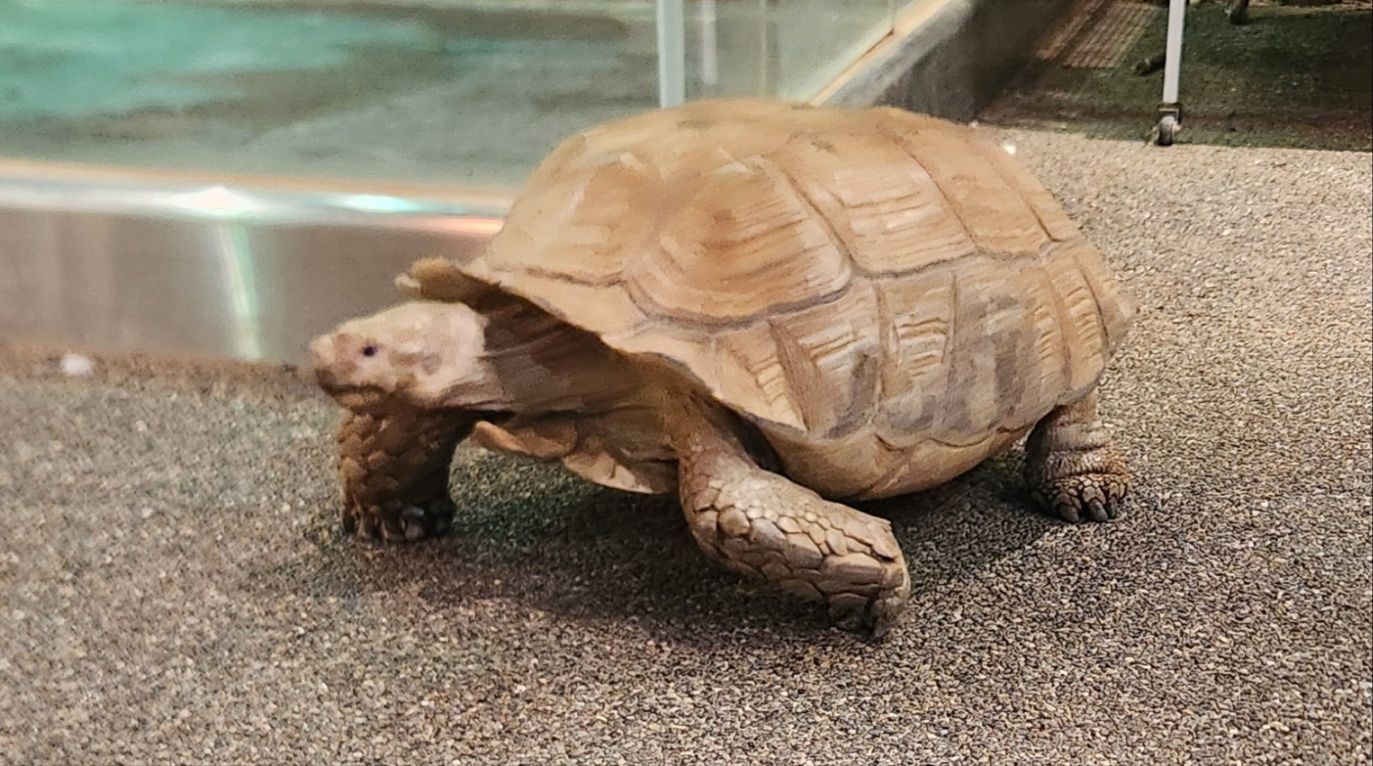
The recently discovered indoor zoo located in Gyeonggi Province shows a Sulcata tortoise outside its enclosure. Photo by Seonjin Byun
원본보기 아이콘Another issue is that the enclosures are excessively cramped or lack adequate hiding places. At Indoor Zoo A, there were only about five shelters in an enclosure housing 20 to 30 guinea pigs. As a result, most of the guinea pigs stayed close to the glass wall or remained huddled, minimizing their movement. In the penguin habitat at Indoor Zoo B, there were no separate shelters for the six penguins to hide.
'Mixed-species housing' is also common. At Indoor Zoo A, capybaras and leopard tortoises were kept together, while at Indoor Zoo B, rabbits and Sulcata tortoises shared the same enclosure. Such mixed-species housing is criticized for ignoring the ecological habits and emotional well-being of different species.
"Contact with Humans Is a Serious Source of Stress"

Experts pointed out that the operation of indoor zoos, which have shifted their focus to interactive experiences, does not align with the intent of the relevant law. Kim Younghwan, Director of Policy at Animal Rights Action Kara, criticized, "It is instinctive for wild animals to avoid humans, so forcing repeated contact with people can be a serious source of stress for them."
Team leader Jeong Jina also emphasized, "In the true sense, a zoo is not a place for entertainment, but a facility for rescuing animals that have lost their habitats and restoring ecosystems," adding, "Exhibiting animals as objects for interactive experiences does not fit with the growing awareness of animal welfare in today's society."
-

Reporter Byun Seonjin sj@asiae.co.kr
-
Edit Lee Seonju sjlee109@asiae.co.kr
© The Asia Business Daily(www.asiae.co.kr). All rights reserved.





![[Reportage]"It Only Leads to Arguments"... Chungnam's True Sentiments Hide Deeper After Martial Law](https://cwcontent.asiae.co.kr/asiaresize/304/2026051223490460082_1778597344.jpg)