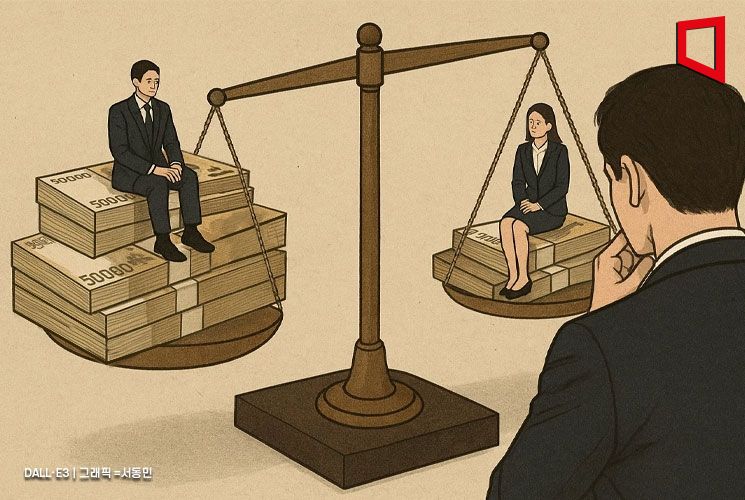
Last year, the average wage per male worker was 97.8 million won, while for female workers it was only 67.73 million won, indicating that the gender wage gap widened compared to 2023.
Wage Gap: 26.3% in 2023 → 30.7% Last Year

On September 5, the Ministry of Gender Equality and Family announced the results of its analysis of 2,980 companies required to disclose gender wage data. According to the findings, the gender wage gap increased by 4.4 percentage points, from 26.3% in 2023 to 30.7% last year. Although the average wage for both men and women declined compared to the previous year, the decrease for women (-6.7%) was much greater than for men (-0.8%). The average wage was calculated by dividing the total annual salary of all employees at the companies subject to disclosure by the number of employees.
The gender wage gap widened particularly in industries with large workforces, such as manufacturing, information and communications, and finance and insurance. In manufacturing, the gender wage gap increased by 9.1 percentage points, from 20% in 2023 to 29.1% last year. The gap also widened by 4.3 percentage points in information and communications, and by 1.0 percentage point in finance and insurance. By industry, the gap was especially pronounced in wholesale and retail (44.1%), construction (41.6%), and information and communications (34.6%). In contrast, the gap was smaller in arts, sports and leisure services (15.8%), and accommodation and food services (17.7%).
Gender Gap in Years of Service Narrows as Women's Participation Grows

As the period of women's participation in the workforce lengthens, the gender gap in years of service has narrowed. The average years of service at companies subject to disclosure was 11.8 years for men and 9.4 years for women, with the gap decreasing by 2.1 percentage points from 23.0% in 2023 to 20.9%. Typically, a narrowing gap in years of service would also reduce the wage gap, but this survey found that despite the reduction in the years of service gap, the wage gap actually widened.
Regarding this, the Ministry of Gender Equality and Family explained, "Wages are influenced by various factors besides years of service, such as position and type of employment." Shin Woori, the lead researcher at the Korean Women's Development Institute who oversaw the survey, stated, "The gender wage gap is affected by a complex set of factors, including not only determinants such as job content, promotion, and leave, but also structural factors like industry and occupational segregation."
Wage Gap Decreases at Public Institutions... Down 2.7% Points in One Year

In contrast to the widening gender wage gap at companies subject to disclosure, the gap at public institutions decreased. The Ministry of Gender Equality and Family analyzed gender wage data from 344 public institutions disclosed on the Public Institutions Management Information System (Alio). The average wage per male worker was 72.67 million won, while for female workers it was 58.16 million won. The gap stood at 20.0%, down 2.7 percentage points from 22.7% in 2023. The average years of service at public institutions was 10.5 years for men and 8.4 years for women, with the gender gap in years of service at 19.9%, a decrease of 9.1 percentage points from 29.0% in 2023.
The Ministry of Gender Equality and Family plans to include a variety of variables-such as age, position, type of employment, career interruptions, and job characteristics-in future analyses to more precisely identify the causes of the gender wage gap. The ministry also stated, "We will work to address the gender wage gap by introducing the Employment Equality Wage Disclosure System, which will require companies to transparently release such information."
-

Reporter Oh Jooyean moon170@asiae.co.kr
-
Edit Kim Boram kbram6457@asiae.co.kr
© The Asia Business Daily(www.asiae.co.kr). All rights reserved.