Leading economic organizations in South Korea, including the Korea Chamber of Commerce and Industry, have joined forces to break down regulatory barriers. These organizations jointly launched the "Corporate Growth Forum" and emphasized the need to improve the system by providing incentives and appropriate rewards to growing companies.
Korea Chamber of Commerce and Industry, Korea Enterprises Federation, and Korea Federation of Middle Market Enterprises Launch 'Corporate Growth Forum' to Promote Systemic Reform
The Korea Chamber of Commerce and Industry, the Korea Enterprises Federation, and the Korea Federation of Middle Market Enterprises held the launch ceremony for the "Corporate Growth Forum" at Lotte Hotel in Jung-gu, Seoul, on September 4. Their plan is to break down regulatory barriers that are difficult to overcome through individual efforts and to push for a system overhaul that ensures growing companies are properly rewarded.

Deputy Prime Minister and Minister of Economy and Finance Koo Yoonchul, Minister of Employment and Labor Kim Younghoon, Chairman of the Korea Chamber of Commerce and Industry Chey Tae-won, heads of major commercial banks, and other attendees are taking a commemorative photo at the launch ceremony of the Corporate Growth Forum held at Lotte Hotel in Jung-gu, Seoul, on the 4th. Photo by Cho Yongjun
원본보기 아이콘Choi Taewon, Chairman of the Korea Chamber of Commerce and Industry and Chairman of SK Group, stated in his keynote address, "The larger a company becomes, the more regulations it faces, so companies hardly feel the need to grow anymore. This is the fundamental reason why Korea's growth is stagnating and private sector vitality is declining." He continued, "Only 4 out of 10,000 small businesses become mid-sized companies, and only 1 or 2 out of 100 mid-sized companies become large enterprises. This is a classic example of a regressive incentive structure," stressing, "We must change this system that discourages companies from growing."
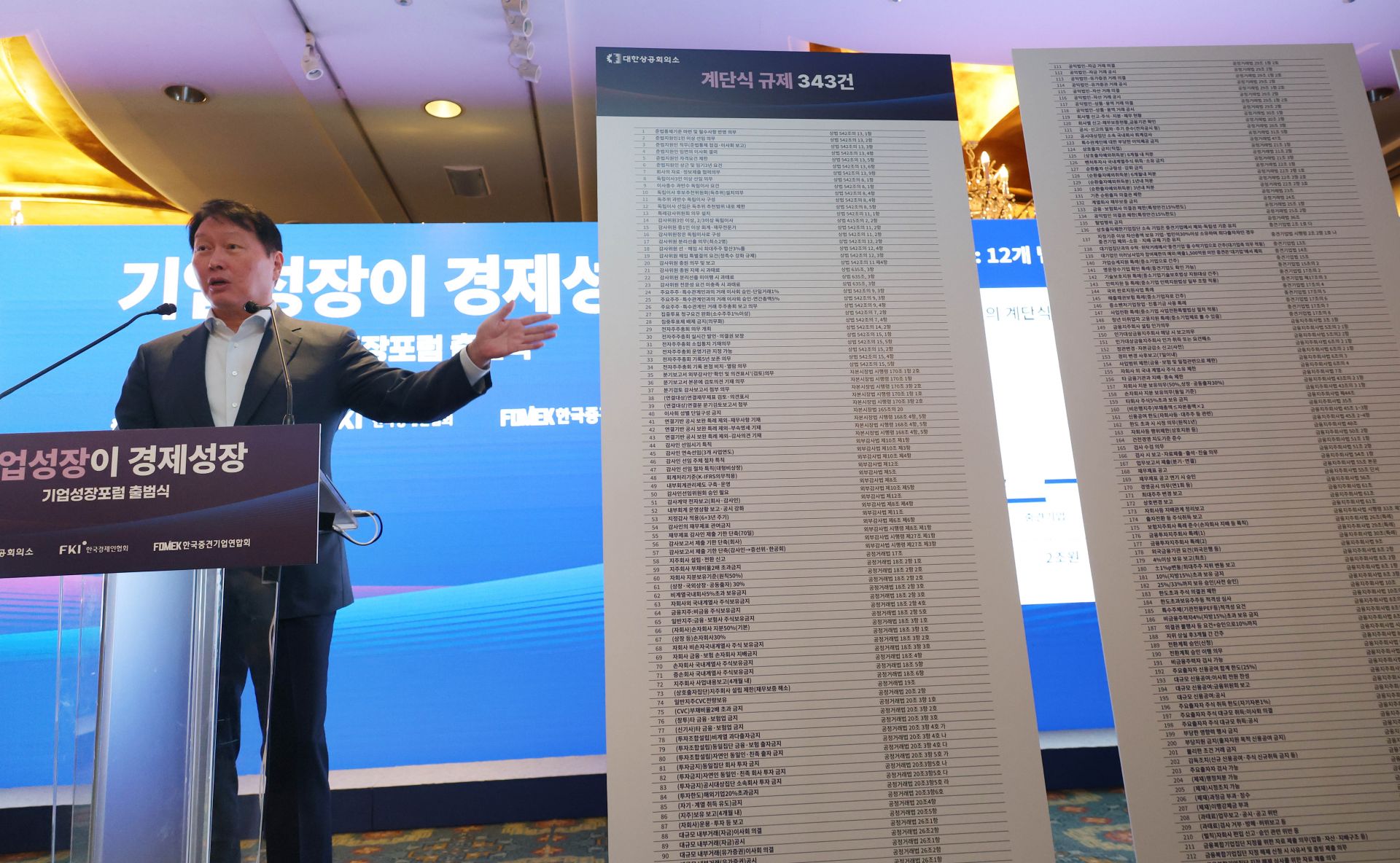
During his speech, Chairman Choi drew attention by unveiling a large panel listing 343 domestic corporate regulations. He criticized, "The very fact that regulations increase when a company joins a large business group is contradictory." According to research by the Korea Chamber of Commerce and Industry and Professor Kim Youngjoo's team at Pusan National University, there are 343 differentiated regulations for companies in just 12 economic laws. When a small business becomes a mid-sized company, 94 additional regulations are imposed, and this number jumps to 329 for large companies. There are reportedly over 6,000 economic criminal provisions.
Chairman Choi Taewon Uses Large Panel in Keynote Speech... Calls for Paradigm Shift
He stated, "The stagnation of economic growth is rooted in the imbalance between regulation and support. As the structure persists where small businesses are protected and large companies face increasing regulations, private sector vitality has rapidly declined." Over the past decade, the average annual sales growth rate for large companies, which exceeded 10% twenty to thirty years ago, has plummeted to 2.6%, while that for small businesses has dropped from around 8-9% to 5.4%. Chairman Choi warned, "If this situation continues, we may face a scenario where all companies revert to being small businesses," and emphasized, "We need a system that supports growing companies and leaves only the essential regulations after a comprehensive review."

The business community has decided to unite for regulatory reform because "stepwise" regulations and excessive economic criminal penalties have been identified as key reasons for the slowdown in corporate growth over the past decade. As the regressive structure-where benefits decrease and regulations increase as companies grow-has become entrenched, the business sector believes improvement is necessary. These organizations stressed the need to create an ecosystem where companies can take on challenges by providing regulatory exemptions and performance-based support to growing businesses.
Creating a Challenging Corporate Ecosystem Through Regulatory Exemptions and Performance-Based Support
The business sector proposed solutions such as introducing regulatory impact assessments for industries, revising enforcement decrees and rules, applying exceptions for advanced industries, and operating experimental systems like "mega sandboxes." There were also calls to establish "growth-oriented policies" throughout society by rewarding growing companies. In fact, analysis shows that if 100 highly profitable small businesses listed on the stock market were scaled up to the level of mid-sized companies, this could generate an additional 5 trillion won in operating profit and raise the nation's GDP by 0.2%.
Attendees at the launch ceremony included Chairman Choi Taewon, Kim Changbeom (Executive Vice Chairman of the Korea Enterprises Federation), Lee Hojun (Executive Vice Chairman of the Korea Federation of Middle Market Enterprises), Deputy Prime Minister and Minister of Economy and Finance Koo Yoonchul, Minister of Employment and Labor Kim Younghoon, First Vice Minister of Trade, Industry and Energy Moon Sinhak, Shinhan Financial Group Chairman Jin Okdong, KB Financial Group Chairman Yang Jonghee, Hana Financial Group Chairman Ham Youngjoo, Woori Financial Group Chairman Lim Jongryong, Samsung Electronics President Park Seunghee, SK Communications Committee Chairman Lee Hyunghee, Hyundai Motor Company Vice President Kim Dongwook, LG Vice President Park Junseong, and about 30 other representatives from the private sector, government, political, and academic circles.

Deputy Prime Minister Koo Yoonchul stated, "Recently, as our economy's transition to a leading economy has been delayed, the potential growth rate has dropped significantly. We will operate an economic criminal penalty rationalization task force and streamline 30% of penalty provisions by the end of the year."
Song Seungheon, Managing Partner of McKinsey Korea Office, said in his keynote speech, "A structure where the upside is small and the downside is large suppresses entrepreneurship. There are limits to government support alone; the market must provide safeguards and rewards." He identified special-purpose semiconductors and generative, agent, and physical artificial intelligence (AI) as new growth opportunities and predicted, "If Korea leverages its manufacturing experience and data capabilities, there is ample potential to accelerate growth again."
Going forward, the Corporate Growth Forum plans to hold regular forums one to two times each quarter, investigating and researching the impact of differentiated regulations by company size on corporate growth and the overall economy, and developing policy alternatives.
-

Reporter Park Joonyi giver@asiae.co.kr
-
Edit Lee Kijae happylee17@asiae.co.kr
© The Asia Business Daily(www.asiae.co.kr). All rights reserved.