
A foreign tourist visiting Insadong, Jongno-gu, Seoul, is holding up a traditional fan. Photo by Sunjin Byun
원본보기 아이콘On September 2, groups of foreign tourists were gathered in front of a traditional craft shop in Insadong, Jongno-gu, Seoul. Antoine (28), who said he was from France, held a fan decorated with a tiger pattern and laughed, saying, "It looks like the tiger I saw in 'K-Pop Demon Hunters (Kedeheon)'." He added, "I came to Korea for the first time after watching K-Pop Demon Hunters. I want to try on the Grim Reaper costume and plan to buy some of the norigae accessories worn by the members."
Sales in the District Reach 3.7 Billion Won Last Month... Up 8.3% from January

A small shop selling traditional crafts in Insadong, Jongno-gu, Seoul. Photo by Byun Seonjin
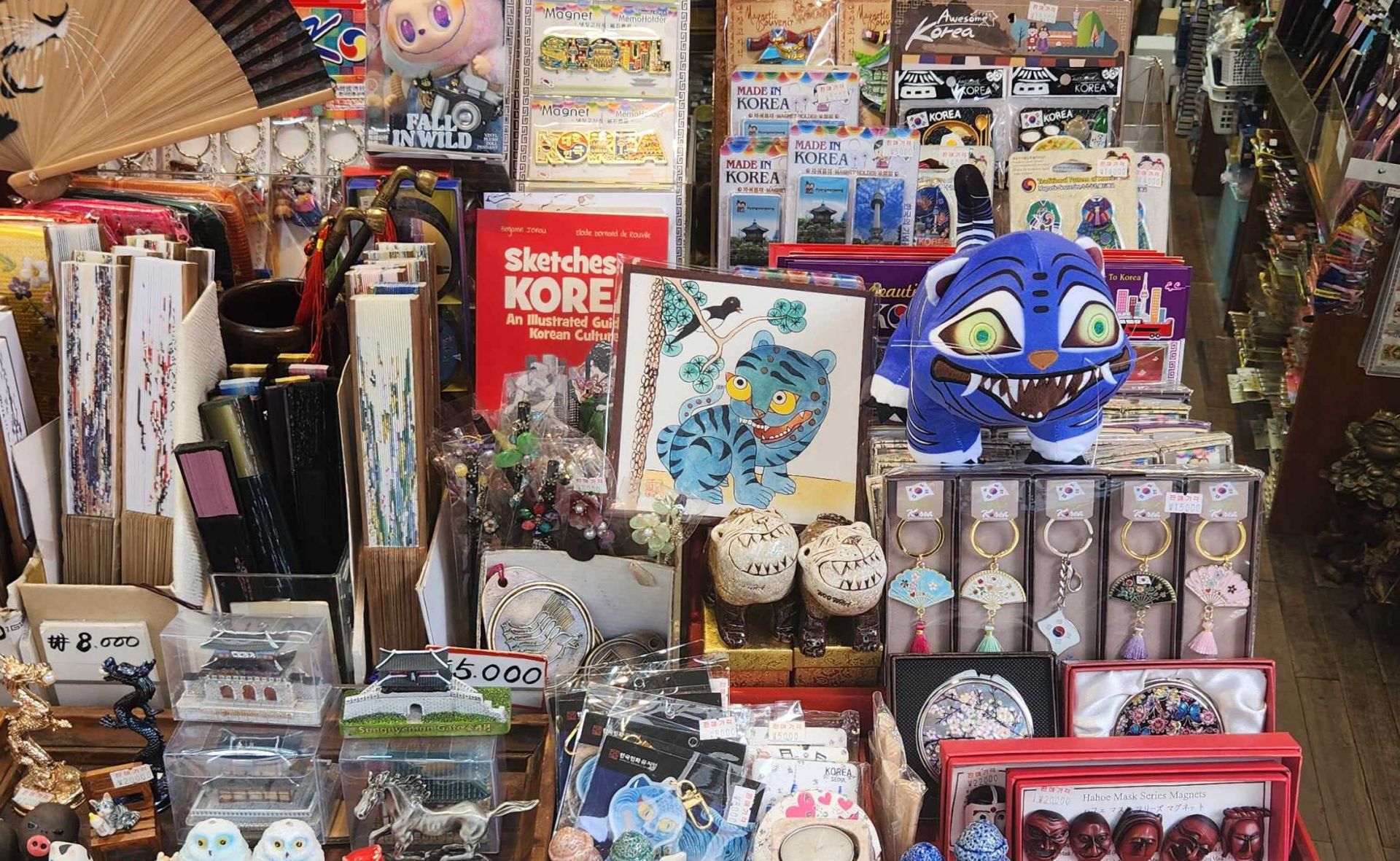
원본보기 아이콘As the popularity of the Netflix animated film K-Pop Demon Hunters spreads, the number of foreign tourists seeking traditional crafts has increased significantly. On this day, the Insadong shopping district, known for its concentration of traditional craft shops, was bustling with tourists. K-Pop Demon Hunters, a film featuring K-pop stars fighting evil spirits, has become a global sensation.
According to Seoul City's real-time urban data on September 3, sales in the Insadong district last month totaled approximately 3.717 billion won, with 167,701 payment transactions. Compared to January (sales of 3.431 billion won and 141,595 transactions), this represents increases of 8.3% and 18.4%, respectively. Merchants selling traditional crafts unanimously agreed that they are experiencing the "K-Pop Demon Hunters effect."
Shin (61), who sells mother-of-pearl crafts and norigae, said, "Since last month, we've had many foreign customers looking for fans and norigae featuring tigers or magpies. It turns out it's because of K-Pop Demon Hunters. I think our sales have increased by 20 to 30 percent since last month." Lee Soon-yi (67), who runs the "Korean Traditional Tourism Souvenir Shop," also said, "After K-Pop Demon Hunters, so many foreigners were asking for 'tiger, tiger' that I urgently requested a manufacturer to make tiger keyrings."
More People Want to Make Traditional Crafts Themselves

Traditional masks and mother-of-pearl jewelry boxes are sold in Insadong, Jongno-gu, Seoul. Photo by Byun Seonjin
원본보기 아이콘The influence of K-Pop Demon Hunters has also led to more people wanting to make traditional crafts like norigae themselves. Han, an employee at a workshop that makes norigae, said, "These days, not only people in their teens and twenties but also many families are visiting. Perhaps thanks to the norigae worn by the K-Pop Demon Hunters group, all classes for the next two weeks are fully booked." Kim Jio (21), who came from Busan, said, "Making the norigae I saw on the K-Pop Demon Hunters stage myself was a unique experience."
Some traditional craft merchants plan to develop products that reinterpret traditional crafts in a modern way. Lee (49), who makes and sells traditional accessories, said, "In the past, the customer base was limited, but since K-Pop Demon Hunters, inquiries from a wide range of age groups have increased. I plan to create keyrings and other items that capture K-tradition with a modern sensibility."
Various products featuring traditional patterns, sold at places like the National Museum of Korea, are also in high demand. Not only is the magpie-tiger badge resembling the popular K-Pop Demon Hunters tiger character "Duffy" sold out, but blue tiger mother-of-pearl stickers and magpie-tiger tumblers are also experiencing "sold-out frenzies."
Heo Kyungok, a professor in the Department of Consumer Industry at Sungshin Women's University, analyzed, "It appears that a new Korean Wave is sweeping through K-traditional crafts after K-Pop Demon Hunters. In order to move beyond simple souvenir sales, it is necessary to establish a system that consistently commercializes products by incorporating modern design and storytelling."
-

Reporter Byun Seonjin sj@asiae.co.kr
-
Edit Kim Boram kbram6457@asiae.co.kr
© The Asia Business Daily(www.asiae.co.kr). All rights reserved.